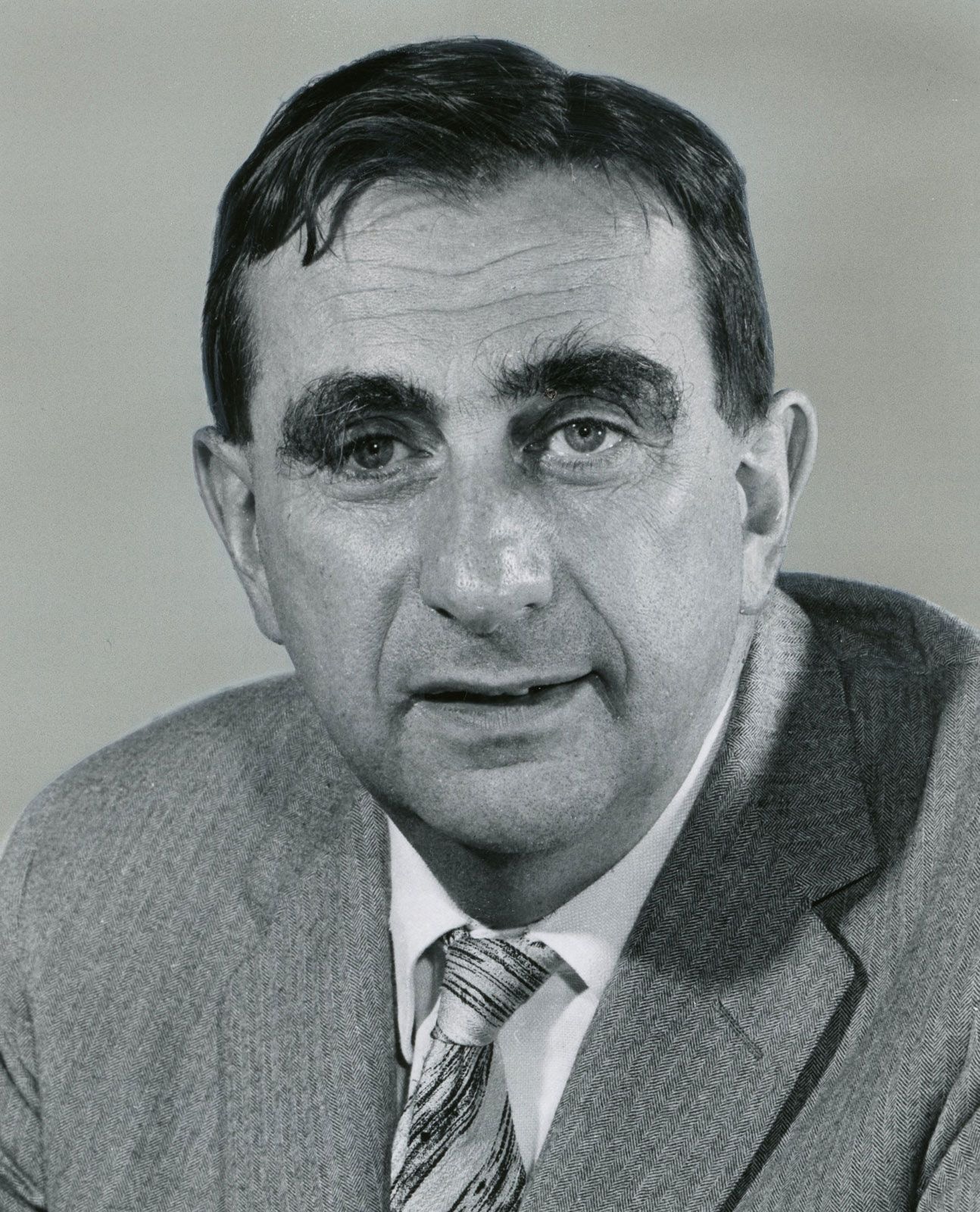
Edward Teller
nuclear physicist•non-fiction writer•university teacher
Also known as: Teller Ede, Father of the hydrogen bomb
Fecha de nacimiento
January 15, 1908
Signo zodiacal
Capricorn
Lugar de nacimiento
Budapest
Edad
Falleció a los 95
Acerca de
Edward Teller, nacido Teller Ede el 15 de enero de 1908 en Budapest, fue un físico teórico e ingeniero químico húngaro-estadounidense. Ganó el apodo de "padre de la bomba de hidrógeno" por su papel central en el desarrollo de armas termonucleares. Teller huyó de Europa en la década de 1930, uniéndose a una ola de emigrados científicos húngaros a veces llamados los "marcianos". Su trabajo temprano en física fue fundamental: el efecto Jahn-Teller, que explica cómo se distorsiona la geometría molecular bajo configuraciones electrónicas, sigue siendo un concepto central en química. La teoría Brunauer-Emmett-Teller (BET), que ayudó a desarrollar, todavía se usa para medir áreas superficiales de materiales. Teller también extendió la teoría de desintegración beta de Enrico Fermi, dando lugar a las transiciones Gamow-Teller que resultaron cruciales para la física nuclear. En 1953, coescribió un artículo histórico con Nicholas Metropolis y otros que introdujo el método Monte Carlo en la mecánica estadística, una técnica ahora omnipresente en la ciencia computacional.
Teller se unió al Proyecto Manhattan en 1942, trabajando en la bomba atómica. Pero su verdadera pasión era la bomba de hidrógeno, un arma de fusión mucho más potente que las bombas de fisión. Después de la Segunda Guerra Mundial, impulsó su desarrollo, a pesar de la resistencia inicial. El avance llegó con el diseño Teller-Ulam, inspirado por Stanislaw Ulam, que utilizaba implosión por radiación para encender combustible termonuclear. Teller ayudó a asegurar el apoyo contribuyendo a la prueba George en la Operación Greenhouse en 1951, la primera prueba de combustión termonuclear. Cofundó el Laboratorio Nacional Lawrence Livermore en 1952 y fue su director o director asociado durante años. Livermore se convirtió en el rival de Los Álamos, centrado en la innovación en armas nucleares.
La influencia de Teller se extendió más allá del laboratorio. Fue un defensor vocal de la energía nuclear y un fuerte arsenal nuclear, e impulsó pruebas vigorosas. En la década de 1950, propuso el Proyecto Chariot, un plan para usar una bomba termonuclear para tallar un puerto en Alaska, que nunca se ejecutó. Más tarde, defendió la Iniciativa de Defensa Estratégica de Ronald Reagan, un sistema de defensa antimisiles que los críticos llamaron "Guerra de las Galaxias". Teller recibió el Premio Enrico Fermi y el Premio Albert Einstein. Murió el 9 de septiembre de 2003 a los 95 años, dejando un legado como una de las figuras más influyentes y controvertidas de la era nuclear.
Primeros años y orígenes
Teller creció en una familia judía acomodada en Budapest. Su padre, Miksa Teller, era abogado, y su madre, Ilona Deutsch, provenía de una familia bancaria. El joven Edward mostró una temprana aptitud para las matemáticas y los idiomas, hablando húngaro, alemán y francés en su adolescencia. Asistió al Minta Gymnasium en Budapest, conocido por su riguroso plan de estudios de ciencias. En 1926, dejó Hungría para estudiar ingeniería química en el Instituto Tecnológico de Karlsruhe en Alemania, donde obtuvo su diploma en 1928. Su interés se desplazó a la física después de asistir a conferencias de Werner Heisenberg. Teller se mudó a la Universidad de Leipzig, obteniendo su doctorado en física bajo la dirección de Heisenberg en 1930, con una disertación sobre el ion molecular de hidrógeno. El ascenso de los nazis lo empujó a abandonar Europa. Con la ayuda del Comité Internacional de Rescate, consiguió un puesto en la Universidad George Washington en Washington, D.C., llegando en 1935. Esos primeros años en Estados Unidos estuvieron marcados por una intensa colaboración con George Gamow y otros, que llevaron al efecto Jahn-Teller y la teoría BET.
Trayectoria profesional
El momento decisivo de Teller llegó en 1942 cuando se unió al Proyecto Manhattan en Los Álamos. Si bien su trabajo en la bomba atómica fue importante, su mente ya estaba en un arma más grande: la bomba de hidrógeno. Después de la guerra, presionó incansablemente por su desarrollo, enfrentando el escepticismo de muchos científicos, incluido J. Robert Oppenheimer. El punto de inflexión llegó en 1951 cuando Stanislaw Ulam propuso un nuevo diseño, y Teller lo refinó en la configuración Teller-Ulam. La prueba George en mayo de 1951 demostró el concepto, y la primera prueba termonuclear a gran escala, Ivy Mike, siguió en noviembre de 1952. Teller cofundó el Laboratorio Nacional Lawrence Livermore en 1952, que se convirtió en un centro para el diseño de armas nucleares. Se desempeñó como su director de 1958 a 1960 y siguió siendo influyente durante décadas. En la década de 1980, se convirtió en un defensor clave de la Iniciativa de Defensa Estratégica, promoviendo la idea de láseres espaciales para interceptar misiles. Teller también asesoró al programa nuclear israelí y continuó publicando artículos científicos hasta los 90 años.
Cronología profesional
Imagen pública y estilo
Teller cultivó una imagen pública como defensor incansable de la fuerza nuclear. Era conocido por su estilo enérgico, a veces combativo, en los debates. Sus críticos lo tildaban de belicista, especialmente después de su controvertido testimonio en la audiencia de seguridad de Oppenheimer. Sus partidarios lo veían como un realista que entendía la necesidad de la disuasión. Aparecía a menudo en los medios, escribiendo artículos de opinión y dando entrevistas. Su fuerte acento húngaro y sus gestos animados lo convertían en una figura reconocible. En sus últimos años, se convirtió en una especie de estadista mayor de la ciencia, asesorando a presidentes y apareciendo en eventos públicos. El apodo de "padre de la bomba de hidrógeno" se mantuvo, aunque compartió el mérito con Ulam. El legado de Teller está profundamente polarizado: es un héroe que ayudó a ganar la Guerra Fría o una figura que aceleró la carrera armamentista.
Fama y fandom (iFAMOUS Rankings)
Edward Teller stands as a figure whose name is inextricably linked to the dawn of the thermonuclear age, yet he currently holds no placement in the published iFANN Global Top 1,000 rankings. The evaluation process confirms that while his historical footprint is massive, he does not secure a numeric rank within the current scope lists. This absence from the leaderboard reflects his status as a polarizing historical figure rather than a contemporary pop culture icon with a measurable daily consumption score. His fame rests on the weight of scientific legacy and ethical debate rather than viral metrics or modern media saturation. The audience surrounding Edward Teller lacks a formal designation; there is no organized fanbase, no registered club, and no collective identity known by a specific name. Unlike entertainers who cultivate devoted followings, Teller's admirers are scattered across academic circles, history enthusiasts, and those interested in Cold War politics. Any tributes found online typically originate from institutions like the National Nuclear Museum or university departments honoring his chair, rather than grassroots movements driven by fans. There are no documented rituals, birthday campaigns, or fan-funded projects dedicated to him. The engagement he receives is strictly professional or educational, characterized by the study of his work at Los Alamos and Lawrence Livermore National Laboratory. While the recent release of the film Oppenheimer has sparked renewed public interest in his testimony against J. Robert Oppenheimer, this surge represents historical curiosity rather than the formation of a new fandom.
Datos interesantes y leyendas
Teller's colleagues often joked that he was one of the "Martians," a group of brilliant Hungarian scientists who fled Europe, including John von Neumann and Leo Szilard, who supposedly came from Mars and spoke with accents. He had a lifelong fear of flying and rarely traveled by plane. Teller was a skilled pianist and considered a career in music before choosing physics; he played at parties and even composed a short piece. The Jahn-Teller effect, which he co-discovered, is taught in every introductory chemistry course. His 1953 paper on the Monte Carlo method is one of the most cited in physics. Despite his hawkish reputation, he opposed the use of nuclear weapons in the Vietnam War. He was a consultant for the 1983 film The Day After.
One of the most retold stories is his proposal to use nuclear bombs for peaceful excavation, such as digging harbors and moving mountains, a scheme that became part of Project Plowshare and is often cited as an example of Cold War-era hubris. Another legendary moment is his testimony at the Oppenheimer security hearing, where he said he would "feel personally safer" without Oppenheimer's involvement, effectively ending his colleague's career and casting Teller as a villain in popular culture, a narrative amplified by the 2023 film Oppenheimer. More recently, his 1959 warning to the American Petroleum Institute about carbon dioxide causing global warming has been celebrated as ahead of its time.
Frases destacadas
“The objective of weapon development is to have the capacity to deter war.”
“If you want to destroy this country, you must destroy its freedom.”
“I have always considered myself a scientist, not a politician.”
“The hydrogen bomb is the most powerful weapon ever invented. It is also the most moral.”
Familia y vida personal
Teller se casó con Augusta "Mici" Harkanyi en 1934. Era la hermana de un amigo y una compañera emigrada húngara. La pareja tuvo dos hijos: un hijo, Paul, y una hija, Wendy. Paul Teller se convirtió en físico y trabajó en la Universidad de Chicago. Mici fue una pareja solidaria que administraba su hogar y vida social. Los Teller vivieron en varios lugares, incluidos Los Álamos, Nuevo México, y más tarde en Stanford, California, donde Edward trabajó en la Institución Hoover. Poseían una casa modesta y disfrutaban organizando cenas para científicos y políticos. Mici falleció en 2000, tres años antes que Edward. Los padres de Teller y la mayor parte de su familia extensa perecieron en el Holocausto, una tragedia que afectó profundamente sus puntos de vista sobre el comunismo soviético y la necesidad de una defensa estadounidense fuerte.
Conexiones destacadas
Teller trabajó estrechamente con Stanislaw Ulam, cuya idea inspiró el diseño Teller-Ulam para la bomba de hidrógeno. Colaboró con Nicholas Metropolis en el artículo sobre el método Monte Carlo. Enrico Fermi fue su mentor y colega; Teller amplió la teoría de la desintegración beta de Fermi. Tuvo una relación compleja con J. Robert Oppenheimer, testificando en su contra durante la audiencia de seguridad. Teller también asesoró a físicos israelíes y mantuvo correspondencia con científicos húngaros. Su esposa Augusta fue una compañera y apoyo constante.
Relaciones e historial sentimental
Teller se casó con Augusta "Mici" Harkanyi en 1934. Se conocieron a través de un amigo en común en Alemania y compartían antecedentes húngaros. La pareja tuvo dos hijos, Paul y Wendy. Su matrimonio duró 66 años hasta la muerte de Mici en 2000. No se conocen relaciones extramatrimoniales ni escándalos. Teller permaneció dedicado a su esposa durante toda su vida, a menudo atribuyéndole su estabilidad y éxito. Tras el fallecimiento de Mici, Teller no volvió a casarse. Murió en 2003.
- Casado/aAugusta H. Teller1934 - 2000Casado durante 66 años hasta su muerte; tuvieron dos hijos juntos.
Muerte y repercusiones
Fallecimiento
September 9, 2003 (a los 95 años)
Lugar de fallecimiento
Stanford, California
Causa de la muerte
Reported as natural causes associated with old age, specifically a heart attack or cardiac arrest
In his final years, Edward Teller lived quietly at his home in Stanford, California, having largely stepped back from active scientific leadership while remaining a respected figure in nuclear policy discussions. He passed away there on September 9, 2003, at the age of 95, with his family and affiliated institutions like Lawrence Livermore National Laboratory confirming the event as a natural occurrence linked to old age. Reports described the immediate cause as a heart attack or cardiac arrest, leaving the specific medical details within the realm of private family knowledge rather than official record.
The scientific community responded with tributes acknowledging his complex legacy; Science magazine published an obituary highlighting his pivotal role in the Manhattan Project and the hydrogen bomb, while the American Physical Society and the Atomic Heritage Foundation issued statements honoring his intellect and contributions despite his controversial advocacy for weapons development. His funeral was a private ceremony held shortly after his death, attended by colleagues from Lawrence Livermore and former collaborators who focused on his scientific achievements rather than public spectacle. Posthumously, his influence endured through the establishment of the Edward Teller Award at Lawrence Livermore, which continues to recognize outstanding contributions to national security and physics, with Hye-Sook Park noted as a recent recipient in 2025.
His life story gained renewed attention in 2023 when Benny Safdie portrayed him in the film Oppenheimer and he appeared in documentaries such as To End All War: Oppenheimer & the Atomic Bomb. While specific details regarding the handling of his estate remain private family matters, scholarships and foundations bearing his name continue to support education in physics and engineering.
Patrimonio neto (valor de la herencia)
$10 Million
Estimación del equipo editorial de iFANN
At the time of his death in 2003, iFANN's editorial research estimates Edward Teller's net worth at $10 million. His income primarily came from his salary as a physicist and director at Lawrence Livermore National Laboratory, book royalties, and speaking fees. Teller authored several books, including The Legacy of Hiroshima and Conversations on the Dark Secrets of Physics. He also received substantial awards, such as the Enrico Fermi Award, which came with a cash prize. Teller lived modestly, investing in stocks and real estate. His estate was managed by his children. As of 2026, the estate's value has likely appreciated due to copyright royalties and licensing of his image and work.
Premios ganados (2)
Teller recibió el Premio Enrico Fermi en 1991 por sus contribuciones a la física nuclear y la seguridad nacional. También ganó el Premio Albert Einstein y la Medalla Nacional de Ciencia. Estos honores reconocieron sus logros científicos y su influencia en la política de defensa.
1991 · Ciencia y Tecnología
Contributions to nuclear physics and national security
1958 · Ciencia
Contributions to theoretical physics
Conocido por
Father of the hydrogen bomb
1952 · Lead physicist and advocate
Jahn-Teller effect
1937 · Codescubridor
BET theory
1938 · Codesarrollador
Lawrence Livermore National Laboratory
1952 · Co-founder and director
Palabras clave
Datos rápidos
- Profesión
- nuclear physicist, non-fiction writer, university teacher
- Nacimiento
- +1908-01-15
- Lugar de nacimiento
- Budapest
- Fallecimiento
- +2003-09-09
- Lugar de fallecimiento
- Stanford
- Género
- Hombre
- Cónyuge
- Augusta H. Teller
- Signo zodiacal
- Capricorn
Datos personales
- Nombre completo
- Teller Ede
- Cónyuge
- Augusta H. Teller
Preguntas frecuentes
¿Quién es Edward Teller?
¿Cuál era el patrimonio neto de Edward Teller en 2026?
¿Qué es el diseño Teller-Ulam?
¿Estuvo Edward Teller involucrado en el Proyecto Manhattan?
¿Se considera a Edward Teller una figura controvertida?
Personas similares
Únete a la comunidad
fans comentando