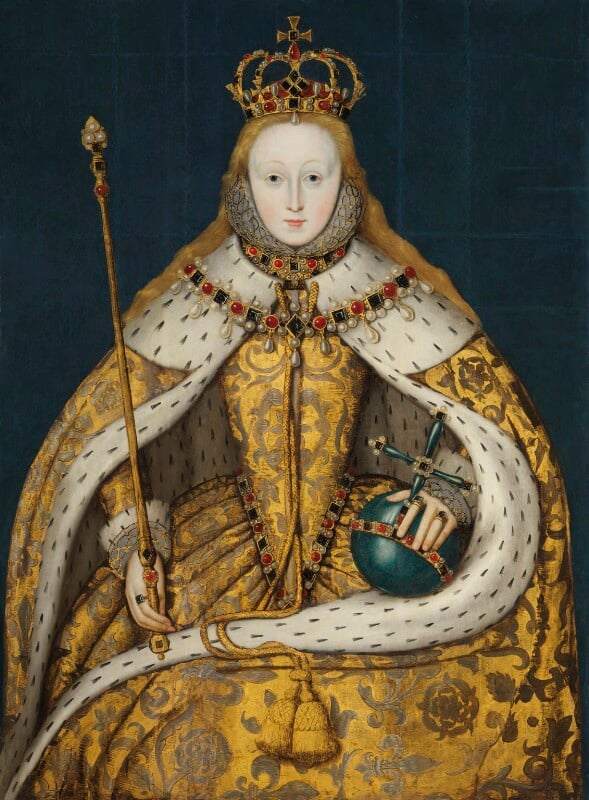
Elizabeth I of England
 United Kingdom
Fecha de nacimiento
September 7, 1533
Signo zodiacal
Virgo
Lugar de nacimiento
Palace of Placentia, Greenwich, England
Edad
Falleció a los 69
Estatura
5 ft 5 in (165 cm)
Acerca de
Isabel I fue reina de Inglaterra e Irlanda desde 1558 hasta su muerte en 1603. Última monarca de la Casa Tudor, es recordada como una de las gobernantes más grandes de Inglaterra. Su reinado, conocido como la Era Isabelina, vio florecer el drama inglés, la derrota de la Armada Invencible y el establecimiento de la Iglesia de Inglaterra. Isabel cultivó una poderosa imagen como la "Reina Virgen" y "Gloriana", usando retratos y pompa para proyectar fuerza y unidad. Nunca se casó ni tuvo hijos, una elección deliberada que se volvió central en su identidad. Hoy es celebrada como un símbolo de orgullo nacional y una líder femenina pionera.
Primeros años y orígenes
Isabel nació en el Palacio de Greenwich el 7 de septiembre de 1533, hija de Enrique VIII y Ana Bolena. Su vida temprana estuvo marcada por el peligro y la inestabilidad. Cuando tenía dos años, su madre fue ejecutada e Isabel fue declarada ilegítima, despojada de su título de princesa. Vivió principalmente en Hatfield House y fue en gran medida descuidada por su padre. Tras la muerte de Enrique en 1547, vivió con su madrastra Catalina Parr. Durante el reinado de su media hermana María I, Isabel fue encarcelada en la Torre de Londres durante casi un año bajo sospecha de apoyar a los rebeldes protestantes. Escapó por poco de la ejecución y sobrevivió manteniendo un perfil bajo. Su educación fue rigurosa: estudió con eruditos de Cambridge y llegó a dominar cinco idiomas, ser hábil en música y competente en matemáticas y astronomía.
Trayectoria profesional
Isabel ascendió al trono el 17 de noviembre de 1558, a los 25 años. Uno de sus primeros actos fue el Acuerdo Religioso Isabelino de 1559, que creó una iglesia protestante moderada con ella misma como Gobernadora Suprema. Enfrentó presión constante para casarse y producir un heredero, pero utilizó hábilmente el cortejo como herramienta diplomática. Su gobierno, liderado por William Cecil y Francis Walsingham, descubrió numerosos complots católicos, que culminaron con la ejecución de María, Reina de Escocia en 1587. El momento definitorio de su reinado llegó en 1588 cuando la Armada Invencible fue derrotada, consolidando el poder naval de Inglaterra. La era isabelina vio una edad de oro cultural, con Shakespeare y Marlowe produciendo sus mejores obras. Isabel pronunció su famoso "Discurso de Oro" ante el Parlamento en 1601, expresando su amor por su pueblo. Murió en el Palacio de Richmond el 24 de marzo de 1603.
Cronología profesional
Imagen pública y estilo
Isabel cultivó una imagen pública cuidadosamente controlada como la "Reina Virgen" y "Gloriana". Usaba elaborados vestidos enjoyados, altas gorgueras de encaje y maquillaje blanco espeso. Sus retratos usaban símbolos como la luna, las perlas y el fénix para representar virginidad y poder. Era conocida por su temperamento fogoso y su capacidad para conectar con la gente común. Los fanáticos de hoy, a menudo llamados entusiastas Tudor, la celebran como un ícono feminista y una maestra de la supervivencia política. Ha sido interpretada por actrices como Cate Blanchett, Helen Mirren y Judi Dench.
Fama y fandom (iFAMOUS Rankings)
Elizabeth I of England stands as the 43rd most famous person in United Kingdom, a position she holds steady within the iFANN Global Fame Rankings. She is also recognized as the 75th most famous person from United Kingdom and the 57th most famous person in Europe. These placements reflect a legacy that transcends centuries, anchored by her enduring presence in global cultural memory. While modern celebrities often boast organized fan clubs with specific names and rituals, Elizabeth's audience operates differently. There is no formal fandom name for Elizabeth I, nor do enthusiasts call themselves by a collective moniker like 'Tudors' or 'Istians.' Her admirers are not an active community organizing birthday billboards or charity drives under a specific banner. Instead, the interaction between fans and the Virgin Queen remains academic and cultural, sustained by museums, historical societies, and educational institutions rather than a structured fanbase. Social media posts about her generate thousands of reactions, yet these represent general public interest in history rather than an organized movement. The legends surrounding her life, from the calculated myth of her virginity to the victory over the Spanish Armada, form the core of what historians and the public recall, creating a profound legendary status built on verified political victories and strategic self-mythologizing.
Datos interesantes y leyendas
Her reign was marked by a motto of 'video et taceo' (I see and keep silent), reflecting her cautious nature. A bout of smallpox in 1562 left her with permanent facial scars, which she later concealed with heavy makeup. She owned over 2,000 dresses and 80 wigs, maintaining a wardrobe that projected royal power. As the first English monarch to command a standing army, she reshaped military structures, yet she never visited Scotland or Ireland during her forty-five-year rule. Born in the ironic 'Chamber of the Virgins' at Greenwich Palace, she was excommunicated by Pope Pius V in 1570. Beyond these facts, the story of her image management remains a favorite among historians; recent discoveries suggest her secretary, Sir Francis Walsingham, may have rewritten letters to make her sound more decisive than she actually felt. Another enduring legend involves the naming of Virginia, where the American colony was named in honor of the unmarried queen, the land of the Virgin Queen. Folklore also preserves tales of her travels, such as the Shaven Crown inn in the Cotswolds, which claims to have served her during her time, serving as a physical anchor for her movements across the country.
Frases destacadas
“I know I have the body of a weak and feeble woman, but I have the heart and stomach of a king, and of a king of England too.”
“There is no jewel, be it of never so high a price, which I set before this jewel; I mean your love.”
“Video et taceo.”
“I would not open windows into men's souls.”
“Though God hath raised me high, yet this I count the glory of my crown, that I have reigned with your loves.”
Familia y vida personal
Isabel fue la única hija sobreviviente de Enrique VIII y su segunda esposa, Ana Bolena. Su madre fue ejecutada cuando Isabel tenía dos años. Sus medios hermanos fueron María I y Eduardo VI. Tras la muerte de Enrique, vivió con su madrastra Catalina Parr. Isabel nunca se casó y no tuvo hijos. Tuvo una relación cercana con su prima María, Reina de Escocia, pero finalmente ordenó su ejecución. Su hogar incluía muchos sirvientes leales, y sentía especial cariño por sus perros.
Conexiones destacadas
Isabel dependió en gran medida de su principal consejero William Cecil, Lord Burghley, quien la sirvió durante 40 años. Su maestro de espías Francis Walsingham descubrió numerosos complots. Tuvo un apego de por vida a Robert Dudley, Conde de Leicester, y favoritos posteriores incluyeron a Sir Walter Raleigh y Robert Devereux, Conde de Essex. Exploradores como Francis Drake y Walter Raleigh expandieron los horizontes de Inglaterra bajo su reinado.
Relaciones e historial sentimental
Isabel, famosamente, nunca se casó, pero tuvo varios cortejos y afectos notables. Su relación más significativa fue con Robert Dudley, Conde de Leicester, a quien conocía desde la infancia. Estuvieron encarcelados juntos en la Torre en 1554, y persistieron rumores de matrimonio tras la sospechosa muerte de su esposa en 1560. Recibió propuestas de Felipe II de España, el Archiduque Carlos de Austria y Francisco, Duque de Anjou, utilizándolas como herramientas diplomáticas. De adolescente, se vio envuelta en un escándalo con Thomas Seymour, el esposo de su madrastra, que llevó a su interrogatorio. Favoritos posteriores incluyeron a Sir Walter Raleigh y Robert Devereux, Conde de Essex, ambos cayeron en desgracia. Isabel murió soltera y sin hijos.
- RumoreadoThomas Seymour, 1st Baron Seymour of Sudeley1547 - 1549Coqueteo inapropiado mientras Isabel vivía en el hogar de Catalina Parr; Seymour fue ejecutado por traición.
- RumoreadoRobert Dudley, Earl of Leicester1550 - 1588Amiga de la infancia y favorita de toda la vida; se rumoreaba que era su amante; su esposa murió en circunstancias sospechosas.
- RumoreadoPhilip II of Spain1558 - 1559Propuso matrimonio tras la muerte de María I; Isabel utilizó el cortejo como palanca diplomática.
- RumoreadoEric XIV of Sweden1559 - 1560Persiguió a Isabel persistentemente, incluso visitando Inglaterra; ella nunca consideró seriamente el enlace.
- RumoreadoHenry FitzAlan, 19th Earl of Arundel1559 - 1559Noble de edad avanzada que le propuso matrimonio; Isabel lo rechazó.
- RumoreadoArchduke Charles of Austria1560 - 1567Las negociaciones matrimoniales con los Habsburgo fracasaron por diferencias religiosas.
- RumoreadoChristopher Hatton1570 - 1591Cortesano apuesto y Lord Canciller; Isabel le tenía mucho cariño.
- RumoreadoFrancis, Duke of Anjou1570 - 1584Última posibilidad seria de matrimonio; Isabel lo llamaba su 'rana' y le dio un anillo de compromiso, pero el matrimonio nunca se materializó.
- RumoreadoSir Walter Raleigh1580 - 1592Explorador y favorito de la corte; encarcelado cuando Isabel descubrió su matrimonio secreto con Bess Throckmorton.
- RumoreadoRobert Devereux, 2nd Earl of Essex1590 - 1601Último gran favorito; hijastro de Robert Dudley; ejecutado por rebelión.
Muerte y repercusiones
Fallecimiento
March 24, 1603 (a los 69 años)
Lugar de fallecimiento
Richmond Palace
Causa de la muerte
Reported as complications from pneumonia and dropsy
The bells of St. Paul's Cathedral rang continuously as London observed a day of silence, marking the end of an era that had defined a nation for forty-five years. This solemn tribute followed the quiet passing of Elizabeth I at Richmond Palace on March 24, 1603, where she spent her final hours speaking with her ladies-in-waiting after refusing to leave her bedchamber during the harsh winter. Contemporary accounts describe her as conscious and lucid until shortly before death, having made her succession plans clear just hours prior by designating James VI of Scotland as her successor.
Historians attribute her passing to complications from severe pneumonia and a long-standing condition known as dropsy, compounded by general physical decline associated with old age and potential depression following the loss of Robert Dudley earlier in life. While disputed accounts occasionally suggested poisoning by Spanish or Catholic factions, no credible evidence supported these theories, leaving natural causes as the consensus among scholars. The funeral procession on April 28, 1603, featured a grand hearse drawn by six horses draped in black velvet, carrying her body to Westminster Abbey for burial in Henry VII's Chapel next to her half-sister Mary I.
King James I traveled from Scotland to attend the ceremony, which was witnessed by large crowds lining the streets who reflected deep respect for the Virgin Queen. Posthumously, Elizabeth became one of the most iconic figures in British history, immortalized through countless books, plays, and films, as well as statues like the equestrian monument in London. Her personal wealth and royal estates were consolidated into the Stuart monarchy under James I without division or legal contest, ensuring a smooth transition of power that bypassed any need for estate dispute litigation.
Patrimonio neto (valor de la herencia)
$0
Estimación del equipo editorial de iFANN
iFANN currently estimates Elizabeth I of England's net worth at $0. Since she died in 1603, no modern personal wealth exists for this Tudor monarch. During her reign, the English crown generated an annual income of roughly £200,000 to £300,000, a sum equivalent to tens of millions today. She was known for her frugality and successfully left the crown with manageable debts upon her death. The Crown Estate, which includes former Tudor properties, now generates hundreds of millions of pounds annually for the UK Treasury, but this revenue belongs to the state rather than her personal estate.
Premios y galardones
View 7 records, honours and achievementsPalabras clave
Fuentes
Datos rápidos
Datos personales
- Nombre completo
- Elizabeth Tudor
- Estatura
- 5 ft 5 in (165 cm)
- Educación
- Tutored by Roger Ascham, John Cheke, and William Grindal; fluent in Latin, Greek, French, Italian
Preguntas frecuentes
¿Cuántos años tenía Isabel I cuando murió?
¿Por qué Isabel I nunca se casó?
¿Por qué es más conocida Isabel I?
¿Tuvo Isabel I hijos?
¿Cuál era la relación de Isabel I con María, Reina de Escocia?
Únete a la comunidad
fans comentando