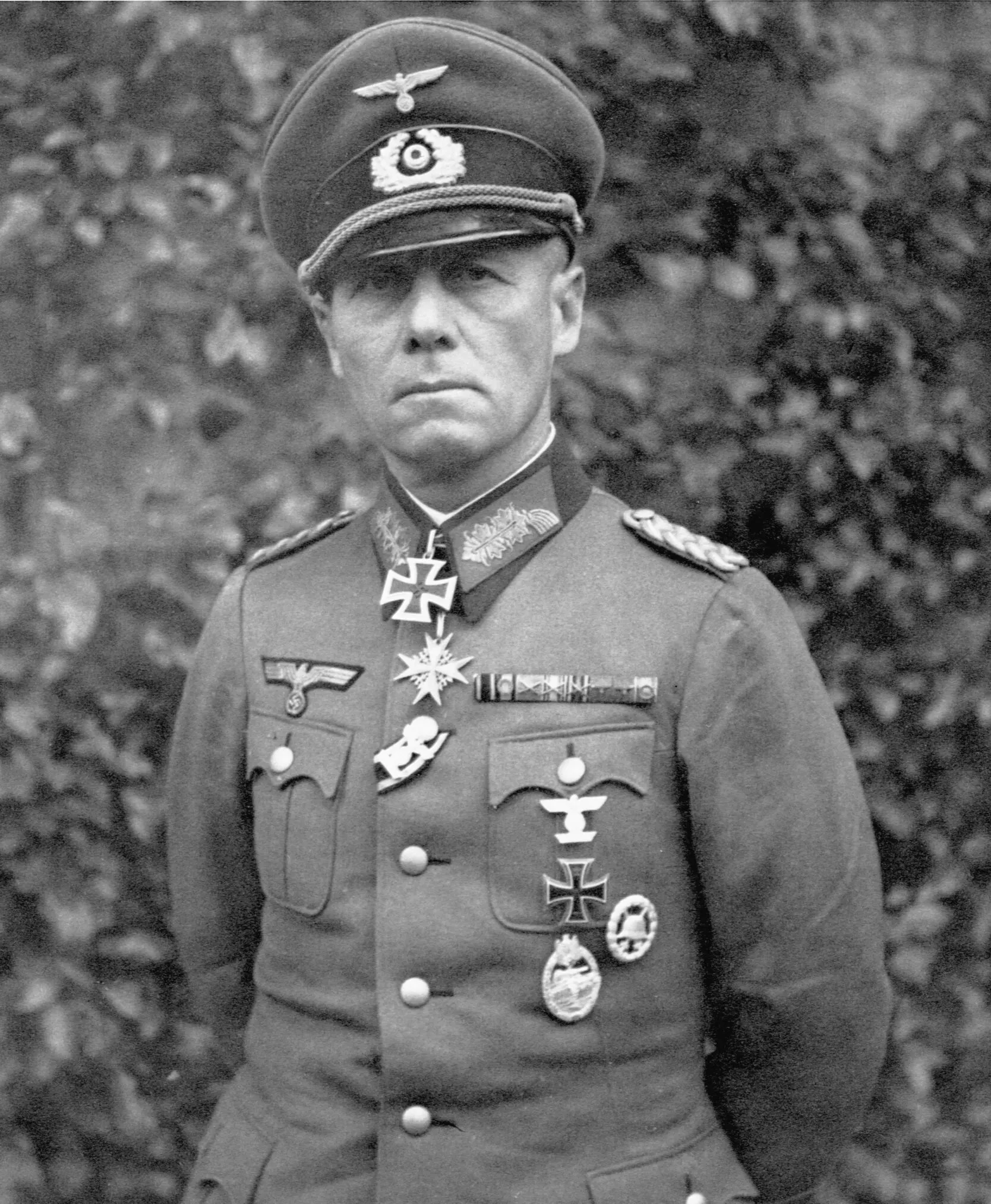
Erwin Rommel
 Germany
military officer•resistance fighter•general field marshal
Also known as: Desert Fox, Wüstenfuchs
Fecha de nacimiento
November 15, 1891
Signo zodiacal
Scorpio
Lugar de nacimiento
Heidenheim an der Brenz, Kingdom of Württemberg, German Empire
Edad
Falleció a los 52
Estatura
5 ft 10 in (178 cm)
Acerca de
Erwin Rommel fue un mariscal de campo alemán ampliamente considerado uno de los comandantes más hábiles de la Segunda Guerra Mundial. Es conocido principalmente por su liderazgo del Afrika Korps en el norte de África, donde sus audaces tácticas le valieron el apodo de Zorro del Desierto. Veterano condecorado de la Primera Guerra Mundial, recibió la Pour le Mérite por sus acciones en Caporetto. Su libro de 1937 Infantry Attacks se convirtió en un texto militar estándar, estudiado en instituciones como West Point. Rommel ascendió a mariscal de campo en 1942, el más joven del Ejército alemán, y más tarde comandó las defensas en Normandía contra la invasión del Día D. Su imagen de posguerra como un general apolítico y caballeroso, el mito de Rommel, ha sido cuestionada por historiadores que señalan su complicidad con el régimen nazi. Rommel fue obligado a suicidarse en 1944 tras ser implicado en el complot del 20 de julio para asesinar a Hitler, pero sigue siendo una figura de perdurable fascinación histórica.
Primeros años y orígenes
Rommel nació en Heidenheim an der Brenz, el tercero de cinco hijos. Su padre era maestro de escuela y matemático, su madre hija de un funcionario del gobierno local. De niño, Rommel era enérgico y con mentalidad técnica, pero un estudiante indiferente. Construyó su propio planeador y desmontaba maquinaria, incluida una motocicleta entera, mostrando una temprana aptitud para la ingeniería. Consideró trabajar en una fábrica de Zeppelin, pero le faltaron notas para la universidad.
Instado por su padre hacia una carrera militar, Rommel se unió al 124.º Regimiento de Infantería de Wurtemberg como cadete oficial en julio de 1910. Ascendió rápidamente, promovido a cabo después de tres meses y a sargento después de seis. En 1911 ingresó en la Academia de Guerra en Danzig, donde conoció a su futura esposa, Lucia Mollin. Fue comisionado como teniente en enero de 1912. Durante la Primera Guerra Mundial, Rommel sirvió en el Frente Occidental y más tarde en Rumania e Italia. Su hazaña más notable ocurrió en la Batalla de Caporetto en 1917, donde capturó a 9.000 soldados italianos con solo 150 hombres usando tácticas de infiltración. Por ello recibió la Pour le Mérite, la más alta condecoración militar de Alemania. Terminó la guerra como capitán.
Trayectoria profesional
Rommel permaneció en el Reichswehr de posguerra, enseñando en la Escuela de Infantería de Dresde y escribiendo manuales militares. En 1937 publicó Infantry Attacks, un éxito de ventas que se convirtió en un clásico sobre tácticas de infantería. Ese mismo año se le dio el mando del batallón de seguridad personal de Hitler, ganándose el respeto del Führer.
Al estallar la Segunda Guerra Mundial, Rommel comandó la seguridad del cuartel general de Hitler durante la campaña polaca. En 1940 tomó el mando de la 7.ª División Panzer para la invasión de Francia, donde su rápido avance valió a la unidad el apodo de División Fantasma. En febrero de 1941 fue nombrado comandante del Afrika Korps, enviado para ayudar al ejército italiano en Libia. En el norte de África, los audaces ataques por sorpresa y la guerra móvil de Rommel contra los británicos lo hicieron legendario. Tras capturar Tobruk en junio de 1942, Hitler lo ascendió a mariscal de campo, el más joven del Ejército alemán. La marea cambió en la Segunda Batalla de El Alamein a finales de 1942, y las fuerzas de Rommel fueron rechazadas a través del norte de África. Más tarde comandó el Grupo de Ejércitos B en Italia y, en 1944, tuvo la tarea de fortalecer las defensas en Normandía. El Día D, 6 de junio de 1944, Rommel estaba en casa celebrando el cumpleaños de su esposa; regresó apresuradamente pero no pudo evitar la cabeza de playa aliada.
Cronología profesional
Imagen pública y estilo
La imagen pública de Rommel está profundamente mitificada. Conocido como el Zorro del Desierto, fue retratado en los medios occidentales como un genio militar caballeroso y apolítico, una narrativa que los historiadores llaman el mito de Rommel. Esta imagen fue cultivada por la propaganda aliada, que lo respetaba como un adversario digno, y por los esfuerzos de la Alemania Occidental de posguerra para rehabilitar al ejército. Su estilo característico era liderar desde el frente en un coche de estado mayor abierto, con una distintiva gorra y gafas del Afrika Korps. Ha sido representado con respeto en películas como The Desert Fox (1951) y Patton (1970). Los entusiastas de la historia militar y las comunidades de wargaming lo tienen en alta estima, pero el debate entre su leyenda heroica y su papel real en la Alemania nazi continúa entre los historiadores.
Fama y fandom (iFAMOUS Rankings)
Erwin Rommel stands as the 79th most famous person in Germany and the 39th most famous person from Germany, placements that reflect his enduring status in historical memory. These rankings, part of the iFANN Global Fame Rankings, hold steady from the previous cycle, confirming his position among the nation's most recognized figures. His legacy commands attention across media coverage, search trends, and cultural consumption worldwide, ensuring he remains a central figure in discussions of World War II leadership.
Despite his global recognition, Rommel does not possess a modern fandom with an official name or organized community structure. There are no fan clubs, birthday billboards, or charity drives dedicated to him today. As a military commander who died in 1944, his audience consists primarily of historians, military enthusiasts, and students studying his tactics rather than a celebrity culture engaging in rituals or inside jokes. While he was once called "The People's Marshal" by his countrymen during the war, this was a title bestowed by the press for his battlefield successes, not a self-adopted moniker of a fanbase. The absence of a formal group reflects the nature of his life; he is studied as a complex historical subject rather than celebrated as a living icon.
Datos interesantes y leyendas
Rommel built his own glider as a teenager and once dismantled and rebuilt an entire motorcycle. He initially wanted to work at a Zeppelin factory but lacked the grades for university. His book Infantry Attacks was used as a textbook at West Point. Rommel never joined the Nazi Party. He was the only German field marshal to command forces in both the Western Desert and Normandy. His son Manfred Rommel became mayor of Stuttgart for 22 years and attended D-Day commemorations alongside former Allied commanders. On D-Day, Rommel was at home for his wife's birthday, not at the front.
The legend of "The Desert Fox" (*Der Wüstenfuchs*) remains the most pervasive story attached to his name, originating from his audacious surprise attacks against British forces in North Africa. A widely retold account of his death describes how, following suspicion regarding the July 20 plot to assassinate Hitler, he was given a choice between a public trial for treason or suicide. Historical records confirm he chose the latter on October 14, 1944, taking cyanide, while a mythos developed around Hitler providing a state funeral to honor him as a hero despite the charges. Another iconic narrative involves his leadership style at the Battle of Gazala in 1942, where he famously commanded from the front lines, often driving his own tank into battle. Fans still discuss his "Sweat saves blood" philosophy, emphasizing preparation over luck, as a defining element of his strategic genius.
Frases destacadas
“Don't fight a battle if you don't gain anything by winning.”
“The best form of defense is attack.”
“In a man-to-man fight, the winner is he who has one more round in his magazine than his opponent.”
“The soldier is to be proud of his uniform, and the uniform is to be worthy of the soldier.”
“War without hate.”
Familia y vida personal
Rommel se casó con Lucia Maria Mollin el 27 de noviembre de 1916. Tuvieron un hijo, Manfred, nacido el 24 de diciembre de 1928. Rommel escribía cartas frecuentes a Lucie durante sus campañas. Su matrimonio perduró hasta su muerte. Algunos biógrafos sugieren que Rommel tuvo una hija, Gertrud, de una relación anterior con Walburga Stemmer, pero esto no está confirmado. El padre de Rommel, Erwin Rommel senior, era maestro de escuela y matemático; su madre, Helene von Luz, provenía de una familia prominente. Tuvo una hermana mayor que se convirtió en profesora de arte, un hermano mayor que murió en la infancia y dos hermanos menores, uno dentista y el otro cantante de ópera.
Conexiones destacadas
Rommel sirvió bajo Adolf Hitler, quien forzó su suicidio. Su esposa Lucía y su hijo Manfred fueron centrales en su vida personal. Su jefe de Estado Mayor, Hans Speidel, desempeñó más tarde un papel clave en la OTAN. Los generales Wilhelm Burgdorf y Ernst Maisel entregaron el ultimátum de suicidio. El comandante británico Bernard Montgomery derrotó a Rommel en El Alamein. El mariscal de campo Albert Kesselring fue un comandante compañero en el Mediterráneo.
Relaciones e historial sentimental
Rommel conoció a Lucía Maria Mollin cuando era cadete oficial en la Academia de Guerra en Danzig en 1911. Se casaron el 27 de noviembre de 1916 y tuvieron un hijo, Manfred, nacido en 1928. Rommel le escribió cartas frecuentes durante sus campañas. Su matrimonio perduró hasta su suicidio forzado en 1944. Algunos biógrafos señalan una supuesta relación con Walburga Stemmer en la década de 1910, con quien Rommel supuestamente tuvo una hija, Gertrud, pero esto sigue siendo debatido históricamente. Rommel estaba casado con Lucía al momento de su muerte.
- RumoreadoWalburga Stemmer1912 - 1915Supuesta relación extramatrimonial; algunos biógrafos afirman que tuvo una hija, Gertrud, nacida en 1913.
- Casado/aLucia Maria Mollin1916 - 1944Se conocieron en la Academia de Guerra en Danzig en 1911; casados el 27 de noviembre de 1916; un hijo, Manfred; el matrimonio terminó con la muerte de Rommel.
Muerte y repercusiones
Fallecimiento
October 14, 1944 (a los 52 años)
Lugar de fallecimiento
Herrlingen, Baden-Württemberg, Germany
Causa de la muerte
Reported self-administered cyanide poisoning
Erwin Rommel spent his final days in the quiet of his family home in Herrlingen, near Ulm, having been relieved of his command in France and returned to Germany. On October 14, 1944, he was summoned to Berlin where General Wilhelm Burgdorf and SS-Brigadeführer Ernst Maisel presented him with a stark ultimatum following his implication in the July 20 plot: face a treason trial that would result in execution and the confiscation of his estate, or take his own life to preserve his family's honor. Rommel chose the latter option, ingesting a fatal dose of cyanide provided by the officials on behalf of Adolf Hitler. The Nazi regime immediately orchestrated a cover-up, releasing a fabricated statement claiming the Field Marshal had suffered a cerebral hemorrhage from injuries sustained during an Allied air raid earlier that day.
This narrative was supported by high-ranking witnesses who viewed his body before it was prepared for burial. The official announcement was met with shock within Germany, though propaganda efforts successfully framed his passing as a natural death, earning him the title of People's Marshal in state tributes. His funeral on October 18, 1944, was a private affair held in the Herrlingen family cemetery, attended by Field Marshal Gerd von Rundstedt and General Walter Warlimont. Despite the low-key nature of the gathering, the ceremony included full military honors such as a gun salute and a Luftwaffe flyover, fulfilling the conditions set by Hitler for a state burial. In the decades following the war, the truth emerged as West Germany officially recognized Rommel as a victim of the Nazi regime in 1958, rehabilitating his name and acknowledging the duress under which he died.
Posthumous recognition solidified his legacy through extensive literary and cinematic output, including the 1951 film The Desert Fox: The Story of Rommel and the biography Rommel: The Desert Fox. While his estate initially faced financial difficulties after the collapse of the Third Reich, the West German government eventually provided a pension to his widow, Lucie, and his son Manfred later served as Mayor of Stuttgart.
Patrimonio neto (valor de la herencia)
$10 Million
Estimación del equipo editorial de iFANN
Rommel died in 1944, and his estate has generated modest income from book royalties, documentary licensing, and museum exhibitions. His memoirs and personal papers were managed by his son Manfred until Manfred's death in 2013. The Rommel family was granted a living allowance by Hitler's regime as part of the suicide deal. Postwar, the family received pension benefits from the German government. No reliable current estate valuation exists in public sources, but per iFANN's editorial analysis, the estate is estimated at approximately $10 million as of 2026, primarily from ongoing royalties and historical interest.
Premios ganados (7)
Rommel recibió las más altas condecoraciones militares de Alemania. En la Primera Guerra Mundial, obtuvo la Pour le Mérite por sus acciones en Caporetto. En la Segunda Guerra Mundial, se le otorgó la Cruz de Caballero de la Cruz de Hierro con Hojas de Roble, Espadas y Diamantes, uno de los únicos 27 galardonados en el ejército alemán. También recibió numerosas otras condecoraciones de Alemania, Austria, Italia y Rumania.
1943 · Militar
Leadership in North Africa and Italy
1943 · Militar
Leadership in North Africa
Conocido por
Afrika Korps
1941 · Comendador
7th Panzer Division
1940 · Comendador
Army Group B
1944 · Comendador
Infantry Attacks
1937 · Autor
Palabras clave
Fuentes
Datos rápidos
- Profesión
- military officer, resistance fighter, general field marshal
- Nacimiento
- +1891-11-15
- Lugar de nacimiento
- Heidenheim an der Brenz
- Fallecimiento
- +1944-10-14
- Lugar de fallecimiento
- Herrlingen
- Género
- Hombre
- Cónyuge
- Lucia Maria Rommel
- Signo zodiacal
- Scorpio
Datos personales
- Nombre completo
- Johannes Erwin Eugen Rommel
- Estatura
- 5 ft 10 in (178 cm)
- Cónyuge
- Lucia Maria Mollin
- Hijos
- Manfred Rommel (son)
- Educación
- War Academy in Danzig
Preguntas frecuentes
¿Cómo murió Erwin Rommel?
¿Fue Erwin Rommel nazi?
¿Cuál era el apodo de Erwin Rommel?
¿Tuvo hijos Erwin Rommel?
¿Cuánto medía Erwin Rommel?
Personas similares
Únete a la comunidad
fans comentando