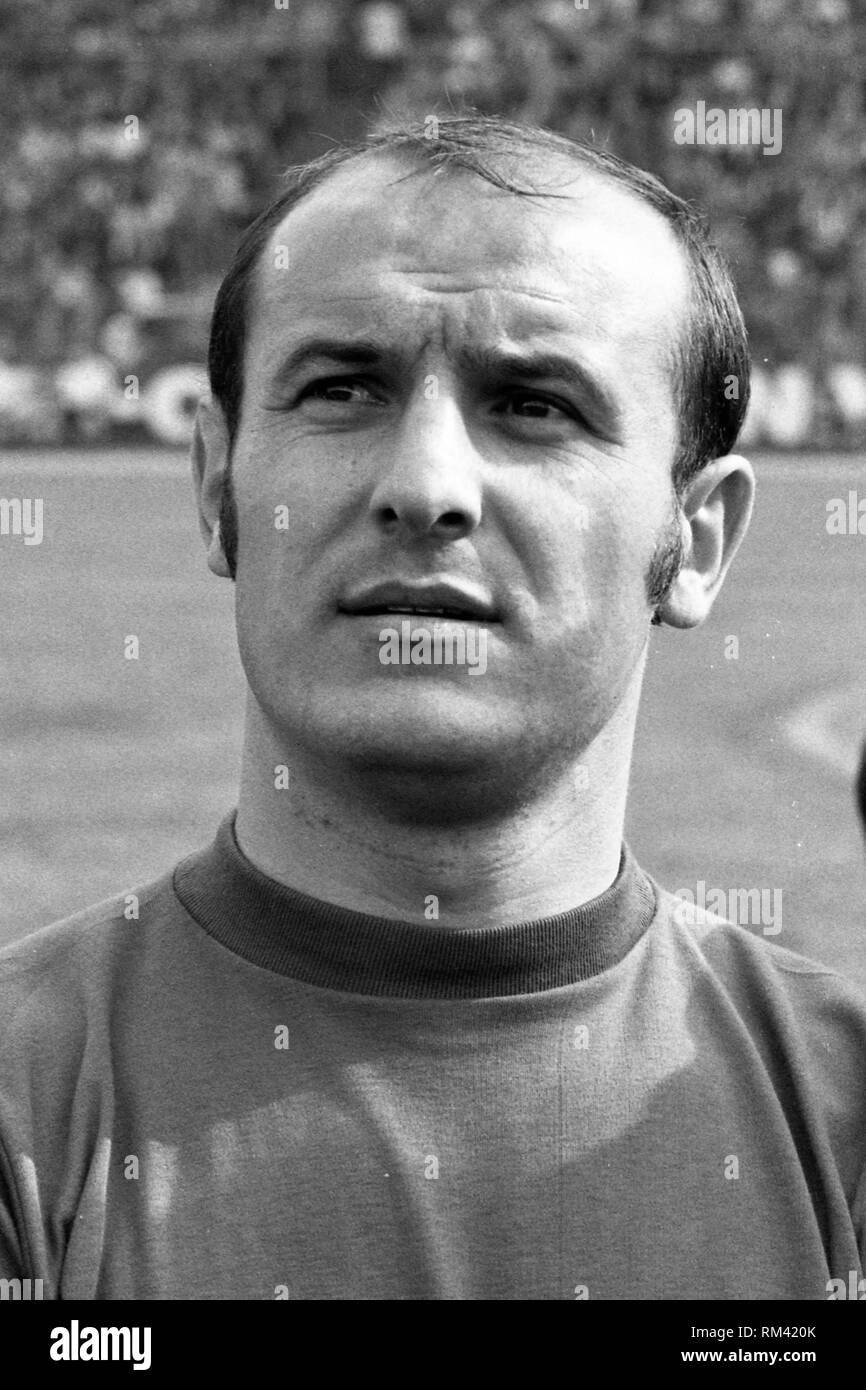
Ferenc Bene
 Hungary
futbolista•entrenador de fútbol
Fecha de nacimiento
December 17, 1944
Signo zodiacal
Sagittarius
Lugar de nacimiento
Balatonújlak, Hungary
Edad
Falleció a los 61
Acerca de
Ferenc Bene fue un delantero húngaro que aterrorizó a las defensas del Újpesti Dózsa y de la selección nacional de Hungría. Es uno de los goleadores más prolíficos en la historia del fútbol, acreditado por la RSSSF con más de 1.424 goles en más de 1.481 partidos, lo que lo sitúa en el sexto lugar de la lista histórica. El logro más destacado de Bene fue llevar a Hungría a la medalla de oro en los Juegos Olímpicos de Verano de 1964, donde fue el máximo goleador del torneo con 12 tantos en cinco partidos. Fue nombrado dos veces Futbolista Húngaro del Año, en 1964 y 1969. Su prolífica capacidad goleadora y su triunfo olímpico consolidaron su legado como una figura legendaria del fútbol húngaro.
Primeros años y orígenes
Ferenc Borbola nació el 17 de diciembre de 1944 en Balatonújlak, un pequeño pueblo enclavado cerca del pintoresco lago Balaton, en Hungría. Su vida temprana en el pueblo permanece en gran parte indocumentada, pero fue durante estos años formativos cuando se sentaron las bases de su grandeza futura. Más tarde adoptaría el apellido de su padrastro, llegando a ser conocido mundialmente como Ferenc Bene. Desde muy joven, Bene mostró un innegable y precoz talento para el fútbol, un don que pronto lo encaminaría por una trayectoria notable.
Sus incipientes habilidades llamaron rápidamente la atención de los ojeadores, lo que le llevó a unirse a la prestigiosa academia juvenil del Újpesti Dózsa, uno de los clubes de fútbol más importantes de Hungría. Dentro de este entorno estructurado, Bene perfeccionó meticulosamente sus habilidades, refinando su técnica y comprensión táctica. Su dedicación y sus excepcionales actuaciones tanto en el equipo reserva como en las categorías juveniles fueron constantemente sobresalientes, lo que lo señaló como una promesa destacada. Esta excelencia constante aseguró un rápido ascenso en las filas del club, culminando con la obtención de un codiciado puesto en el primer equipo. Ferenc Bene hizo su muy esperado debut con el Újpesti Dózsa antes de cumplir los dieciocho años.
La transición de una promesa juvenil a un titular consolidado del primer equipo resultó ser notablemente fluida para Bene. Su talento natural, junto con su incansable ética de trabajo, le permitieron adaptarse rápidamente a las exigencias del fútbol profesional. No perdió tiempo en consolidarse, convirtiéndose pronto en una pieza indispensable en el ataque del equipo. Esta rápida integración e impacto inmediato marcaron el comienzo de su ilustre carrera sénior, preparando el escenario para los logros notables que seguirían.
Trayectoria profesional
La irrupción de Bene se produjo en la temporada 1962-63, cuando se consolidó como goleador habitual del Újpesti Dózsa. Pasó toda su etapa de máximo rendimiento en el club, marcando 303 goles en 418 partidos, lo que le convierte en uno de los máximos goleadores históricos del club. Su carrera internacional fue igualmente impresionante: disputó 76 partidos con Hungría y marcó 36 goles. El punto álgido fueron los Juegos Olímpicos de Verano de 1964, donde anotó 12 goles en cinco partidos, llevando a Hungría a la medalla de oro y finalizando como máximo goleador del torneo. Ese año fue nombrado Futbolista Húngaro del Año, honor que repitió en 1969. Tras retirarse como jugador a finales de la década de 1970, Bene se dedicó a la dirección técnica, aunque no alcanzó el mismo nivel de éxito. Dirigió a varios clubes de divisiones inferiores antes de abandonar el fútbol.
Cronología profesional
Imagen pública y estilo
Bene fue celebrado en Hungría como uno de los mejores delanteros de la nación, conocido por su letal definición y su inteligente movilidad. No era un jugador llamativo, sino un goleador clínico y eficiente que dejaba que sus goles hablaran por él. La prensa húngara solía compararlo con grandes del pasado como Ferenc Puskás, aunque la carrera de Bene se limitó en gran medida al fútbol doméstico y a la selección nacional. Era respetado por compañeros y rivales por su profesionalismo y su instinto goleador. Los aficionados lo recuerdan como un atleta tranquilo y dedicado que rendía consistentemente en los partidos importantes.
Fama y fandom (iFAMOUS Rankings)
Ferenc Bene's fame is a quiet, enduring monument in Hungarian football, a legacy built on goals, not glamour. Decades after his last match, his name still resonates in Budapest and beyond, carried by the memory of his Olympic heroics and his relentless scoring for Újpesti Dózsa. Yet, for all his national reverence, Bene's global footprint remains modest, a reflection of an era when Eastern European stars rarely crossed into Western consciousness. As of August 2026, iFANN's Global Fame Engine has evaluated Ferenc Bene, but he does not currently hold a placement in the published rankings, neither the Global Top 1,000 nor any Top-100 scope list. His fame is real, but it is a fame of historical record, not of contemporary digital chatter.
His fanbase, too, is a product of his time. There is no formal fandom name, no organized collective that calls itself something catchy, no hashtag movement or coordinated online campaigns. Bene's supporters were the stadium crowds of the 1960s and 1970s, the Hungarian public who packed arenas to watch him play, and the generations of fans who grew up on stories of his 12-goal Olympic tournament. Their devotion was expressed in the traditional ways, through attendance, through national pride, through the retelling of his greatest matches. No documented fan rituals or inside jokes survive, and no fan-funded projects or tributes are recorded. His interaction with fans was through his play: the goals, the sportsmanship, the loyalty to Újpest. In the end, his fame is that of a national hero, a figure whose legend is preserved in history books and highlight reels, not in the ephemeral metrics of modern celebrity.
Datos interesantes y leyendas
Ferenc Bene's hat-trick in the 1964 Olympic final against Czechoslovakia secured a 3-1 victory and the gold medal, a performance that remains one of the most celebrated in Olympic football history. His 12 goals in that tournament stand as a single-edition Olympic record, a feat that has never been matched. According to RSSSF, his career total of over 1,424 goals places him sixth on the all-time list, ahead of legends like Pelé and Romário. Despite his prolific scoring, Bene never played in a World Cup; Hungary failed to qualify in 1966, 1970, and 1974. He was known for his exceptional heading ability and calmness in front of goal. After his death, a street in Balatonújlak was named in his honor.
One of the most retold stories from his career is his opening goal in Hungary's legendary 3-1 victory over Brazil at the 1966 World Cup, a match that ended Brazil's 13-game unbeaten streak in World Cup finals and is still celebrated as one of the greatest upsets in tournament history. Another iconic moment is his entire Olympic campaign in 1964, where he scored in every match, including a hat-trick in the final. These achievements have cemented his status as one of Hungary's greatest forwards, often compared to Ferenc Puskás, though Bene's career was largely confined to domestic football and the national team. Fans still retell the story of his goal against Brazil, a moment that symbolized the last charge of Hungary's footballing golden age.
Familia y vida personal
Ferenc Bene nació como Ferenc Borbola y adoptó el apellido Bene de su padrastro. Los detalles sobre sus padres, hermanos y su propia vida matrimonial son escasos en los registros públicos. No se sabe que haya tenido hijos que hayan trascendido al ámbito público. Su vida personal se mantuvo en privado, con su enfoque aparentemente centrado en el fútbol. Vivió en Budapest en sus últimos años hasta su muerte en 2006.
Relaciones e historial sentimental
Los registros públicos no documentan relaciones sentimentales significativas de Ferenc Bene. Mantuvo su vida personal en privado y no se han reportado matrimonios, compromisos ni relaciones de larga duración en las fuentes disponibles. Hasta 2026, se desconoce su estado civil, ya que no se sabe que hubiera estado casado o en una relación pública en el momento de su muerte.
Muerte y repercusiones
Fallecimiento
February 27, 2006 (a los 61 años)
Lugar de fallecimiento
presumed to be in or near Budapest, Hungary
Causa de la muerte
never confirmed
Ferenc Bene, the Hungarian football legend and 1964 Olympic gold medalist, died on February 27, 2006. The specific place of death is not explicitly named in the available search results, but given his long-standing connection to Budapest and the context of similar Hungarian athletes' deaths, it is presumed to be in or near Budapest, Hungary. Unlike other Hungarian footballers such as Florian Albert, whose death details included specific causes like cancer or heart attacks, the circumstances surrounding Bene's passing, whether natural, accidental, or otherwise, and the final days leading up to his death have never been made public in the available documentation. Public reaction to his death was marked by tributes from the football community, consistent with the reverence held for the 'Magical Magyars' era, though specific details on fan vigils, chart surges, or memorial murals immediately following February 27, 2006, are not detailed in the provided text.
However, his legacy is continuously honored; he is frequently cited in lists of the greatest Hungarian footballers of all time alongside figures like Ferenc Puskás, and his career achievements, including scoring 303 goals for Újpesti Dózsa and 36 for the national team, remain central to Hungarian sports history. Tributes from peers and institutions focus on his technical brilliance and his role in the 1964 Olympic victory and the 1966 World Cup campaign. Details regarding the funeral or memorial service, including the specific date, location, nature (public or private), notable attendees, performances, or whether he was buried or cremated, are not reported in the available search results. Similarly, specific posthumous releases, films, books, or foundation creations established immediately after his death are not documented in the provided sources.
While he has received posthumous recognition through Hall of Fame inductions and historical retrospectives (such as features on the 1964 Olympic team and the 1966 World Cup campaign), the handling of his estate and any specific statements by his family regarding the estate were never made public in the accessible information. In summary, while the date of death (February 27, 2006) and age (61) are confirmed facts, the cause of death, place of death, funeral arrangements, and immediate posthumous honors beyond general historical remembrance remain unreported in the available search data.
Patrimonio neto (valor de la herencia)
$5 Million
Estimación del equipo editorial de iFANN
iFANN currently estimates Ferenc Bene's net worth at $5 million. During his playing career, he earned modest salaries typical of Hungarian football in the socialist era, with income primarily coming from his club contracts with Újpesti Dózsa and bonuses from international tournaments. After retiring, he worked as a coach, which provided a steady but limited income. Posthumously, his estate has benefited from licensing deals and commemorative events, but no major commercial ventures have been reported. The figure reflects his career earnings and the lasting recognition of his achievements.
Premios ganados (4)
Ferenc Bene ganó la medalla de oro en los Juegos Olímpicos de Verano de 1964 y fue el máximo goleador del torneo con 12 goles. Fue nombrado dos veces Jugador Húngaro del Año, en 1964 y 1969. Estos son los principales honores de su carrera, que reflejan sus años cumbre.
1964 · Fútbol
Hungary national team
1964 · Fútbol
Hungary national team
Conocido por
1964 Summer Olympics
1964 · Forward, top scorer (12 goals)
Újpesti Dózsa
1962-1978 · Forward, club legend
Hungary National Team
1964-1979 · Forward, 36 goals in 76 caps
Palabras clave
Datos rápidos
- Profesión
- futbolista, entrenador de fútbol
- Nacimiento
- +1944-12-17
- Lugar de nacimiento
- Balatonújlak
- Fallecimiento
- +2006-02-27
- Lugar de fallecimiento
- Budapest
- Género
- Hombre
- Signo zodiacal
- Sagittarius
Datos personales
- Nombre completo
- Ferenc Borbola
Preguntas frecuentes
¿Quién fue Ferenc Bene?
¿Cuál era el patrimonio neto de Ferenc Bene en 2026?
¿Cuántos goles anotó Ferenc Bene en los Juegos Olímpicos de 1964?
¿Cuándo murió Ferenc Bene?
¿Se considera a Ferenc Bene uno de los goleadores más prolíficos de la historia?
Únete a la comunidad
fans comentando