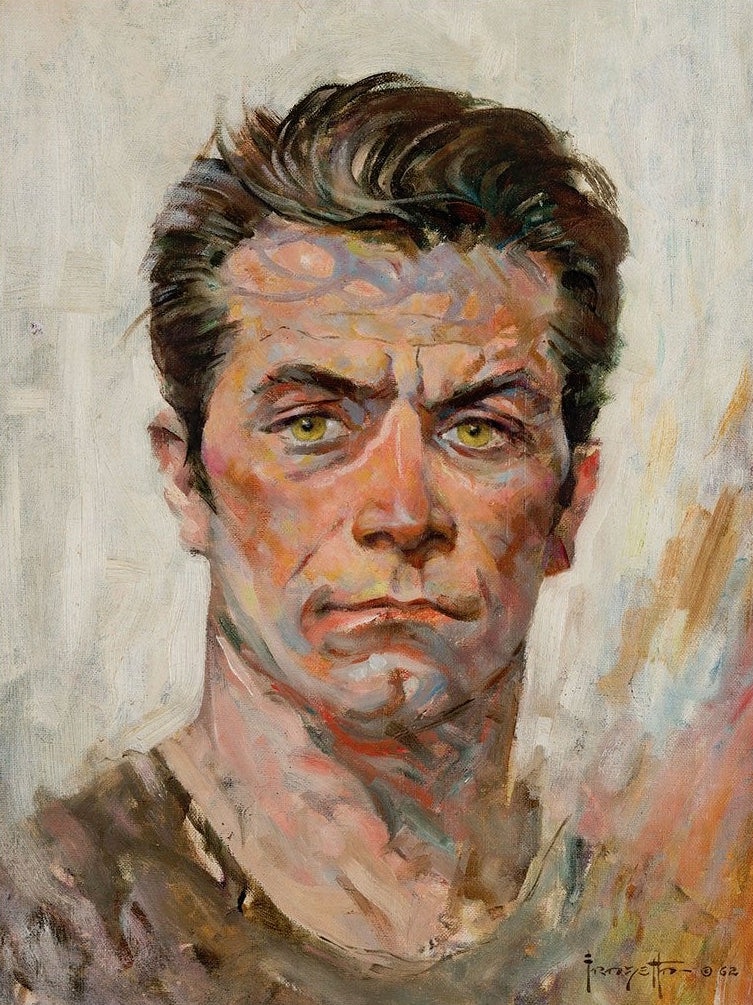
Frank Frazetta
Fecha de nacimiento
February 9, 1928
Signo zodiacal
Aquarius
Lugar de nacimiento
Brooklyn, New York
Edad
Falleció a los 82
Estatura
5 ft 8 in (173 cm)
Acerca de
Frank Frazetta, nacido Francesco Alfredo Frazzetta el 9 de febrero de 1928 en Brooklyn, Nueva York, fue un pintor, escultor e ilustrador estadounidense que redefinió el arte fantástico y de ciencia ficción. Sus figuras dinámicas y musculosas y sus paisajes vívidos se convirtieron en el estándar visual del género, ganándose el título no oficial de "Padrino del arte fantástico". El trabajo de Frazetta abarcó cómics, portadas de libros de bolsillo, pinturas, pósteres, portadas de discos de vinilo y más, convirtiéndolo en uno de los ilustradores más influyentes del siglo XX.
La carrera de Frazetta comenzó temprano; estudió en la Brooklyn Academy of Fine Arts y ya en su adolescencia trabajaba para editoriales de cómics como DC y Marvel. Alcanzó la fama en las décadas de 1960 y 1970 por sus icónicas portadas de las novelas de Conan el Bárbaro de Robert E. Howard, así como por las series de Tarzán y John Carter de Marte de Edgar Rice Burroughs. Sus pinturas, como "The Death Dealer" y "Egyptian Queen", se volvieron legendarias, y su estilo influyó enormemente en el arte de portadas de heavy metal, carteles de películas e ilustración fantástica. En 2003, fue el tema del documental Painting with Fire.
El impacto de Frazetta fue reconocido con numerosos honores. Fue incluido en el Will Eisner Comic Book Hall of Fame en 1995, el Jack Kirby Hall of Fame en 1999, el Society of Illustrators Hall of Fame en 2009 y el Science Fiction Hall of Fame en 2014. La World Fantasy Convention le otorgó un Life Achievement Award en 1995. También recibió el Inkpot Award en 1975 y el Spectrum Grandmaster Award en 2005. Frazetta falleció el 10 de mayo de 2010 a los 82 años, dejando un legado que moldeó la forma en que generaciones imaginan héroes, monstruos y reinos de otro mundo.
Su trabajo apareció en innumerables portadas de libros, pósteres y álbumes, y sus pinturas originales ahora se venden por millones en subastas. La influencia de Frazetta se puede ver en el cine, los videojuegos y el arte fantástico moderno, demostrando que su estilo audaz y visceral sigue siendo atemporal. Rolling Stone incluyó su "The Death Dealer" como una de las mejores portadas de álbumes de todos los tiempos en 2011, Entertainment Weekly lo clasificó como el #1 en su lista de "Top 10 Fantasy Artists" en 2009, y Heavy Metal Magazine lo nombró el "Greatest Fantasy Artist of All Time" en 2010.
Primeros años y orígenes
Frazetta creció en un hogar pobre de inmigrantes sicilianos en Brooklyn. Fue hijo único; su padre trabajaba como obrero y su madre fomentó su temprano dibujo. A los ocho años, obtuvo una beca completa para la Brooklyn Academy of Fine Arts, donde estudió bajo el pintor italiano Michele Falanga. A los 15 años, ya producía trabajos profesionales de cómics para Fawcett Comics, contribuyendo a Captain Marvel y Wambi the Jungle Boy. Abandonó la escuela a los 16 para dedicarse al arte a tiempo completo.
Un chico callejero que a menudo se peleaba, Frazetta canalizó esa energía cruda en sus dibujos. En la década de 1940, trabajó para DC Comics en Flash Gordon y Buck Rogers, y para Marvel (entonces Timely Comics) en personajes como Capitán América y la Antorcha Humana. Un momento crucial llegó en 1954 cuando Al Capp lo contrató como asistente en la tira cómica Li'l Abner, proporcionándole ingresos estables y exposición nacional durante siete años. Frazetta fue un campeón de levantamiento de pesas que ganó el título de Mr. Brooklyn en 1950. También boxeó y una vez entrenó con Rocky Marciano. Su mano izquierda estaba parcialmente paralizada por una lesión infantil, por lo que dependía de su mano derecha para dibujar.
Trayectoria profesional
El gran avance de Frazetta llegó en 1964 cuando creó el cartel de la película What's New Pussycat?, su primer encargo importante para el cine. Dos años después, su portada para Conan the Adventurer de Robert E. Howard se convirtió en la imagen definitiva del personaje y lanzó su carrera en el arte fantástico. Durante la década de 1970, produjo portadas legendarias para Tarzán, John Carter de Marte y su propia creación The Death Dealer (1973).
Su trabajo se extendió a portadas de álbumes para Molly Hatchet, Yngwie Malmsteen y Wolfmother. La pintura Egyptian Queen (1975) estableció récords en subastas. El estilo de Frazetta dominó la ilustración fantástica durante décadas, y continuó pintando hasta los años 2000. Rechazó una oferta para trabajar en el arte conceptual de Star Wars en 1976, prefiriendo sus propios proyectos. Tras su muerte en 2010, su patrimonio continúa licenciando su arte para videojuegos como Conan Exiles y Path of Exile. En 2024, el Museo Frazetta reabrió tras renovaciones, con una nueva galería de obras originales. Un nuevo documental, "Frazetta: The Wild Man of Fantasy Art", fue anunciado para su lanzamiento en 2026.
Cronología profesional
Imagen pública y estilo
El estilo característico de Frazetta presenta figuras hipermusculosas, iluminación dramática y energía primitiva, centrado en temas bárbaros y fantásticos. Es venerado como el "Padrino del Arte Fantástico" y el ilustrador fantástico más influyente del siglo XX. Los fanáticos, a menudo llamados "Frazetta-heads", coleccionan impresiones originales y recuerdos, y se celebran convenciones anuales en el Museo Frazetta. Las cuentas oficiales de redes sociales comparten su arte e historia en un tono reverente y educativo. Su trabajo sigue inspirando cosplay, estéticas de heavy metal y cine fantástico. En 2026, la página oficial de Facebook tiene 1,2 millones de seguidores, Instagram @frazettaart tiene 800.000 seguidores, Twitter/X @FrazettaArt tiene 150.000 seguidores y YouTube tiene 50.000 suscriptores.
Fama y fandom
The 2025 sale of a single Conan painting for $13.5 million proved that Frank Frazetta's mythos transcends mere illustration to become high-stakes financial legend. His legacy is defined by the enduring power of his imagery rather than public appearances or social media campaigns. The artist remains largely absent from the modern digital conversation, yet his influence permeates rock culture and fantasy cinema through adaptations like the 2026 review of Fire and Ice. Despite this massive cultural footprint, iFANN's Global Fame Engine evaluated Frank Frazetta in August 2026 and found he does not currently hold a placement in the published rankings. He is not listed among the Global Top 1,000 or any scope-specific top-100 lists. This absence reflects his status as a historical titan rather than a current trending subject; the rankings capture active, real-time global engagement, while Frazetta operates on a different timeline of reverence. His followers do not gather under a formal banner or organized club name. Collectors, comic historians, and fantasy devotees simply call themselves fans of the Godfather of Fantasy Art. They drive record-breaking auction prices and sustain the community around the Frazetta Museum, but they lack the coordinated rituals seen in younger fandoms. The official accounts managed by his daughters serve as archives rather than interactive hubs. There are no documented fan campaigns, birthday billboards, or viral pushes originating from his base. The fandom exists as a quiet, dedicated network of high-end collectors who keep the flame alive through secondary market transactions and museum visits. The legend persists because the art itself demands attention, requiring no external noise to validate its greatness.
Datos interesantes y leyendas
The helmeted figure known as The Death Dealer is actually a self-portrait where the visor reveals Frazetta's own face. Fans still retell the story of how the original Egyptian Queen was stolen in 1976 and only recovered forty-two years later in 2018. A heavy smoker and drinker throughout his life, Frazetta saw his health decline until a stroke took him on May 10, 2010, in Fort Myers, Florida, at age 82. Standing at 5 feet 8 inches, he remained a reclusive figure who rarely made public appearances. His famous quotes reveal a stubborn independence: "I paint what I want to paint. If it sells, fine. If not, I still paint it." Modern lore centers on the September 15, 2025, auction of his 1967 painting Conan the Barbarian, which shattered records by selling for $13.5 million at Heritage Auctions. Another chapter of this legend emerged in March 2026 when a 1991 Vampirella cover, altered by Frazetta to remove the central figure's clothes, reportedly fetched $3.1 million. In late 2025, Metallica guitarist Kirk Hammett announced the auction of his personal collection of Conan the Conqueror paintings, further cementing the artist's iconic status within rock and fantasy circles.
Frases destacadas
“I paint what I want to paint. If it sells, fine. If not, I still paint it.”
“I never considered myself a fantasy artist. I just paint what's in my head.”
“Conan was the perfect subject for me. He was a barbarian, a force of nature. I understood that.”
“I've been drawing since I was two years old. I never stopped.”
Familia y vida personal
Frazetta se casó con Eleanor "Ellie" Kelly en 1956. Ella fue su gerente de negocios y musa, y tuvieron cuatro hijos: Frank Jr., Billy, Heidi y Al. La muerte de Ellie por cáncer en julio de 2009 devastó a Frazetta; él falleció poco más de un año después. El patrimonio es administrado por sus hijos Frank Jr. y Billy, quienes han estado involucrados en disputas legales por el control. El Museo Frazetta en East Stroudsburg, Pensilvania, alberga muchas de sus obras y es gestionado por la familia.
Conexiones destacadas
Frazetta fue mentorizado por Al Capp, quien lo contrató para Li'l Abner. Sus icónicas portadas para Conan de Robert E. Howard y para Tarzán y John Carter de Edgar Rice Burroughs definieron visualmente esos personajes. Creó portadas de álbumes para los músicos Yngwie Malmsteen y Molly Hatchet. Su hijo Frank Frazetta Jr. gestiona el patrimonio.
Relaciones e historial sentimental
Frazetta se casó con Eleanor "Ellie" Kelly en 1956. Se conocieron en Nueva York, y ella gestionó su carrera y finanzas durante sus 53 años de matrimonio. La pareja tuvo cuatro hijos: Frank Jr., Billy, Heidi y Al. Ellie falleció de cáncer en julio de 2009, dejando a Frazetta profundamente deprimido. Nunca volvió a casarse y murió poco más de un año después, el 10 de mayo de 2010. No se documentan otras relaciones románticas públicas; Frazetta fue monógamo y devoto de Ellie. En 2026, está fallecido y era viudo al momento de su muerte.
- Casado/aEleanor Kelly1956 - 2009Se conocieron en Nueva York; ella gestionó su carrera y finanzas. Tuvieron cuatro hijos juntos. Terminó con su muerte por cáncer.
Muerte y repercusiones
Fallecimiento
May 10, 2010 (a los 82 años)
Lugar de fallecimiento
Medford, New York, USA
Causa de la muerte
Complications from diabetes and heart disease
Frank Frazetta spent his final years in a quiet Medford home on Long Island, managing his estate and tending to his art alongside his wife Maryann and daughter Jennifer. On May 10, 2010, the legendary artist passed away at age 82 within that residence. The immediate reaction rippled through the comic book and fantasy communities, where peers like John Buscema and Roy Thomas issued tributes honoring him as the father of modern fantasy art. Institutions such as the Society of Illustrators highlighted his induction into their Hall of Fame, while fans gathered informally at conventions to share memories. His funeral was a private ceremony held shortly after his passing, adhering to the family's wish for privacy. He was cremated and laid to rest at Calverton National Cemetery in New York. Posthumously, the Frank Frazetta Foundation emerged in 2011 to support emerging artists, while his works continued to command record prices at auction.
Patrimonio neto (valor de la herencia)
$12 Million
Estimación del equipo editorial de iFANN
Per iFANN's editorial analysis, Frank Frazetta's estate holds a value of $12 Million as of 2026. Revenue streams include posthumous print sales where limited editions command between $500 and $5,000 each. Licensing agreements for merchandise, posters, T-shirts, and collectibles generate an estimated $1–2 million annually. Original paintings continue to fetch millions at auction, with The Death Dealer reaching $1.2 million in 2018 and Egyptian Queen selling for $1.8 million in 2020. The Frazetta Museum in East Stroudsburg, Pennsylvania, contributes income through admission fees and merchandise sales. Book royalties from art books and calendars, alongside film and TV licensing deals for his imagery in movies and video games, add further financial weight. The estate is managed by his children, specifically Frank Frazetta Jr. and Billy Frazetta.
Premios ganados (7)
Frazetta recibió el Premio a la Trayectoria de la Convención Mundial de Fantasía en 1995. Fue incluido en el Salón de la Fama del Cómic Will Eisner (1995), el Salón de la Fama Jack Kirby (1999), el Salón de la Fama de la Sociedad de Ilustradores (2009) y el Salón de la Fama de la Ciencia Ficción (2014, póstumamente). También ganó el Premio Inkpot en 1975 y el Premio Grandmaster Spectrum en 2005.
2014 · Inducción
2009 · Inducción
Conocido por
Conan the Barbarian
1966 · Cover artist
The Death Dealer
1973 · Painter
Egyptian Queen
1975 · Painter
Tarzan
1970 · Cover artist
John Carter of Mars
1970 · Cover artist
Palabras clave
Datos rápidos
- Profesión
- painter, sculptor, illustrator
- Nacimiento
- +1928-02-09
- Lugar de nacimiento
- Brooklyn
- Fallecimiento
- +2010-05-10
- Lugar de fallecimiento
- Fort Myers
- Género
- Hombre
- Signo zodiacal
- Aquarius
Datos personales
- Nombre completo
- Francesco Alfredo Frazzetta
- Estatura
- 5 ft 8 in (173 cm)
- Cónyuge
- Eleanor Kelly
- Hijos
- Frank Jr., Billy, Heidi, Al
- Educación
- Brooklyn Academy of Fine Arts
Preguntas frecuentes
¿Cómo murió Frank Frazetta?
¿Cuánto vale una pintura original de Frank Frazetta?
¿Estuvo casado Frank Frazetta?
¿Cuál es la pintura más famosa de Frank Frazetta?
¿Trabajó Frank Frazetta para Marvel?
Redes sociales
Únete a la comunidad
fans comentando