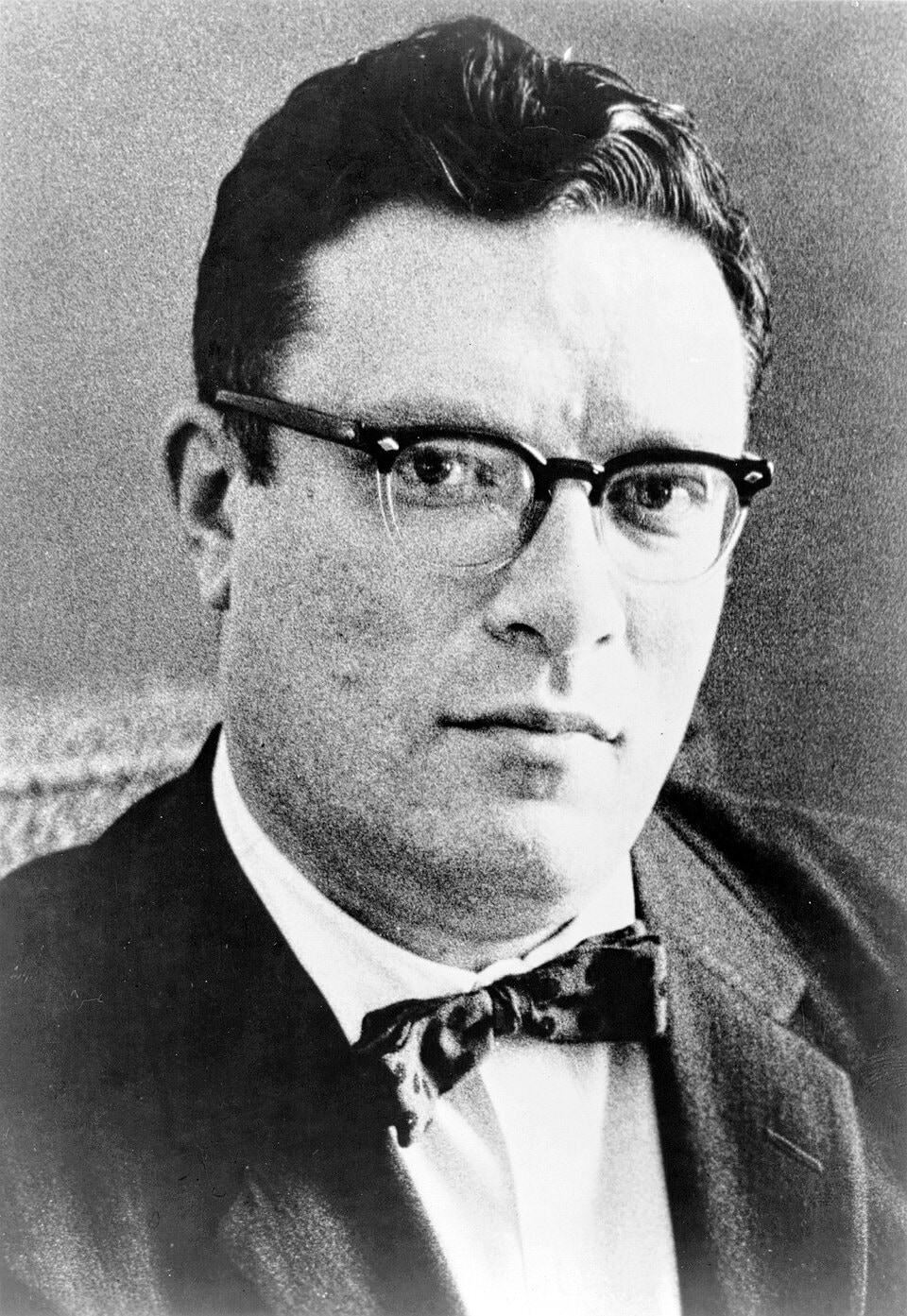
Isaac Asimov
 Russia
biochemist•novelist•prose writer
Also known as: Paul French
Fecha de nacimiento
January 2, 1920
Signo zodiacal
Capricorn
Lugar de nacimiento
Petrovichi, Smolensk Governorate, Russian SFSR
Edad
Falleció a los 72
Estatura
5 ft 9 in (175 cm)
Acerca de
Isaac Asimov fue un bioquímico estadounidense y uno de los escritores más prolíficos del siglo XX, conocido principalmente por sus obras de ciencia ficción, en particular las series Foundation y Robot. Escribió o editó más de 500 libros y unas 90.000 cartas y postales, abarcando ciencia ficción, divulgación científica, misterio, fantasía y no ficción sobre temas que van desde la Biblia hasta Shakespeare. Sus Tres Leyes de la Robótica siguen siendo un concepto fundamental tanto en la literatura como en la robótica real. La escritura de Asimov se caracteriza por una prosa clara y conversacional y un profundo optimismo sobre el progreso humano a través de la ciencia y la razón. Fue presidente de la Asociación Humanista Estadounidense y recibió numerosos premios, incluidos múltiples premios Hugo y Nebula. A partir de 2026, su legado continúa a través de adaptaciones en curso como la serie Foundation de Apple TV+, que ha presentado su obra a una nueva generación.
Primeros años y orígenes
Asimov nació en Petrovichi, una pequeña aldea en Rusia, y emigró con su familia a Brooklyn, Nueva York, en 1923. Sus padres poseían una serie de tiendas de golosinas, donde el joven Isaac aprendió a leer a los cinco años. Las revistas pulp vendidas en la tienda despertaron su amor de por vida por la ciencia ficción. Comenzó a escribir sus propias historias a los 11 años. Un momento clave ocurrió en 1938 cuando conoció a John W. Campbell, editor de Astounding Science Fiction, quien se convirtió en su mentor. Su primer relato publicado, «Marooned off Vesta», apareció en Amazing Stories en 1939. Asimov obtuvo una licenciatura (1939), una maestría (1941) y un doctorado en Bioquímica (1948) de la Universidad de Columbia, todo mientras escribía ciencia ficción como actividad paralela.
Trayectoria profesional
El gran avance de Asimov llegó en 1941 con el relato «Nightfall», que fue votado como el mejor cuento de ciencia ficción de todos los tiempos por la Asociación de Escritores de Ciencia Ficción de Estados Unidos. Durante la Segunda Guerra Mundial, trabajó en la Estación Experimental Aérea Naval de Filadelfia, junto a los colegas escritores Robert Heinlein y L. Sprague de Camp. Después de la guerra, se unió a la facultad de la Escuela de Medicina de la Universidad de Boston en 1949. Sus obras principales incluyen la trilogía Foundation (1951–1953), que ganó un premio Hugo especial a la Mejor Serie de Todos los Tiempos en 1966, y las novelas de Robot que comienzan con The Caves of Steel (1954). En 1972, The Gods Themselves ganó tanto el premio Hugo como el Nebula. Asimov se convirtió en escritor a tiempo completo en 1958, escribiendo una columna mensual de ciencia para The Magazine of Fantasy & Science Fiction durante más de 30 años. Sus novelas posteriores, como Foundation's Edge (1982), se convirtieron en superventas del New York Times. En 1986, Foundation and Earth unificó sus series de Robot, Imperio y Foundation en una sola línea temporal.
Cronología profesional
Imagen pública y estilo
Asimov es recordado como un intelectual amable, brillante e increíblemente prolífico con un desarmante sentido del humor. Su imagen pública era la de un genio amigable y accesible que podía explicar ciencia compleja en términos simples. A menudo se le llamaba el «padre de la robótica moderna» debido a sus Tres Leyes. Sus fans, conocidos como «asimovianos», celebran su obra mediante lecturas anuales de relatos como «Nightfall» y «The Last Question». Los debates sobre las Tres Leyes siguen siendo un elemento básico en los foros de fans. El canal oficial de YouTube de la herencia conserva sus conferencias y entrevistas, manteniendo un tono archivístico y académico.
Fama y fandom
The audience for Isaac Asimov's work defies the modern model of a celebrity cult. There is no formal name for his followers, no organized fanbase structure, and no specific rituals or hashtags that define their community. Instead, his legacy rests on a quiet, enduring reverence from readers who view him as a foundational architect of science fiction rather than a pop culture icon with a dedicated following. His relationship with the public was defined by an educational mission; he introduced terms like "positronic" and "psychohistory" into the English language, creating the very vocabulary that fans use today without ever needing to engage in direct fan service or interactive campaigns. The most iconic moments surrounding him are intellectual rather than physical, his appearance on The David Letterman Show where he discussed his medical predictions remains a legendary clip, and his lament about the "Cult of Ignorance" has been revived as a viral anecdote in recent years. While stories circulate about crowds reacting to his presence, the reality is that his fame stems from a vast bibliography of over 500 books that continue to shape the genre decades after his passing. He stands as a figure whose influence permeates the culture through ideas rather than stage appearances. This enduring global attention places him firmly within the current metrics of fame. He is currently ranked as the 20th most famous person from Russia, a position holding steady from the previous cycle according to the iFANN Global Fame Rankings.
Datos interesantes y leyendas
Isaac Asimov possessed a unique psychological profile, being a claustrophile who loved enclosed spaces yet harbored a deep terror of flying. A true polyglot, he spoke English, Yiddish, Russian, and some French and German. In 1941, he coined the term "robotics" in his story "Liar!" and wrote the Lucky Starr juvenile novels under the pen name Paul French. He once penned a limerick about himself: "There once was a writer named Asimov / Whose writing was quite a great prism of / All things bright and new / From the Robot to You / And the Foundation of all that is his." Beyond fiction, he authored guides to both the Bible and Shakespeare. A widely retold legend involves his appearance on The David Letterman Show, where he shared his vision of future medicine and communications, a moment that has garnered millions of views years later. Another persistent story features his 1980 quote decrying the "Cult of Ignorance" in the United States, which has recently been revived in commentary to critique societal trends. These intellectual milestones cement his status as a visionary whose concepts, such as the Three Laws of Robotics and Psychohistory, have become part of scientific mythology.
Frases destacadas
“The most exciting phrase to hear in science, the one that heralds new discoveries, is not 'Eureka!' but 'That's funny...'”
“I do not fear computers. I fear the lack of them.”
“Violence is the last refuge of the incompetent.”
“Self-education is, I firmly believe, the only kind of education there is.”
Familia y vida personal
Los padres de Asimov fueron Judah Asimov y Anna Rachel Berman, inmigrantes judíos de Rusia. Tuvo una hermana menor, Marcia. Se casó con Gertrude Blugerman en 1942; tuvieron dos hijos, David (nacido en 1951) y Robyn Joan (nacida en 1955). El matrimonio terminó en divorcio en 1973. Ese mismo año, se casó con Janet Opal Jeppson, psiquiatra y escritora. Janet editó varias de sus obras póstumas y escribió su propia ciencia ficción. La hija de Asimov, Robyn, gestiona su legado literario.
Conexiones destacadas
Asimov fue mentoreado por el editor John W. Campbell. Formó parte de los «Tres Grandes» de la ciencia ficción junto a Arthur C. Clarke y Robert A. Heinlein. Su segunda esposa, Janet Asimov, fue escritora y editora. Su hija Robyn Asimov gestiona su legado literario.
Relaciones e historial sentimental
Asimov se casó con Gertrude Blugerman en 1942 tras conocerse en una cita a ciegas. Tuvieron dos hijos, David y Robyn, pero el matrimonio se vio afectado por la infidelidad de Asimov y su exigente horario de trabajo. Se divorciaron en 1973. Ese mismo año, se casó con Janet Opal Jeppson, psiquiatra y escritora con quien había tenido una aventura antes del divorcio. Janet se convirtió en su compañera de por vida y editó varias de sus obras póstumas. Asimov permaneció casado con Janet hasta su muerte en 1992. No tuvo más relaciones después de su matrimonio con Janet.
- Casado/aGertrude Blugerman1942 - 1973Se conocieron en una cita a ciegas; tuvieron dos hijos; se divorciaron por infidelidad y presiones laborales.
- Casado/aJanet Opal Jeppson1973 - 1992ActualPsiquiatra y escritora; editó sus obras póstumas; permaneció casada hasta su muerte.
Muerte y repercusiones
Fallecimiento
April 6, 1992 (a los 72 años)
Lugar de fallecimiento
New York City, New York, USA
Causa de la muerte
Heart failure due to HIV/AIDS complications
Isaac Asimov died on April 6, 1992, at his home in New York City. The official cause was heart failure resulting from complications of HIV/AIDS, a condition contracted through blood transfusions during heart surgery in 1983. He had lived with the illness for several years while keeping the diagnosis private until shortly before his passing, and his final days were spent under the care of his wife Janet and close friends. Tributes poured in immediately from peers like Arthur C. Clarke and Robert Silverberg, while libraries and bookstores held moments of silence and fan gatherings featured black ribbons. Sales of his major works surged as reprints of the Foundation series and I, Robot became bestsellers.
A private funeral service took place on April 9, 1992, at the Riverside Memorial Chapel in New York City, attended by family including his daughter Robyn and wife Janet. Following the service, Asimov was cremated and his ashes were scattered over the Hudson River near his Manhattan home. No public eulogies were delivered to reflect the family's desire for a low-key departure. Posthumous releases included collections of his letters and essays, while the estate managed by Robyn oversaw new adaptations like the Apple TV+ series Foundation. He has since been inducted into the Science Fiction Hall of Fame and the Mystery Writers of America Hall of Fame, with scholarships established to support aspiring writers.
Patrimonio neto (valor de la herencia)
$12 Million
Estimación del equipo editorial de iFANN
Per iFANN's editorial analysis, the estate of Isaac Asimov is valued at $12 Million as of 2026. This wealth derives primarily from ongoing royalties generated by his extensive bibliography of over 500 books, which maintain strong sales worldwide. Licensing agreements for film and television adaptations, specifically Apple TV+'s Foundation series (2021–present), have introduced significant new revenue streams for the estate. Additional income flows from the continued sale of his short stories and nonfiction works. Robyn Asimov manages the estate on behalf of the family. No major catalog sales or legal settlements have been reported. The estate's value has seen modest growth since his death, driven largely by renewed interest sparked by the television adaptation.
Premios ganados (22)
Asimov ganó múltiples premios Hugo y Nebula, incluidos los Premios Hugo a la Mejor Novela por The Gods Themselves (1973) y Foundation's Edge (1983), y un Hugo especial en 1963 por añadir ciencia a la ciencia ficción. Su trilogía de la Fundación recibió un Hugo único a la Mejor Serie de Todos los Tiempos en 1966. También ganó Premios Nebula por The Gods Themselves y The Bicentennial Man, junto con varios Premios Locus y un Hugo Retroactivo en 2016 por 'Robbie'.
1995 · Mejor Libro Relacionado
I. Asimov: A Memoir
1992 · Mejor Libro de No Ficción
Asimov: A Memoir
Conocido por
Foundation series
1951 · Autor
Robot series
1950 · Autor
I, Robot
1950 · Autor
The Gods Themselves
1972 · Autor
Nightfall
1941 · Autor
Palabras clave
Datos rápidos
- Profesión
- biochemist, novelist, prose writer
- Nacimiento
- +1920-01-02
- Lugar de nacimiento
- Petrovichi
- Fallecimiento
- +1992-04-06
- Lugar de fallecimiento
- Manhattan
- Género
- Hombre
- Cónyuge
- Janet Asimov, Gertrude Asimov
- Signo zodiacal
- Capricorn
Datos personales
- Nombre completo
- Isaak Yudovich Ozimov
- Estatura
- 5 ft 9 in (175 cm)
- Cónyuge
- Janet Opal Jeppson (m. 1973–1992), Gertrude Blugerman (m. 1942–1973)
- Hijos
- David Asimov (son), Robyn Joan Asimov (daughter)
- Educación
- Columbia University (B.S., M.A., Ph.D. in Biochemistry)
Preguntas frecuentes
¿Cuál es la obra más famosa de Isaac Asimov?
¿Cuáles son las Tres Leyes de la Robótica?
¿Cuántos libros escribió Isaac Asimov?
¿Cuándo y cómo murió Isaac Asimov?
¿Fue Isaac Asimov profesor?
Redes sociales
Personas similares
Únete a la comunidad
fans comentando