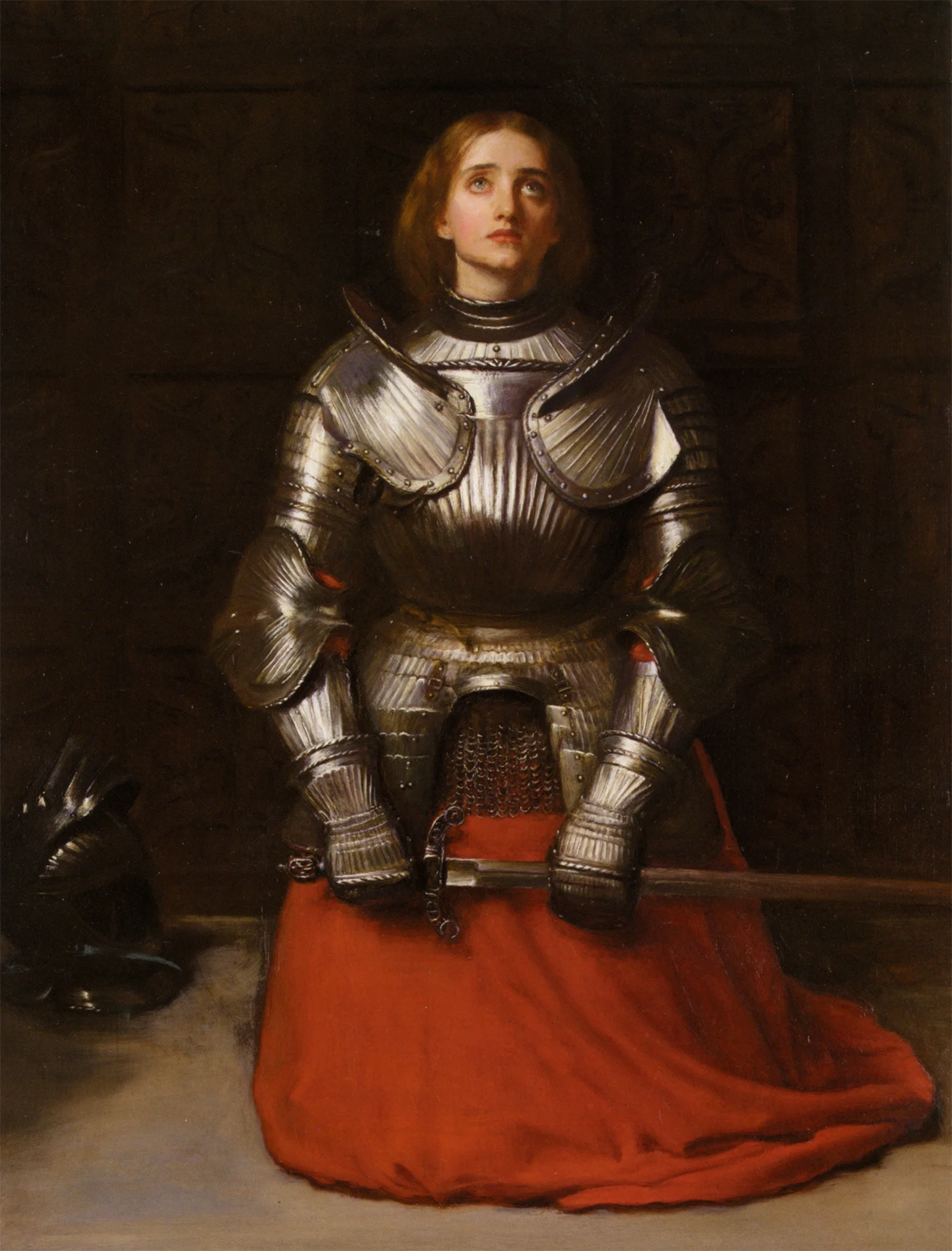
Joan of Arc
 France
military personnel•religious leader
Also known as: The Maid of Orléans, Jeanne d'Arc, Saint Joan of Arc
Fecha de nacimiento
January 6, 1412
Signo zodiacal
Capricorn
Lugar de nacimiento
Domrémy-la-Pucelle
Edad
Falleció a los 19
Estatura
5 ft 0 in (152 cm)
Acerca de
Joan of Arc was a national heroine of France and a canonized Catholic saint, remembered as the teenage peasant girl who helped turn the tide of the Hundred Years' War. Born around 1412 in the village of Domrémy, she claimed to receive visions from saints and the archangel Michael instructing her to drive the English from France and see the disinherited Charles VII crowned king. That conviction, extraordinary in a young woman of no rank, propelled her from rural obscurity to the center of a nation's struggle.
Her legend rests on a stunning few years of action. Granted an audience with Charles and given a role in the army, she helped lift the siege of Orléans and inspired a demoralized French force to a string of victories that opened the road to Reims, where Charles was crowned. Captured by Burgundian forces and handed to the English, she was tried by a church court and burned at the stake in 1431, not yet twenty years old. Decades later her conviction was overturned, and centuries after that she was declared a saint.
Joan endures as one of history's most compelling figures, a symbol of faith, courage, and patriotism whose story has inspired countless retellings in books, films, and art. Her feast day is May 30, and she is the patron saint of soldiers, prisoners, and France.
Primeros años y orígenes
Juana creció en Domrémy, un pequeño pueblo en la región de Lorena, en el noreste de Francia, durante la Guerra de los Cien Años. Sus padres, Jacques d'Arc e Isabelle Romée, eran agricultores arrendatarios que criaban ganado y cultivaban la tierra. El pueblo se encontraba en el Ducado de Bar, cuya gente permaneció leal a la facción armagnac a pesar de estar rodeado de territorios pro-borgoñones. En 1425, Domrémy fue atacada y se robaron ganado, endureciendo el sentimiento local contra los ingleses y sus aliados borgoñones.
Juana nunca aprendió a leer ni a escribir. Su madre le enseñó habilidades domésticas como coser y hilar, y ella ayudó a su padre en los campos y cuidó de los animales. La familia asistía a la iglesia regularmente, y Juana recibió una sólida educación religiosa. Alrededor de los 13 años, comenzó a tener visiones y a oír voces que creía divinas. Informó haber visto a San Miguel Arcángel, Santa Catalina y Santa Margarita, quienes inicialmente le instruyeron a ser buena e ir a la iglesia. Con el tiempo, las voces se volvieron más urgentes, diciéndole que tenía una gran misión: expulsar a los ingleses de Francia y ver al Delfín Carlos coronado rey en Reims.
Aproximadamente a los 16 años, Juana decidió actuar. Se acercó al comandante local en Vaucouleurs, Robert de Baudricourt, solicitando una escolta para llevarla a la Corte Real. Él la desestimó dos veces, pero ella persistió y finalmente obtuvo una audiencia con el Delfín en Chinon a principios de 1429.
Trayectoria profesional
Juana llegó a Chinon en febrero de 1429 y convenció a Carlos VII para que le permitiera unirse al esfuerzo bélico. Teólogos de Poitiers la examinaron y no encontraron maldad, por lo que se le dio armadura, un estandarte con la flor de lis y los nombres de Jesús y María, y un caballo blanco. Su primera gran acción llegó en el Asedio de Orléans en abril-mayo de 1429. Liderando a tropas francesas desmoralizadas, las inspiró a levantar el asedio en nueve días, un punto de inflexión en la guerra. La victoria le valió el apodo de La Doncella de Orléans.
Después de Orléans, Juana lideró la campaña del Valle del Loira, capturando Jargeau y ganando la Batalla de Patay en junio de 1429. Estas victorias abrieron el camino a Reims, donde Carlos VII fue coronado rey el 17 de julio de 1429, con Juana a su lado sosteniendo su estandarte. En mayo de 1430, durante una escaramuza en Compiègne, fue arrojada de su caballo y capturada por fuerzas borgoñonas, quienes la vendieron a los ingleses. Fue juzgada por herejía por un tribunal eclesiástico en Ruan a partir del 9 de enero de 1431. Condenada por usar ropa de hombre y actuar por visiones demoníacas, fue quemada en la hoguera el 30 de mayo de 1431, a la edad de 19 años. Un juicio de nulidad en 1456 anuló la condena, y fue canonizada en 1920.
Cronología profesional
Imagen pública y estilo
Juana es representada típicamente en armadura con un estandarte blanco que lleva la flor de lis, a menudo con el pelo corto y vistiendo ropa de hombre. Se la representa como un símbolo de coraje, fe, patriotismo y convicción divina. Su imagen ha sido interpretada en cientos de películas, obras de teatro, libros y obras de arte, que van desde mártir religiosa hasta icono feminista o heroína militar. Los católicos la veneran como santa, mientras que los nacionalistas franceses la celebran como heroína. Las celebraciones anuales en su día festivo, el 30 de mayo, incluyen peregrinaciones a Domrémy y Ruan, recreaciones históricas y conferencias académicas. Las narraciones educativas se centran en la precisión histórica, mientras que las narraciones católicas enfatizan su significado espiritual.
Fama y fandom
Joan of Arc commands a devotion that transcends the modern definition of fandom. There is no organized group calling themselves by a specific name, nor are there fan-funded subway ads or birthday billboards for the 15th-century peasant girl turned military leader. Instead, her following consists of devotees, historians, and cultural admirers who interact with her legacy through religious veneration and academic study. Her story serves as a narrative of resilience against occupation and injustice, inspiring individuals facing oppression to seek moral courage. Communities gather today not to stream a new single, but to reflect on themes of saintly patriotism and divine guidance in theatrical productions and theological discussions. This enduring reverence functions as a form of worship rather than celebrity worship, cementing her status as a symbol of freedom and independence across centuries. The iFANN Global Fame Rankings track this unique blend of historical weight and cultural consumption worldwide. Joan of Arc is currently the 368th most famous person in the world, holding steady from the previous cycle. She ranks as the 20th most famous person in France and stands as the 15th most famous person from France. In Europe, she holds the position of the 92nd most famous person in Europe. Within the pop culture sphere, she is recognized as the 72nd most famous person in Pop.
Datos interesantes y leyendas
Joan dictated her letters to scribes because she could not write herself. Her trial transcript remains one of the most complete medieval documents, preserving extensive eyewitness accounts of her proceedings. She wore men's clothing, a choice that became a central charge during her trial. The French royal family paid a ransom of 10,000 livres after her capture, yet the English refused to release her. Her birthplace, Domrémy, was renamed Domrémy-la-Pucelle in her honor. She correctly predicted the outcome of a military engagement at Orléans, which convinced Charles VII of her divine mission. A sword she claimed was guided by voices was discovered behind the altar of the church of Sainte-Catherine-de-Fierbois. Legends still retell how her presence lifted the siege of Orléans, turning the tide of the Hundred Years' War despite her lack of military training. The story of her martyrdom, where she refused to recant her visions even under threat of death, defines her tragic arc. A posthumous retrial in 1456 declared her innocent, leading to her canonization as a saint in 1920.
Frases destacadas
“I am not afraid; I was born to do this.”
“If I am not, may God put me there; and if I am, may God keep me there.”
“Hold the standard in the battle, and it will touch the king's person. The standard belongs to the king. And for love of the standard, do not let it fall.”
“God has pity on the French. He wishes them to be free.”
“I would rather die than do something which I know to be a sin, or to be against God's will.”
Familia y vida personal
Juana nació de Jacques d'Arc, un granjero y funcionario del pueblo, e Isabelle Romée, quien le proporcionó educación religiosa. Tenía tres hermanos mayores, Jean, Pierre y Jacques, y una hermana mayor llamada Catherine. La familia vivía en una modesta casa en Domrémy y eran profundamente cristianos. Juana nunca se casó ni tuvo hijos. Hizo un voto de castidad como parte de su misión divina. Después de su muerte, su madre y hermanos participaron en la petición del juicio de nulidad.
Conexiones destacadas
La historia de Juana está profundamente ligada a Carlos VII, el Delfín a quien ayudó a coronar. Se opuso a ella el obispo Pierre Cauchon, quien presidió su juicio. Robert de Baudricourt, el comandante local de Vaucouleurs, inicialmente la rechazó y luego aprobó su misión. El Duque de Borgoña, Felipe el Bueno, cuyas fuerzas la capturaron, y el Rey Enrique VI de Inglaterra, cuya reclamación ella se opuso, fueron adversarios clave. Ella informó visiones de San Miguel, Santa Catalina y Santa Margarita.
Relaciones e historial sentimental
Juana de Arco nunca se casó y no tuvo relaciones románticas conocidas. Los registros históricos indican que, alrededor de los 16 años, su familia arregló un posible matrimonio, pero Juana se negó y impugnó con éxito el compromiso en un tribunal eclesiástico. Hizo un voto de castidad como parte de su misión divina. No hay registros históricos creíbles de ninguna relación romántica o sexual. Como santa canonizada y figura histórica, no tiene estado civil actual.
Muerte y repercusiones
Fallecimiento
May 30, 1431 (a los 19 años)
Lugar de fallecimiento
Rouen, Normandy
Causa de la muerte
Execution by burning at the stake
Immediate mourning was absent in the streets of Rouen, where many viewed her as a traitor or witch rather than a martyr. The public spectacle concluded with her body consumed by flames, leaving only ashes that were cast into the Seine River to prevent veneration as relics. On May 30, 1431, she stood bound to a post in the Old Market Square following a mass at the church of Saint-Sauveur, reciting the name of Jesus as the fire took hold. While some later accounts suggested she may have been strangled before the flames fully consumed her, this remains an unconfirmed detail within the trial transcripts. The legal aftermath transformed her legacy through the Nullification Trial initiated in 1455 by Pope Callixtus III at the request of her mother, Isabelle Romée.
This inquiry annulled the original verdict of heresy seven years after her death, declaring the proceedings procedurally flawed and politically motivated. Her family focused their efforts on justice and the restoration of her honor, which the papal ruling ultimately secured. Centuries later, the Catholic Church canonized her as a saint on May 16, 1920, establishing her feast day on May 30. Modern tributes include annual vigils, memorial murals, and artistic works like the 1928 silent film The Passion of Joan of Arc, cementing her status as a co-patroness of France.
Patrimonio neto (valor de la herencia)
$0
Estimación del equipo editorial de iFANN
Joan of Arc died in 1431 with no personal wealth. Per iFANN's editorial analysis, her net worth is estimated at $0. As a historical and religious figure, she has no living net worth. The Catholic Church manages her legacy through the veneration of saints. No monetary value is assigned to her historical legacy.
Premios ganados (1)
Juana de Arco no recibió honores formales durante su vida. Póstumamente, fue canonizada como santa por la Iglesia Católica en 1920 y es reconocida como heroína nacional de Francia.
1920 · Santidad
Life and martyrdom
Conocido por
Siege of Orléans
1429 · Líder militar
Coronation of Charles VII
1429 · Inspirational figure
Hundred Years' War
1429-1430 · Comandante militar
Palabras clave
Fuentes
Datos rápidos
- Profesión
- military personnel, religious leader
- Nacimiento
- January 6, 1412
- Lugar de nacimiento
- Domrémy-la-Pucelle
- Fallecimiento
- May 30, 1431
- Lugar de fallecimiento
- Rouen
- Género
- Mujer
Datos personales
- Nombre completo
- Jehanne d'Arc
- Estatura
- 5 ft 0 in (152 cm)
- Educación
- No formal education; could not read or write
Preguntas frecuentes
¿Juana de Arco fue realmente quemada en la hoguera?
¿Juana de Arco realmente escuchó voces?
¿Cuántos años tenía Juana de Arco cuando murió?
¿Por qué mataron a Juana de Arco?
¿Tuvo Juana de Arco hijos?
Personas similares
Únete a la comunidad
fans comentando