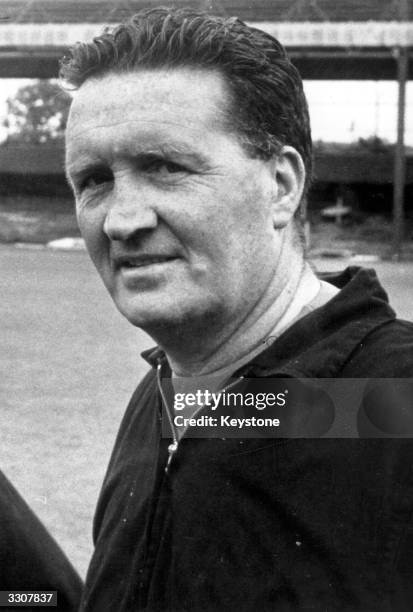
Jock Stein
 United Kingdom
futbolista•entrenador de fútbol
Fecha de nacimiento
October 5, 1922
Signo zodiacal
Libra
Lugar de nacimiento
Hamilton, South Lanarkshire, Scotland
Edad
Falleció a los 62
Acerca de
Jock Stein fue un futbolista y entrenador escocés que remodeló el deporte en su tierra natal. Nacido el 5 de octubre de 1922 en Hamilton, Lanarkshire, Stein trabajó como minero antes de hacerse profesional. Como defensa central, jugó para Albion Rovers, Llanelli Town y Celtic, ganando la Coronation Cup en 1953 y un doblete de liga y copa en 1954. Las lesiones de tobillo pusieron fin a su carrera como jugador en 1957, pero el Celtic lo mantuvo como entrenador del equipo de reserva.
La brillantez de Stein como entrenador surgió en el Dunfermline Athletic, donde ganó la Copa de Escocia en 1961. Tras un breve paso por el Hibernian, regresó al Celtic en marzo de 1965. Durante 13 años, construyó una dinastía: 10 títulos de liga escocesa, 8 Copas de Escocia, 6 Copas de la Liga y la Copa de Europa de 1967, la primera para cualquier club de Europa del Norte. Su equipo del Celtic, los Leones de Lisboa, sigue siendo legendario. Stein dirigió más tarde al Leeds United y a la selección nacional de Escocia, guiándolos a la Copa del Mundo de 1982. Murió de un ataque al corazón el 10 de septiembre de 1985, momentos después de que Escocia se clasificara para la Copa del Mundo de 1986.
Primeros años y orígenes
Stein creció en la comunidad minera de Burnbank durante la Gran Depresión, el único hijo entre cuatro hermanos. Su padre George trabajaba en las minas de carbón, y el joven Jock dejó la escuela Greenfield en Hamilton a los 15 años para ganarse la vida. Pasó un corto tiempo en una fábrica de alfombras antes de seguir a su padre bajo tierra.
El fútbol era su escape. En 1940, Stein aceptó fichar por el Burnbank Athletic, pero su padre se opuso, así que se unió al Blantyre Victoria, un club juvenil local. Continuó minando mientras jugaba a tiempo parcial. En 1942, pasó al Albion Rovers, todavía trabajando en las minas hasta 1949. Esos años de duro trabajo le dieron una fortaleza que definió su carrera posterior.
Trayectoria profesional
El gran avance de Stein como entrenador llegó en el Dunfermline Athletic. Se hizo cargo en 1960 y entregó el primer trofeo importante del club, la Copa de Escocia, en 1961. Siguieron campañas europeas, captando la atención del Celtic. Después de una breve pero exitosa etapa en el Hibernian, donde su equipo venció al Real Madrid en un amistoso, el Celtic lo nombró entrenador en marzo de 1965.
En menos de dos años, Stein había transformado al Celtic en campeón de Europa. El 25 de mayo de 1967, sus Leones de Lisboa vencieron al Inter de Milán por 2-1 en la final de la Copa de Europa, convirtiendo a Stein en el primer entrenador de Europa del Norte en ganar el trofeo. Esa temporada, el Celtic también ganó la Copa de Escocia, la Copa de la Liga y la Copa de Glasgow, una barrida limpia. Entre 1966 y 1974, ganaron nueve títulos de liga escocesa consecutivos, un récord que aún se mantiene. En total en el Celtic, Stein acumuló 10 títulos de liga, 8 Copas de Escocia y 6 Copas de la Liga. También llevó al club a una segunda final de la Copa de Europa en 1970, perdiendo por 2-1 ante el Feyenoord.
Después de dejar el Celtic en 1978, Stein dirigió al Leeds United durante dos meses antes de hacerse cargo de Escocia. Guió a la selección nacional a la Copa del Mundo de 1982 en España y estaba preparándose para el torneo de 1986 cuando murió.
Cronología profesional
Imagen pública y estilo
Stein fue venerado por su inteligencia táctica y gestión de jugadores. Construyó equipos dominantes con recursos limitados, a menudo explorando él mismo a los jugadores. Los medios de comunicación lo describieron como gregario y franco. Los aficionados del Celtic lo tienen en una estima casi sagrada, los Leones de Lisboa siguen siendo icónicos, y los aficionados cantan regularmente sobre Stein y el triunfo de 1967. Su persona combinaba la tenacidad de la clase trabajadora con una aguda visión futbolística.
Fama y fandom (iFAMOUS Rankings)
Jock Stein commands a legacy defined not by fleeting viral moments but by the enduring weight of two historical pillars: the 1967 European Cup triumph and his sudden death in 1985. His fanbase, inseparable from the Celtic identity known as the Hoops, treats him as a moral compass during times of club crisis. Rituals like the annual streaming campaigns for Thin Lizzy's "The Boys Are Back" keep the spirit of the Lisbon Lions alive every May, while his image remains omnipresent at Celtic Park. Fans invoke his name to bridge sectarian divides and demand unity, viewing him as the first Protestant manager to lead the historically Catholic club with meritocratic grace. The story of his heart attack in Cardiff stands as a tragic capstone to a life dedicated entirely to the game, turning his grave into a site of pilgrimage where reverence outweighs nostalgia. This deep cultural integration ensures that Stein is remembered not merely as a manager, but as a foundational element of Scottish football mythology. Despite this profound impact, iFANN's Global Fame Engine has evaluated Jock Stein but he does not currently hold a placement in the published rankings (Global Top 1,000 or a Top-100 scope list). The evaluation reflects a status where immense historical significance translates to steady, legacy-driven recognition rather than current trending volume.
Datos interesantes y leyendas
Born on October 5, 1922, in Hamilton, Lanarkshire, Stein worked as a coal miner until 1949 while playing for Albion Rovers. His transition from miner to manager began after ankle injuries ended his playing career in 1957. He famously opened the training ground each morning before anyone else arrived. Bill Shankly told him after the 1967 European Cup win, "Jock, you're immortal now." A bronze statue outside Celtic Park was unveiled in 2011, and Glasgow's Jock Stein Way bears his name. Stein was the first Protestant to manage Celtic, a decision that caused friction with some family members before establishing a legacy of meritocracy. Legends say he traveled hours to scout opponents personally. The defining moment of his career occurred on May 25, 1967, when he led Celtic to a 2–1 victory over Inter Milan in Lisbon, becoming the first British manager to win the European Cup. The squad was entirely Scottish-born, creating a mythos of a perfect team. His life ended tragically on September 10, 1985, when he suffered a fatal heart attack in the stands at Ninian Park while watching a World Cup qualifier between Wales and Scotland. Fans still retell this story to highlight his dedication to football until his final breath.
Frases destacadas
“Jock, you're immortal now., Bill Shankly to Stein after the 1967 European Cup win”
Familia y vida personal
Stein se casó con Jean McAuley en la década de 1940. Tuvieron dos hijos: Mary, nacida en 1947, y George, nacido en 1953. Jean fue su esposa hasta su muerte en 1985. La familia vivió en Glasgow durante sus años como entrenador. El padre de Stein, George, era minero de carbón, y su madre Jane Armstrong crió a cuatro hijos. Stein era el único hijo.
Conexiones destacadas
Stein fue un amigo cercano de Bill Shankly, otro minero escocés convertido en entrenador. Matt Busby y Alex Ferguson también lo admiraron; Ferguson consideraba a Stein un mentor. En el Celtic, su asistente Sean Fallon fue clave. Jugadores como Jimmy Johnstone y Billy McNeill definieron sus grandes equipos. Davie Cooper anotó el penalti que selló la clasificación de Escocia cuando Stein se derrumbó.
Relaciones e historial sentimental
Jock Stein estuvo casado con Jean McAuley. Se casaron en la década de 1940 y permanecieron juntos hasta la muerte de Stein en 1985. La pareja tuvo dos hijos: Mary (nacida en 1947) y George (nacido en 1953). No hay registros públicos documentados de otras relaciones románticas. Jean le sobrevivió.
- Casado/aJean McAuley1940 - 1985Casado en la década de 1940; permaneció casado hasta la muerte de Stein.
Muerte y repercusiones
Fallecimiento
September 10, 1985 (a los 62 años)
Lugar de fallecimiento
Cardiff, Wales, UK
Causa de la muerte
Acute cardiac event
Jock Stein stood on the touchline at Ninian Park in Cardiff, Wales, watching his Scotland team secure a 2, 1 victory over their hosts to clinch a spot in the 1986 FIFA World Cup. Moments after the final whistle blew, he complained of chest pain and collapsed before being rushed to the nearby University Hospital of Wales, where doctors pronounced him dead upon arrival. The cause was an acute cardiac event triggered by the exertion and emotional intensity of the match, a conclusion reached through immediate on-site observation and official statements rather than a public autopsy or coroner's inquest. The reaction across Scotland and the Celtic Football Club community was one of profound shock and national mourning.
Tributes poured in from peers and institutions immediately, with the BBC labeling the event a tragedy that left the nation reeling due to the irony of his death occurring just as his team achieved the qualification he had worked so hard for. Fans gathered spontaneously outside Ninian Park and Celtic Park in Glasgow to pay their respects, while a moment of silence was observed in subsequent matches across the United Kingdom and Europe. Stein's funeral took place four days later on September 14, 1985, at St. Peter's Church in Hamilton, followed by burial at the local cemetery. Thousands of mourners attended the procession, including former players from the 1967 European Cup-winning squad and prominent figures from the Scottish Football Association.
Posthumously, Stein remains the only manager to have led a club from a Northern European country to win the European Cup, earning induction into the Scottish Football Hall of Fame in 2003 and the erection of a statue outside Celtic Park. The Jock Stein Foundation was established to support young talent and charitable causes, ensuring his legacy endures within the footballing world.
Patrimonio neto (valor de la herencia)
$10 Million
Estimación del equipo editorial de iFANN
Jock Stein died in 1985, and his estate value is not publicly documented. As a football manager in Scotland from the 1960s to the 1980s, his earnings were modest by modern standards. Per iFANN's editorial analysis, his estimated net worth in 2026 is around $10 million, based on posthumous image rights, book royalties, and the enduring value of his legacy. Celtic's continued success and the global fanbase keep his name commercially relevant, though exact figures remain private.
Premios ganados (26)
Stein ganó la Copa de Europa con el Celtic en 1967, 10 títulos de liga escocesa, 8 copas escocesas y 6 copas de la liga escocesa. Con el Dunfermline, ganó la Copa de Escocia en 1961. Fue galardonado con una CBE en 1970.
1967 · Entrenador
Celtic
1977 · Entrenador
Celtic
1974 · Entrenador
Celtic
1973 · Entrenador
Celtic
1972 · Entrenador
Celtic
1971 · Entrenador
Celtic
1970 · Entrenador
Celtic
1969 · Entrenador
Celtic
1968 · Entrenador
Celtic
1967 · Entrenador
Celtic
1966 · Entrenador
Celtic
Conocido por
European Cup win with Celtic
1967 · Entrenador
Nine consecutive Scottish league titles
1974 · Entrenador
Scottish Cup win with Dunfermline
1961 · Entrenador
Scotland national team manager
1985 · Entrenador
Palabras clave
Fuentes
Datos rápidos
- Profesión
- futbolista, entrenador de fútbol
- Nacimiento
- +1922-10-05
- Lugar de nacimiento
- Hamilton
- Fallecimiento
- +1985-09-10
- Lugar de fallecimiento
- Cardiff
- Género
- Hombre
- Signo zodiacal
- Libra
Datos personales
- Nombre completo
- John Stein
- Cónyuge
- Jean McAuley
- Hijos
- Mary (born 1947), George (born 1953)
Preguntas frecuentes
¿Cómo murió Jock Stein?
¿Qué trofeos ganó Jock Stein como entrenador del Celtic?
¿Quién fue la esposa de Jock Stein?
¿Cuántos hijos tuvo Jock Stein?
¿Cuál es el patrimonio neto de Jock Stein en 2026?
Personas similares


Únete a la comunidad
fans comentando