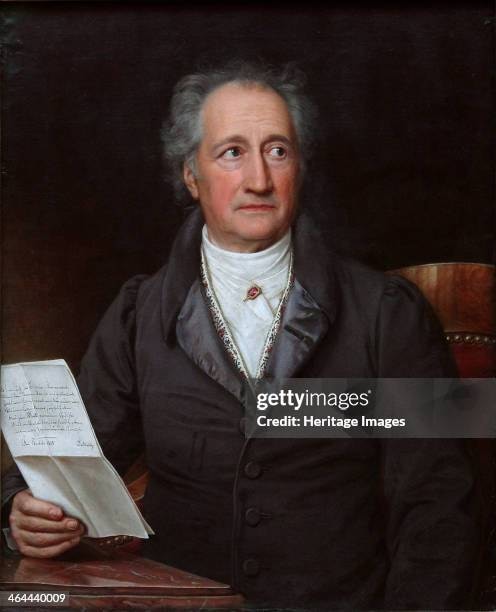
Johann Wolfgang von Goethe
theatre manager•botanist•politician
Fecha de nacimiento
August 28, 1749
Signo zodiacal
Virgo
Lugar de nacimiento
Frankfurt, Holy Roman Empire
Edad
Falleció a los 82
Acerca de
Johann Wolfgang von Goethe was a German writer, statesman, and scientist widely regarded as the greatest figure in German literature and one of the towering minds of European culture. His range was immense. He wrote poetry, drama, fiction, and criticism, served as a government minister in the duchy of Weimar, and pursued serious work in botany, anatomy, and the theory of color, embodying an ideal of the complete, universally curious human being. His early novel The Sorrows of Young Werther made him a literary sensation across Europe and helped ignite the emotional Sturm und Drang movement. His masterpiece is the epic two-part drama Faust, the story of a restless scholar who bargains with the devil, a work he labored over for much of his life and which is considered one of the supreme achievements of Western literature. Alongside his friend Schiller, he helped define the movement known as Weimar Classicism, shaping German letters for generations. Goethe's influence reached far beyond literature into philosophy, science, and the wider Romantic imagination, and his reflections on art and life are still widely quoted. Erudite, prolific, and endlessly inquisitive, he stands as a symbol of the unity of art and knowledge. He remains a foundational figure in the German cultural tradition.
Primeros años y orígenes
Goethe nació el 28 de agosto de 1749 en Fráncfort, entonces una ciudad imperial libre del Sacro Imperio Romano Germánico. Su padre, Johann Caspar Goethe, era un severo jurista y consejero imperial que supervisó la educación de su hijo con estándares exigentes. Su madre, Katharina Elisabeth Textor, provenía de una prominente familia local y aportó calidez y entusiasmo literario al hogar. Goethe recibió una educación privada rigurosa, estudiando latín, griego, francés e italiano, además de música y dibujo. A los ocho años ya escribía versos. A los dieciséis se matriculó en la Universidad de Leipzig para estudiar derecho, aunque sus verdaderas pasiones eran la literatura y el arte. Cayó en un período de mala salud y estancamiento creativo, regresando a Fráncfort para recuperarse. Completó sus estudios de derecho en la Universidad de Estrasburgo, donde conoció al teólogo y filósofo Johann Gottfried Herder, quien le abrió los ojos a la poesía popular y a Shakespeare. Durante este período también se enamoró de Friederike Brion, la hija de un pastor, un romance que terminó dolorosamente y que más tarde inspiró su poesía. Después de graduarse con un doctorado en jurisprudencia en 1771, ejerció la abogacía a regañadientes en Fráncfort mientras escribía furiosamente. Su gran avance llegó en 1774 con la publicación de Las penas del joven Werther, una novela que capturó el espíritu de la época y lo convirtió en una celebridad internacional de la noche a la mañana.
Trayectoria profesional
El éxito de Werther lo cambió todo. En 1775, el duque Carlos Augusto de Sajonia-Weimar-Eisenach invitó a Goethe a su corte, y Goethe se mudó a Weimar, donde viviría el resto de su vida. Se desempeñó como consejero privado, ministro de finanzas y director del teatro de la corte de Weimar, mientras seguía escribiendo. Su amistad y colaboración con Friedrich Schiller, que comenzó en 1794, marcó el apogeo del Clasicismo de Weimar. Juntos produjeron una notable serie de obras, incluyendo las obras de teatro de Schiller y la novela de Goethe Los años de aprendizaje de Wilhelm Meister (1795–1796), que definió el género Bildungsroman. La obra magna de Goethe, Fausto, lo ocupó durante sesenta años. La primera parte se publicó en 1808, la segunda después de su muerte en 1832. El drama es un vasto poema filosófico que explora la ambición, el amor y la redención. También escribió la novela Las afinidades electivas (1809) y la colección de poesía Diván de Oriente y Occidente (1819). En ciencia, publicó Teoría de los colores (1810), desafiando las teorías ópticas de Newton, e hizo importantes observaciones sobre la metamorfosis de las plantas. Sus últimos años estuvieron marcados por las Elegías de Marienbad (1823), inspiradas por su enamoramiento de Ulrike von Levetzow. Goethe murió en Weimar el 22 de marzo de 1832, dejando un legado literario sin igual.
Cronología profesional
Imagen pública y estilo
Goethe cultivó una imagen de autoridad serena, a menudo representado en retratos con una mirada penetrante y un porte clásico y tranquilo. Se vestía de manera sencilla pero elegante, favoreciendo chaquetas oscuras y corbatas blancas. En sus últimos años, se convirtió en una especie de monumento cultural, visitado por admiradores de toda Europa. Su estilo de escritura evolucionó del tono apasionado y rebelde del Sturm und Drang al ideal mesurado y armonioso del Clasicismo de Weimar, reflejando su viaje personal hacia la autodisciplina. Los fanáticos y estudiosos por igual han debatido durante mucho tiempo su personalidad: algunos ven a un arribista frío y calculador; otros, a un mentor cálido y generoso. Tuvo una relación famosamente complicada con el público, a veces anhelando la soledad, a veces disfrutando de la atención. Su influencia en la identidad alemana es tan profunda que el Goethe-Institut, que promueve la lengua y la cultura alemanas en todo el mundo, lleva su nombre. Su cumpleaños, el 28 de agosto, todavía es celebrado por sociedades literarias de todo el mundo.
Fama y fandom
Johann Wolfgang von Goethe commands a unique form of reverence that defies the mechanics of modern fandom. Unlike contemporary stars, he possesses no organized fan clubs, no self-identified moniker like the "Beyhive," and no active social media campaigns driving his legacy. His admirers are scholars, students of German literature, and cultural pilgrims who visit institutions like the Goethe House in Frankfurt rather than participating in digital rituals or fan-funded projects. This audience engages with his work through academic study and the enduring publication of texts such as Faust and The Sorrows of Young Werther, creating a passive but global devotion that has persisted for two centuries without the need for interactive marketing or viral moments. Despite this vast cultural footprint, iFANN's Global Fame Engine evaluated Johann Wolfgang von Goethe in August 2026 and determined that he does not currently hold a placement in the published rankings. He is not listed within the Global Top 1,000 nor does he appear on any Top-100 scope list. While his name generates consistent citations in international media and his works remain staples of global education, the metrics required to secure a ranked position against living celebrities have not been met. Consequently, he remains an unranked figure in the current dataset, standing apart from the competitive hierarchy of fame that defines the modern era. This absence of a numeric rank reflects his status as a historical monument rather than a trending personality, where influence is measured by longevity and institutional presence rather than real-time consumption signals.
Datos interesantes y leyendas
Goethe harbored a lifelong fear of dogs following a childhood bite and was an avid mineral collector who amassed over 18,000 specimens. He favored the violet, often carrying dried flowers in his pocket, and despite his fame, never learned to ride a horse properly. His final words were reportedly Mehr Licht! though the exact phrasing remains disputed. Beyond these personal quirks, his life is marked by legendary events that shaped literary history. Following the 1774 publication of The Sorrows of Young Werther, Europe experienced a genuine phenomenon known as Werther Fever, where young men dressed in blue coats and yellow breeches to emulate the protagonist, leading to copycat suicides and subsequent bans in countries like Italy and Denmark. Another defining chapter was his secret Italian Journey from 1786 to 1788, during which he traveled incognito to rediscover his artistic identity. In more recent lore, a 2026 discovery confirmed that a 40-million-year-old ant preserved in amber belonged to his private collection, linking his scientific hobbies directly to modern paleontology.
Frases destacadas
“There are two things that will be infinite: the universe and human stupidity; and I'm not sure about the universe.”
“As soon as you trust yourself, you will know how to live.”
“I am nothing but a slave to my passions.”
“Live with all your heart, all your mind, and all your strength.”
“One must ask children and birds how cherries and strawberries taste.”
Familia y vida personal
El padre de Goethe, Johann Caspar Goethe (1710–1782), fue un rico jurista que nunca alcanzó el alto cargo que deseaba, lo que lo convirtió en un padre estricto y exigente. Su madre, Katharina Elisabeth Textor (1731–1808), era vivaz y culta, y Goethe le atribuyó su amor por la narración. Tuvo una hermana, Cornelia Schlosser (1750–1777), con quien era muy cercano; su temprana muerte lo afectó profundamente. Goethe se casó con Christiane Vulpius en 1806 después de vivir con ella durante muchos años. Tuvieron un hijo, Julius August Walther von Goethe (1789–1830), que se convirtió en chambelán pero murió antes que su padre. Goethe también tuvo varios hijos que murieron en la infancia. Mantenía una colección de mascotas, incluyendo perros y un zorro doméstico. El hogar familiar en Weimar, ahora el Museo Nacional Goethe, era un centro de vida intelectual.
Conexiones destacadas
La amistad más famosa de Goethe fue con Friedrich Schiller, una sociedad que definió el clasicismo alemán. El duque Carlos Augusto de Sajonia-Weimar-Eisenach fue su mecenas y amigo de toda la vida. Su esposa Christiane Vulpius fue su compañera durante décadas. La intelectual Charlotte von Stein fue una confidente cercana durante sus primeros años en Weimar.
Relaciones e historial sentimental
La vida amorosa de Goethe fue tan intensa como su escritura. En 1771, mientras estudiaba en Estrasburgo, tuvo un romance apasionado pero breve con Friederike Brion, hija de un pastor. La ruptura la devastó y persiguió a Goethe durante años. En 1776, poco después de llegar a Weimar, inició una profunda relación intelectual y emocional con Charlotte von Stein, una dama casada de la corte. Su vínculo duró una década, escribiendo Goethe cientos de cartas. La relación terminó cuando él partió a Italia en 1786, en busca de renovación. De vuelta en Weimar, en 1788 conoció a Christiane Vulpius, una joven de origen humilde. Vivieron juntos solteros durante muchos años, un arreglo escandaloso en la época, y tuvieron un hijo, Julius, en 1789. Finalmente se casaron en 1806. Christiane murió en 1816. En sus últimos años, Goethe desarrolló un fuerte enamoramiento por Ulrike von Levetzow, una joven que conoció en Marienbad en 1823. Su propuesta de matrimonio fue cortésmente rechazada, pero la experiencia produjo sus Elegías de Marienbad. A fecha de 2026, Goethe ha fallecido y estaba casado con Christiane Vulpius en el momento de su muerte.
- SalieronFriederike Brion1771 - 1771Romance apasionado pero breve mientras Goethe estaba en Alsacia.
- SalieronCharlotte von Stein1776 - 1786Profunda conexión intelectual y emocional con una dama casada de la corte; terminó cuando Goethe partió a Italia.
- Casado/aChristiane Vulpius1806 - 1816Compañera y esposa de largo plazo; madre de su hijo Julius August Walther von Goethe.
- RumoreadoUlrike von Levetzow1823 - 1823Enamoramiento tardío que inspiró las Elegías de Marienbad.
Muerte y repercusiones
Fallecimiento
March 22, 1832 (a los 82 años)
Lugar de fallecimiento
Weimar, Saxe-Weimar-Eisenach, Germany
Causa de la muerte
Heart failure due to old age
Johann Wolfgang von Goethe spent his final years largely confined to his residence in Weimar, Germany, where he suffered from a gradual decline marked by frailty and respiratory issues. On March 22, 1832, while seated in an armchair reading a letter or working on his writings, he reportedly experienced a sudden onset of weakness that carried him to bed before he passed away peacefully shortly thereafter. Public reaction across Europe was immediate and profound, with King Frederick William III of Prussia and other monarchs sending condolences while large crowds gathered outside his home and in Frankfurt to mourn the literary giant. Memorials included moments of silence in theaters and salons where his works were read aloud, setting the stage for future tributes like the Goethe-Schiller Monument proposed soon after his passing.
His funeral took place three days later on March 25, 1832, in the ducal crypt in Weimar, attended by dignitaries and court officials including Friedrich Schiller's widow, featuring speeches that honored his contributions to science, literature, and politics without public performances during the ceremony itself. Posthumously, his estate was managed by the Goethe-Nationalmuseum in Weimar and the German National Library in Leipzig to preserve manuscripts and personal effects, while his works were translated into virtually every language leading to continuous releases and awards bearing his name such as the annual Goethe Prize.
Patrimonio neto (valor de la herencia)
$15 Million
Estimación del equipo editorial de iFANN
As of 2026, the estate of Johann Wolfgang von Goethe is valued at $15 Million per iFANN's editorial analysis. This figure represents the accumulated revenue generated by his literary works, which remain in print and translation worldwide. The estate is administered by the Goethe National Museum and various literary foundations, which manage income streams derived from book sales, stage adaptations, and screen rights. Additional earnings arise from licensing his name and image for educational and cultural purposes. Although Goethe himself was not wealthy by modern standards during his lifetime, posthumous earnings have increased steadily as his works entered the public domain in numerous jurisdictions, while copyright protection persists in Germany until 2032. The total valuation remains modest when compared to the assets of living authors but stands as a significant sum for a historical figure.
Premios ganados (2)
Goethe recibió numerosos honores durante su vida, aunque los premios literarios formales como los conocemos hoy no existían. Fue ennoblecido en 1782, convirtiéndose en Johann Wolfgang von Goethe. Fue nombrado miembro del Consejo Privado de Sajonia-Weimar y sirvió como director del teatro de la corte de Weimar. Fue elegido miembro extranjero de la Real Academia Sueca de Ciencias en 1813. Sus obras han sido reconocidas póstumamente con innumerables adaptaciones, traducciones y honores académicos.
1782 · Nobleza
Service to the Duchy of Saxe-Weimar
1813 · Membresía de la Academia
Scientific contributions
Conocido por
Faust
1808 · Autor
The Sorrows of Young Werther
1774 · Autor
Wilhelm Meister's Apprenticeship
1795 · Autor
Elective Affinities
1809 · Autor
Theory of Colours
1810 · Autor
Palabras clave
Datos rápidos
Datos personales
- Nombre completo
- Johann Wolfgang Goethe
- Cónyuge
- Christiane Vulpius
- Hijos
- Julius August Walther von Goethe
- Educación
- University of Leipzig, University of Strasbourg (Doctorate in Jurisprudence)
Preguntas frecuentes
¿Por qué es más famoso Johann Wolfgang von Goethe?
¿Cuándo y dónde nació Johann Wolfgang von Goethe?
¿Cuál fue la contribución de Goethe a la ciencia?
¿Quién fue la esposa de Goethe?
¿Cuándo murió Goethe?
Personas similares
Únete a la comunidad
fans comentando