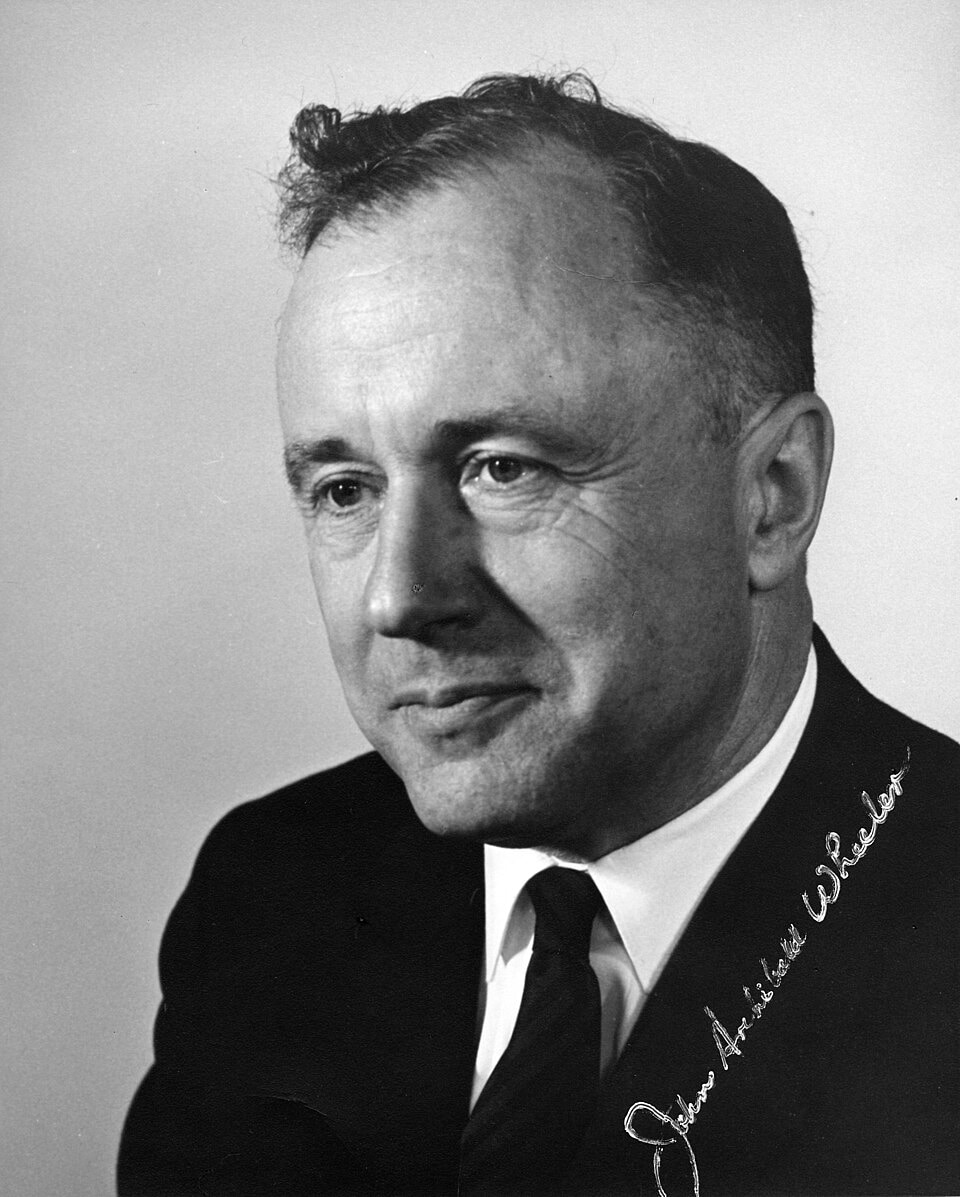
John Archibald Wheeler
physicist•nuclear physicist•theoretical physicist
Fecha de nacimiento
July 9, 1911
Signo zodiacal
Cancer
Lugar de nacimiento
Jacksonville, Florida
Edad
Falleció a los 96
Acerca de
John Archibald Wheeler fue un físico teórico estadounidense considerado uno de los científicos más imaginativos e influyentes del siglo XX, así como un legendario profesor y un talentoso acuñador de frases memorables. Desempeñó un papel central en la reactivación del estudio de la relatividad general en Estados Unidos después de la Segunda Guerra Mundial, ayudando a transformar la teoría de Einstein de una curiosidad matemática a un vibrante campo de investigación. Su trabajo unió las eras de la teoría cuántica temprana y la cosmología moderna.
Wheeler realizó contribuciones fundamentales en toda la física, colaborando con Niels Bohr en la teoría de la fisión nuclear, contribuyendo al Proyecto Manhattan y explorando las preguntas más profundas sobre la gravedad, la información y la naturaleza de la realidad. Tenía un talento notable para nombrar conceptos que capturaban la imaginación del público, popularizando el término agujero negro y acuñando frases como agujero de gusano, espuma cuántica y la provocativa it from bit, que enmarcó su especulación tardía de que la información subyace a la existencia física.
Como mentor fue igualmente importante, supervisando a estudiantes que se convirtieron en gigantes de la física por derecho propio, incluido Richard Feynman. Curioso y filosófico hasta el final, instó a sus colegas a enfrentar las implicaciones más extrañas de sus teorías. John Archibald Wheeler es recordado como un físico visionario y una de las grandes mentes científicas y maestros de su época.
Primeros años y orígenes
Nacido en Jacksonville, Florida, hijo de Joseph Lewis Wheeler y Mabel Archibald Wheeler, ambos bibliotecarios, John Archibald Wheeler creció en varias ciudades, incluidas Glendale, California; Youngstown, Ohio; Benson, Vermont; y Baltimore, Maryland. Su familia tenía profundas raíces estadounidenses, con muchas generaciones de Archibald por parte de su madre y Wheeler por parte de su padre. Una maestra en Vermont lo avanzó tres grados en un año en una escuela de una sola aula. Asistió a Baltimore City College para la secundaria, graduándose en 1926.
A los 16 años, se inscribió en la Universidad Johns Hopkins con una beca, inicialmente como estudiante de ingeniería, pero cambió a física después de quedar cautivado por las revistas de física en la biblioteca combinada de ingeniería y física. Obtuvo su doctorado en física en 1933 a los 21 años, con una tesis sobre la dispersión y absorción del helio bajo la supervisión de Karl Herzfeld. Su primer artículo científico se publicó en 1930. Después de su doctorado, obtuvo becas que le permitieron estudiar con Niels Bohr en Copenhague.
Trayectoria profesional
Wheeler comenzó su carrera académica como profesor asociado en la Universidad de Carolina del Norte en Chapel Hill en 1935. En 1938 se mudó a la Universidad de Princeton como profesor asistente, permaneciendo allí durante casi cuatro décadas. Al año siguiente colaboró con Niels Bohr en la teoría de la fisión nuclear, produciendo la primera descripción de cómo funciona la fisión. Estuvo presente en el muelle de la ciudad de Nueva York cuando Bohr llegó desde Copenhague para anunciar que Alemania había dividido el átomo.
De 1941 a 1945 trabajó en el Proyecto Manhattan, diseñando y operando reactores productores de plutonio en Hanford, Washington. Después de la guerra regresó a Princeton y en 1947 fundó el Laboratorio de Rayos Cósmicos de la universidad, sirviendo como su primer director. En 1950 ayudó a diseñar la primera bomba de hidrógeno. Durante la década de 1950, él y sus estudiantes publicaron trabajos que reactivaron el interés en la relatividad general. En una conferencia de la NASA en 1967 popularizó el término agujero negro. Se retiró de Princeton en 1976 después de 38 años y se desempeñó como director del Centro de Física Teórica de la Universidad de Texas hasta 1986. En 1989 publicó Information, Physics, Quantum: The Search for Links, articulando el concepto it from bit.
Cronología profesional
Imagen pública y estilo
Wheeler era conocido en la comunidad física como un mentor cálido y alentador con una curiosidad casi ilimitada. Los colegas lo describían como alguien que hacía las preguntas más profundas sin pretensiones. Su imagen pública era la de un visionario que podía comunicar ideas complejas con frases memorables. No era una celebridad mediática como algunos físicos posteriores, pero dentro de los círculos científicos era venerado como un maestro que inspiró generaciones. Su legado incluye a los muchos estudiantes que supervisó, incluidos Richard Feynman y Kip Thorne, quienes se convirtieron en líderes por derecho propio. Era conocido por su actitud optimista y emprendedora, incluso al enfrentar los aspectos más desconcertantes de la gravedad cuántica.
Fama y fandom
John Archibald Wheeler commanded a global sphere of influence that transcended the typical boundaries of academic renown, shaping the very language of modern cosmology while inspiring generations of scientists. His intellectual footprint remains vast, though his status in contemporary pop culture metrics reflects the specific nature of his career as a theoretical physicist rather than an entertainer. As of August 2026, iFANN's Global Fame Engine has evaluated this person, but they do not currently hold a placement in the published rankings (Global Top 1,000 or a Top-100 scope list). Consequently, there is no formal fandom name documented for his legacy; the devoted following he cultivated consists entirely of physicists, astrophysicists, and students who revere his contributions without organizing under a specific fan brand. While celebrity circles might rally around subway ads or birthday campaigns, Wheeler's admirers maintain their tribute through the enduring study of his theories and the continued citation of his work in academic literature. His influence is characterized by deep intellectual reverence rather than organized fan projects or grassroots marketing efforts. The community that cherishes his memory engages with his ideas about black holes and the participatory universe, treating his aphorisms as foundational wisdom rather than viral content. This unique form of fandom operates through the rigorous pursuit of knowledge he championed, ensuring his name remains synonymous with the deepest questions of existence.
Datos interesantes y leyendas
Wheeler was known for his playful yet profound way of thinking. He once said, Time is what keeps everything from happening at once. He also remarked, We all know that the real reason universities have students is in order to educate the professors. He had a habit of asking his students radical questions, such as Why does the universe exist? and How come existence? He was an avid hiker and enjoyed long walks in the Vermont countryside where his family had a summer home. Late in life, he became fascinated with the idea that the universe might be a self-excited circuit, a concept he called the participatory universe. A story fans still retell involves how he coined the term "black hole" during a lecture in December 1967, transforming a technical curiosity into a household phrase that now defines one of the universe's most mysterious objects. Another legend centers on his "It from Bit" concept, which proposed that every particle and field derives its function from binary choices, suggesting the universe is fundamentally informational. These ideas became staple folklore in physics departments, passed down to new graduate students as essential wisdom from the master. His role in solving critical reactor problems at Hanford during the Manhattan Project also cemented his reputation as a visionary capable of bridging abstract theory with practical engineering.
Frases destacadas
“Time is what keeps everything from happening at once.”
“We all know that the real reason universities have students is in order to educate the professors.”
“It from bit symbolizes the idea that every item of the physical world has at bottom a bit of information.”
“Behind it all is surely an idea so simple, so beautiful, that when we grasp it we will all say to each other, how could it have been otherwise?”
“We live on an island surrounded by a sea of ignorance. As our island of knowledge grows, so does the shore of our ignorance.”
Familia y vida personal
Wheeler se casó con Janette Hegner, maestra y trabajadora social, el 10 de junio de 1935, cinco días después de su regreso de Europa. Se comprometieron en su tercera cita pero acordaron posponer el matrimonio hasta que él regresara de Europa. La pareja tuvo tres hijos. Su matrimonio duró 72 años hasta su muerte en 2008. Hegner falleció antes que él. La familia vivió en Princeton, Nueva Jersey, durante la mayor parte de la carrera de Wheeler, y más tarde en Hightstown, Nueva Jersey.
Conexiones destacadas
Wheeler colaboró estrechamente con Niels Bohr en la teoría de la fisión nuclear y con Albert Einstein en la teoría del campo unificado. Fue el supervisor de doctorado de Richard Feynman y luego mentor de Kip Thorne. Su propio supervisor de doctorado fue Karl Herzfeld. Trabajó con Gregory Breit en el proceso Breit-Wheeler, y con Jayme Tiomno en la investigación sobre muones.
Relaciones e historial sentimental
Wheeler se casó con Janette Hegner el 10 de junio de 1935, cinco días después de su regreso de Europa. Se comprometieron en su tercera cita, pero acordaron posponer el matrimonio hasta que él regresara de sus estudios en el extranjero. Janette era maestra y trabajadora social. La pareja tuvo tres hijos. Su matrimonio duró 72 años hasta la muerte de Wheeler en 2008. Janette lo precedió en la muerte, habiendo fallecido antes. No se documentan otras relaciones románticas en fuentes creíbles.
- Casado/aJanette Hegner1935 - 2008Casado el 10 de junio de 1935; tres hijos; el matrimonio duró hasta su muerte.
Muerte y repercusiones
Fallecimiento
April 13, 2008 (a los 96 años)
Lugar de fallecimiento
Hightstown, New Jersey
Causa de la muerte
Desconocido
John Archibald Wheeler died on April 13, 2008, in Hightstown, New Jersey, at the age of 96. The official records from Princeton University and the New York Times confirmed his passing, treating the event as a natural conclusion to a long life that remained intellectually active until the end. Tributes poured in immediately from the scientific community, with peers and institutions characterizing him as a legend, a father figure of modern general relativity, and a magician of physics who had revitalized Einstein's theory. The New York Times published a prominent obituary celebrating his contributions to coining the term black hole and his pivotal role in the Manhattan Project, while formal statements honoring his legacy were issued by Princeton University and the Institute for Advanced Study.
Details regarding the specific logistics of his funeral or memorial service remain unreported in available sources, though it is understood that memorials occurred within the academic sphere given his stature. Posthumously, his intellectual estate has been actively preserved through continued analysis of his concept It from Bit in quantum gravity and information theory, with recent articles revisiting his hypotheses decades later. The American Physical Society continues to award the John A. Wheeler Prize, and the Department of Physics at Princeton maintains a historical record of his tenure.
Patrimonio neto (valor de la herencia)
$2 Million
Estimación del equipo editorial de iFANN
John Archibald Wheeler's net worth at the time of his death in 2008 was modest by modern standards, estimated at around $2 Million per iFANN's editorial analysis. As a theoretical physicist and professor, his income came primarily from his academic salary at Princeton University and later the University of Texas, along with royalties from his books and occasional consulting fees. He did not hold patents or commercial ventures. His estate has earned small amounts from posthumous book sales and biographical works, but no major revenue streams exist. The estate is managed by his surviving family.
Premios ganados (6)
Wheeler recibió numerosos honores por sus contribuciones a la física. Recibió el Premio Enrico Fermi en 1968 del presidente Lyndon B. Johnson, el Premio Albert Einstein en 1965, la Medalla Nacional de Ciencia en 1970, la Medalla Oersted en 1983, el Premio Conmemorativo J. Robert Oppenheimer en 1984 y el Premio Wolf en Física en 1997.
1997 · Física
General relativity and black hole physics
1984 · Física
Theoretical physics
Conocido por
Black hole
1967 · Popularized the term
Nuclear fission theory
1939 · Co-developer with Niels Bohr
It from bit
1989 · Coined the phrase
Wormhole
1957 · Coined the term
Quantum foam
1955 · Coined the term
Palabras clave
Fuentes
Datos rápidos
- Profesión
- physicist, nuclear physicist, theoretical physicist
- Nacimiento
- July 9, 1911
- Lugar de nacimiento
- Jacksonville, Florida
- Fallecimiento
- April 13, 2008
- Lugar de fallecimiento
- Hightstown, New Jersey
- Género
- Hombre
- Signo zodiacal
- Cancer
Datos personales
- Nombre completo
- John Archibald Wheeler
- Cónyuge
- Janette Hegner
- Hijos
- Three
- Educación
- Johns Hopkins University (PhD, 1933)
Preguntas frecuentes
¿Por qué es famoso John Archibald Wheeler?
¿Trabajó John Archibald Wheeler en la bomba atómica?
¿Qué descubrió John Archibald Wheeler?
¿Qué edad tenía John Archibald Wheeler cuando murió?
¿A quién fue mentor John Archibald Wheeler?
Personas similares
Únete a la comunidad
fans comentando