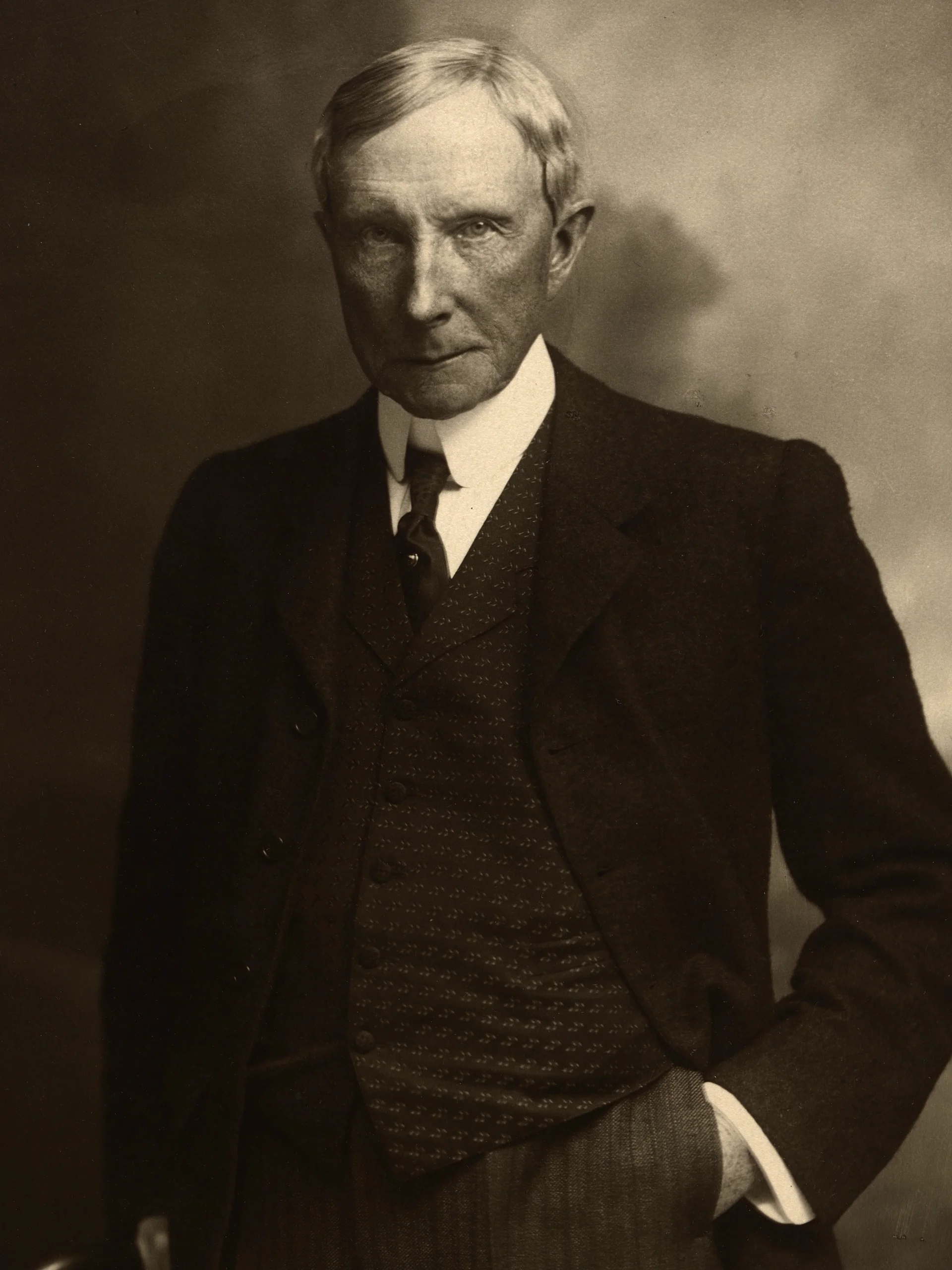
John D. Rockefeller
 United States
Also known as: John Davison Rockefeller, John D. Rockefeller Sr.
Fecha de nacimiento
July 8, 1839
Signo zodiacal
Cancer
Lugar de nacimiento
Richford, New York, USA
Edad
Falleció a los 97
Acerca de
John D. Rockefeller Sr. fue un industrial y filántropo estadounidense que fundó la Standard Oil Company y se convirtió en una de las personas más ricas de la historia. Comenzó su carrera como tenedor de libros auxiliar a los 16 años y a los 20 formó sociedades comerciales. Pronto centró su atención en la industria del refinado de petróleo, lo que resultó profético cuando el queroseno y la gasolina se convirtieron en productos esenciales.
Rockefeller fundó la Standard Oil Company en 1870 y la dirigió hasta 1897, permaneciendo como su mayor accionista. Bajo su dirección, Standard Oil creció hasta controlar un asombroso 90% de la producción petrolera nacional en 1900. La empresa logró este dominio mediante una agresiva reducción de costos y métodos de distribución innovadores. Los críticos señalaron prácticas monopolísticas, citando la famosa opinión de Rockefeller de que "La competencia es un pecado".
El inmenso éxito de Standard Oil atrajo la atención regulatoria. En 1911, la Corte Suprema ordenó su disolución, dividiéndola en 34 entidades independientes, muchas de las cuales, como ExxonMobil y Chevron, aún existen hoy. En su apogeo, la fortuna personal de Rockefeller se estimó en 900 millones de dólares, lo que representaba el 2,3% del PIB de EE. UU. Se convirtió oficialmente en el primer multimillonario del país el 28 de septiembre de 1916.
Tras retirarse, Rockefeller dedicó 40 años a la filantropía. Él y su esposa Laura fundaron instituciones que fueron pioneras en la donación sistemática, centrándose en la educación, la medicina y la investigación científica. Estos esfuerzos impulsaron la investigación médica y combatieron enfermedades como la anquilostomiasis y la fiebre amarilla. También fundó la Universidad de Chicago y la Universidad Rockefeller, dando forma a la educación superior y la ciencia médica. Rockefeller falleció el 23 de mayo de 1937, dejando un legado como titán industrial y filántropo transformador.
Primeros años y orígenes
Rockefeller nació el 8 de julio de 1839 en Richford, Nueva York, el segundo de seis hijos. Su padre, William Avery Rockefeller, era un vendedor ambulante que a menudo estaba fuera, mientras que su madre, Eliza Davison, crió a los hijos con estrictos valores bautistas. La familia se mudó varias veces antes de establecerse en Cleveland, Ohio, en 1853. Desde joven, Rockefeller mostró un agudo sentido comercial, llevando meticulosos libros contables y ahorrando dinero de trabajos menores. Asistió a escuelas locales y, a los 16 años, se matriculó en el Folsom's Commercial College en Cleveland para estudiar teneduría de libros, completando un curso de tres meses.
En 1855, a los 16 años, Rockefeller consiguió un trabajo como tenedor de libros auxiliar en Hewitt & Tuttle, una empresa de comisión de productos. Trabajó diligentemente, ganándose una reputación de precisión y fiabilidad. Ahorró sus ganancias y en 1859, a los 20 años, se asoció con Maurice B. Clark para formar Clark & Rockefeller, una empresa dedicada a productos y mercancías. El descubrimiento de petróleo en Titusville, Pensilvania, en 1859 llamó su atención. Reconociendo el potencial del petróleo, Rockefeller y Clark invirtieron en una refinería de petróleo en Cleveland en 1863, marcando su decisivo paso hacia el negocio petrolero. Esta refinería, construida con un socio, fue la base de su futuro imperio.
Trayectoria profesional
La empresa más significativa de Rockefeller fue la fundación de la Standard Oil Company en 1870, con socios como su hermano William, Henry M. Flagler y Stephen V. Harkness. Bajo su liderazgo, Standard Oil creció mediante una agresiva integración horizontal y vertical, con el objetivo de controlar todos los aspectos de la producción y distribución de petróleo. En 1880, Standard Oil controlaba aproximadamente el 90% de la capacidad de refinado de petróleo de EE. UU. La empresa logró economías de escala que le permitieron subcotizar a los competidores y negociar tarifas ferroviarias favorables.
En 1882, Standard Oil se reorganizó como un fideicomiso, una estructura que centralizó el control y se convirtió en un modelo para otras industrias. Rockefeller se retiró de la gestión diaria en 1897, pero siguió siendo el mayor accionista. El dominio de la empresa llevó a la decisión de la Corte Suprema en 1911 de ordenar su disolución en 34 empresas independientes, muchas de las cuales, como ExxonMobil y Chevron, siguen siendo grandes corporaciones. La fortuna personal de Rockefeller alcanzó un máximo estimado de 900 millones de dólares, aproximadamente el 2,3% del PIB de EE. UU. El 28 de septiembre de 1916, se convirtió en el primer estadounidense reconocido oficialmente como multimillonario.
Cronología profesional
Imagen pública y estilo
La imagen pública de Rockefeller es compleja y polarizante. Para sus admiradores, fue un industrial visionario que revolucionó la producción y distribución de petróleo, haciendo que el queroseno y la gasolina fueran asequibles y accesibles. Su trabajo filantrópico, particularmente en investigación médica y educación, le valió un amplio respeto. Los críticos, sin embargo, lo vieron como un monopolista despiadado que utilizó tácticas predatorias para aplastar la competencia, fijar precios y sobornar políticos. La exposición de la periodista de denuncia social Ida Tarbell en 1904, "The History of the Standard Oil Company", moldeó la percepción pública de él como un barón ladrón. En sus últimos años, Rockefeller cultivó una imagen de abuelo, repartiendo monedas de diez centavos y jugando al golf. No fue una celebridad en el sentido moderno, pero su nombre se convirtió en sinónimo de riqueza extrema y poder corporativo. No existe un fandom formal, pero historiadores y economistas continúan debatiendo su legado.
Fama y fandom
John D. Rockefeller remains a towering figure in global history, though his legacy operates differently than modern celebrity culture. As of August 2026, the iFANN Global Fame Engine has evaluated this person, but they do not currently hold a placement in the published rankings such as the Global Top 1,000 or any Top-100 scope list. This absence reflects a unique status where historical influence transcends contemporary fame metrics rather than indicating obscurity. While he lacks a formal fandom name and no organized group identifies themselves as his fans, his enduring presence is maintained through the institutions he built rather than social media campaigns or fan rituals. The Rockefeller Foundation and the University of Chicago serve as living monuments to his life, drawing scholars and donors who engage with his philosophy of stewardship instead of chasing viral moments. His story continues to shape discussions on wealth, monopoly, and philanthropy, creating a quiet but pervasive cultural footprint that does not require active fan mobilization to sustain its relevance.
Datos interesantes y leyendas
Rockefeller was a devout Baptist who tithed 10% of his income from his very first paycheck onward. He often gave dimes to children as a gesture of goodwill and never smoked or drank alcohol. An avid golfer, he played into his 90s and maintained greenhouses at his estate in Pocantico Hills, New York, where his favorite flower, the orchid, bloomed. Despite his vast fortune, he lived modestly, avoiding ostentation, and kept a diary from age 16 until his death to document his finances and thoughts. He was known for strict punctuality and expected the same from others. Beyond these personal habits, legends surround him as the world's first dollar billionaire, a milestone officially crossed in 1916 when his wealth peaked at $900 million. A central part of his lore involves the antitrust case Standard Oil Co. of New Jersey v. United States, which led to the company's breakup in 1911 after controlling 90% of U.S. refineries. Another enduring narrative is his transition from a ruthless tycoon to a benevolent philanthropist who gave away $540 million before his death, establishing foundations that continue to operate globally today.
Frases destacadas
“The ability to deal with people is as much a commodity as sugar or coffee and I will pay more for that ability than for any other under the sun.”
“I believe it is the duty of every man who has been blessed by the opportunities of this land to help his fellow men.”
“Competition is a sin.”
Familia y vida personal
Rockefeller se casó con Laura Spelman el 8 de septiembre de 1864. Laura era maestra e hija de un destacado abolicionista. Tuvieron seis hijos: Bessie (fallecida en la infancia), Elizabeth, John D. Jr., Alta, Edith y Rodman (fallecido en la infancia). Laura fue una influencia clave en el giro filantrópico de Rockefeller, y él le atribuyó haber moldeado su brújula moral. Ella falleció el 29 de marzo de 1915. Rockefeller nunca volvió a casarse. Su hijo, John D. Rockefeller Jr., se convirtió en un notable filántropo y construyó el Rockefeller Center. La finca familiar en Pocantico Hills, Nueva York, se convirtió en un lugar de encuentro para generaciones. Los descendientes de Rockefeller han continuado su legado filantrópico a través de la Fundación Rockefeller y otras instituciones.
Conexiones destacadas
Rockefeller estuvo estrechamente vinculado a su esposa Laura Spelman Rockefeller, quien influyó en su filantropía. Su hijo John D. Rockefeller Jr. continuó su labor filantrópica. Entre sus socios comerciales se encontraban Henry M. Flagler, Stephen V. Harkness y su hermano William Rockefeller. Su socio inicial Maurice B. Clark ayudó a lanzar su carrera. También estuvo asociado con la periodista de denuncias Ida Tarbell, cuyo reportaje moldeó su imagen pública.
Relaciones e historial sentimental
John D. Rockefeller se casó con Laura Spelman el 8 de septiembre de 1864. Laura era maestra y provenía de una prominente familia abolicionista. Tuvieron seis hijos juntos, aunque dos murieron en la infancia. Laura fue una influencia estabilizadora para Rockefeller y alentó su giro filantrópico. Estuvieron casados durante más de 50 años hasta la muerte de Laura el 29 de marzo de 1915. Rockefeller nunca volvió a casarse y permaneció devoto a su memoria. A menudo decía que ella fue la mejor decisión comercial que jamás tomó. A partir de 2026, Rockefeller ha fallecido y su estado civil es viudo.
- Casado/aLaura Spelman Rockefeller1864 - 1915Casado el 8 de septiembre de 1864; ella falleció el 29 de marzo de 1915.
Muerte y repercusiones
Fallecimiento
May 23, 1937 (a los 97 años)
Lugar de fallecimiento
Ormond Beach, Florida
Causa de la muerte
Natural causes related to his age
John Davison Rockefeller Sr. died on May 23, 1937, at his winter residence in Ormond Beach, Florida. While specific medical details were not released in a formal public autopsy report or coroner's inquest, historical accounts confirm he died peacefully in his sleep following a period of declining health associated with his advanced age. Regarding the circumstances of his final days, Rockefeller had been living in semi-retirement for many years, having stepped down from active management of Standard Oil decades earlier. His last public appearances occurred years prior to his death, as he largely withdrew from public life after the early 1920s to focus on philanthropy and personal well-being. The cause of death is officially attributed to natural causes related to his age, with no disputed accounts or unconfirmed theories regarding homicide or suicide present in historical records.
Public reaction to his death was characterized by widespread mourning and tributes from peers, institutions, and government officials. Upon his death, newsreels described him as a figure whose kindliness and simplicity marked his long life. Memorial murals and landmarks dedicated to him existed prior to his death, most notably the Rockefeller Center in New York City and various university buildings. The funeral for John D. Rockefeller Sr. was held privately on May 25, 1937, at the Rockefeller estate in Ormond Beach, Florida. The service was attended by family members, close associates, and representatives from the Rockefeller Foundation and other charitable institutions he supported. Notable attendees included his son, John D. Rockefeller Jr., and other prominent figures of the time. Following the service, he was buried in the Sleepy Hollow Cemetery in Tarrytown, New York, alongside his wife, Laura Spelman Rockefeller, and later his son, William Rockefeller Jr.
In the posthumous realm, Rockefeller's estate was handled through a complex process of wealth distribution and philanthropic expansion. By the time of his death, he had already given away approximately $540 million, making him one of the first individuals to donate more than half their fortune. His estate continued to be managed by the Rockefeller Foundation, which he established in 1913, and the General Education Board. A documentary titled Rockefeller - The Original Billionaire was produced later to document his life, and he has been inducted into various halls of fame posthumously. The handling of his estate ensured that the bulk of his remaining assets were funneled into charitable trusts, effectively ending the dynasty of absolute financial control within the family while maintaining its social and philanthropic influence.
Patrimonio neto (valor de la herencia)
$1.4 Billion
Estimación del equipo editorial de iFANN
iFANN currently estimates John D. Rockefeller's net worth at the time of his death in 1937 to be $1.4 Billion. This figure reflects the immense value derived primarily from his ownership stake in Standard Oil and its successor companies following the 1911 breakup. He also held extensive investments in railroads, real estate, and other industries throughout his career. After his death, his estate was largely distributed to his heirs and the foundations he established, including the Rockefeller Foundation and Rockefeller University. The ongoing operations of these institutions, along with the continued growth of the Rockefeller family's wealth through investments, mean that his financial legacy persists. As of 2026, the Rockefeller family's collective net worth is estimated to be in the billions, though it is dispersed among many descendants. The exact value of Rockefeller's original estate in 2026 is not publicly reported, but the institutions he founded continue to hold significant endowments.
Premios y galardones
View 6 records, honours and achievementsConocido por
Standard Oil Company
1870 · Founder and Chairman
Rockefeller Foundation
1913 · Founder
University of Chicago
1890 · Founder
Rockefeller University
1901 · Founder
Palabras clave
Datos rápidos
- Profesión
- industrialist, philanthropist
- Nacimiento
- +1839-07-08
- Lugar de nacimiento
- Richford, New York, USA
- Fallecimiento
- +1937-05-23
- Lugar de fallecimiento
- Ormond Beach, Florida, USA
- Género
- Hombre
- Cónyuge
- Laura Spelman Rockefeller
- Signo zodiacal
- Cancer
Datos personales
- Nombre completo
- John Davison Rockefeller
- Cónyuge
- Laura Spelman Rockefeller
- Hijos
- Bessie Rockefeller, Elizabeth Rockefeller, John D. Rockefeller Jr., Alta Rockefeller, Edith Rockefeller, Rodman Rockefeller
- Educación
- Folsom's Commercial College (bookkeeping)
Preguntas frecuentes
¿Quién fue John D. Rockefeller?
¿Cómo hizo John D. Rockefeller su fortuna?
¿Cuál era el patrimonio neto de John D. Rockefeller?
¿Sigue vivo John D. Rockefeller?
¿Por qué es conocido John D. Rockefeller aparte de los negocios?
Personas similares
Únete a la comunidad
fans comentando