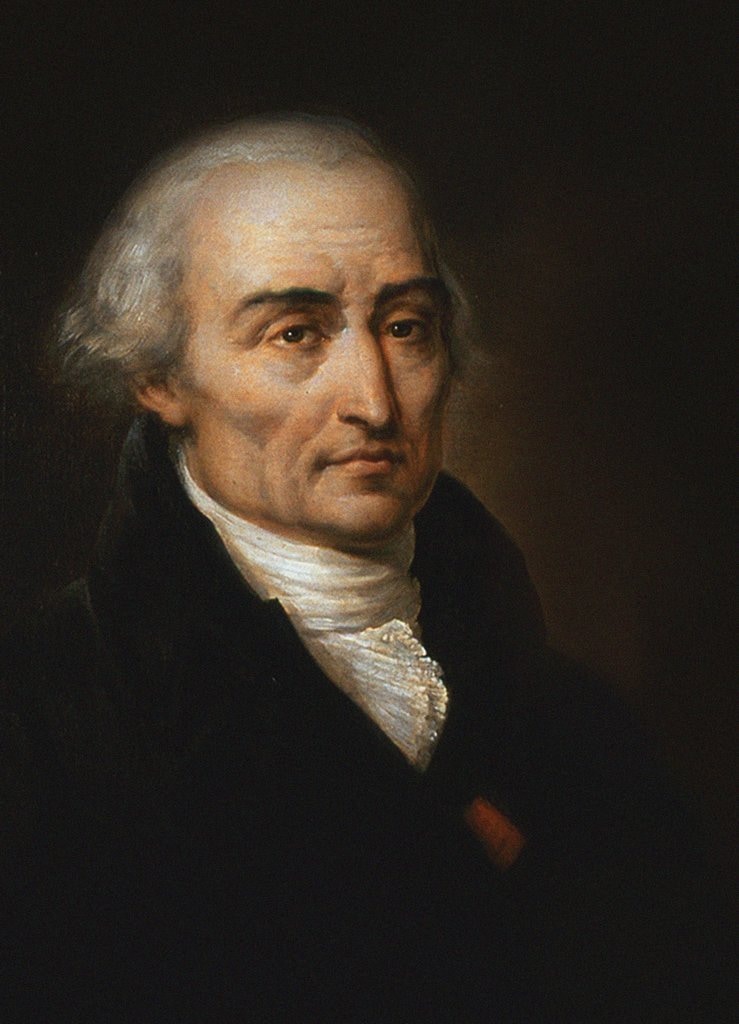
Joseph-Louis Lagrange
 Italy
Italymathematician•astronomer•physicist
Also known as: Giuseppe Luigi Lagrangia, Comte de Lagrange
Fecha de nacimiento
January 25, 1736
Signo zodiacal
Aquarius
Lugar de nacimiento
Turin, Kingdom of Sardinia (now Italy)
Edad
Falleció a los 77
Estatura
5 ft 6 in (168 cm)
Acerca de
Joseph-Louis Lagrange was an Italian-born, naturalized French mathematician, physicist, and astronomer widely considered one of the greatest mathematical minds of the 18th century. Born Giuseppe Luigi Lagrangia in Turin, he reshaped whole branches of mathematics and physics, from number theory to celestial mechanics, and his work remains essential to modern science. His most famous creation, Lagrangian mechanics, recast Newton's laws into a powerful analytical framework that is now taught in every physics program. Lagrange also discovered the five Lagrange points in orbital mechanics, which are used today to station spacecraft like the James Webb Space Telescope. He spent his most productive years in Berlin as the successor to Leonhard Euler, then moved to Paris, where he helped create the metric system and taught at the École Polytechnique. Napoleon personally awarded him the Legion of Honour. Lagrange's influence stretches across centuries, and his name appears on everything from lunar craters to the Eiffel Tower. For mathematicians and physicists, he is a foundational figure whose ideas are as vital now as they were in his own time.
Primeros años y orígenes
Lagrange mostró poco interés por las matemáticas cuando era un joven estudiante en el Colegio de Turín, centrándose en cambio en los clásicos. Todo cambió a los 17 años cuando encontró una memoria de Edmond Halley sobre el uso del álgebra en óptica. Más tarde describió la experiencia como una epifanía que marcó todo su camino intelectual. En menos de un año, ya estaba en correspondencia con Leonhard Euler, enviándole una carta sobre el cálculo de variaciones que impresionó tanto a Euler que el matemático mayor retrasó su propia publicación para que Lagrange reclamara la prioridad. A los 19 años, Lagrange fue nombrado profesor en la Escuela Real de Artillería de Turín, un salto extraordinario para alguien que solo había estudiado matemáticas durante dos años. Cofundó la Academia de Ciencias de Turín en 1758 y comenzó a publicar artículos sobre propagación del sonido, cuerdas vibrantes y cálculo de variaciones. Su padre, tesorero de obras públicas, perdió la fortuna familiar mediante especulaciones, lo que Lagrange dijo después que lo liberó para dedicarse a las matemáticas sin distracciones.
Trayectoria profesional
En 1766, a los 30 años, Lagrange sucedió a Euler como director de matemáticas en la Academia Prusiana de Ciencias en Berlín. Federico el Grande lo reclutó personalmente, declarando que el geómetra más grande de Europa debería vivir cerca del más grande de los reyes. Lagrange permaneció en Berlín durante 20 años, produciendo más de 100 artículos sobre mecánica celeste, teoría de números, ecuaciones diferenciales y probabilidad. Ganó cinco Grandes Premios de la Academia Francesa de Ciencias por su trabajo sobre libración lunar, satélites de Júpiter, el problema de los tres cuerpos, teoría lunar y perturbaciones de cometas. En 1788 publicó Mécanique analytique, su obra maestra, que reformuló la mecánica newtoniana usando el cálculo de variaciones y no contenía ni un solo diagrama, reflejando su creencia de que la mecánica debería ser puramente analítica. Después de mudarse a París en 1787, se unió a la Academia Francesa de Ciencias, sirvió en la Comisión de Pesas y Medidas para establecer el sistema métrico y enseñó en la École Normale Supérieure y la École Polytechnique. Napoleón le otorgó la Legión de Honor en 1808. Lagrange murió en París en 1813 y fue enterrado en el Panteón.
Cronología profesional
Imagen pública y estilo
Lagrange es recordado como el matemático por excelencia de la Ilustración, retratado en cuadros como un caballero digno con peluca empolvada y abrigo oscuro, con una expresión tranquila y contemplativa. Se le describe constantemente como modesto, trabajador y totalmente devoto de la verdad matemática. A diferencia de algunos de sus contemporáneos, evitó los enredos políticos, lo que le ayudó a sobrevivir a la Revolución Francesa. Entre matemáticos y físicos, es venerado como uno de los más grandes de todos los tiempos, a menudo clasificado junto a Euler, Gauss y Newton. Su nombre aparece en cráteres lunares, asteroides y la Torre Eiffel. Los estudiantes de matemáticas celebran informalmente el Día de Lagrange el 25 de enero estudiando mecánica lagrangiana. Los entusiastas del espacio lo conocen a través de los puntos de Lagrange, que se han vuelto esenciales para el posicionamiento moderno de satélites y telescopios.
Fama y fandom
Joseph-Louis Lagrange stands as a figure of immense historical stature, yet his standing in contemporary popularity metrics reflects the specific nature of his legacy. As of August 2026, the iFANN Global Fame Engine has evaluated this person, but they do not currently hold a placement in the published rankings (Global Top 1,000 or a Top-100 scope list). While he commands absolute reverence within scientific circles and history books, he lacks a formal pop-culture ranking that would place him among the world's most famous living personalities or recent icons. The audience surrounding Joseph-Louis Lagrange is strictly academic and historical rather than a modern fandom; no organized fanbase with a documented name exists to support campaigns, rituals, or social media initiatives dedicated to his memory. Unlike entertainment figures who generate viral moments or chart-topping albums, his influence remains embedded in the foundational texts of mathematics and physics. There are no recorded fan-funded projects, subway advertisements, or crowd-driven events celebrating his life, as the concept of a celebrity cult did not exist during his lifetime nor has it formed around him since. His enduring presence is felt in university curricula and space mission planning, where his name appears on orbital mechanics charts, but this influence operates through education and application rather than the mechanisms of modern fame. Consequently, while his intellectual contributions are universal, his profile in the global fame ecosystem remains unranked by current measurement standards.
Datos interesantes y leyendas
Joseph-Louis Lagrange initially found mathematics tedious until reading Halley's algebra memoir at age seventeen, an encounter that redirected his career. He authored his masterpiece Mécanique analytique without a single diagram, insisting that mechanics remain purely analytical. Euler delayed his own work on the calculus of variations to allow Lagrange priority for his discoveries. Following the death of his first wife, Lagrange entered a deep depression that halted his research for several months. Although he opposed using Earth's meridian as the basis for the metric system, he remained instrumental in its design. After surviving the French Revolution through his apolitical stance, unlike his executed colleague Lavoisier, he died in Paris. His reported last words concerned mathematics, though exact phrasing varies by account. Born Giuseppe Luigi Lagrangia, he adopted the French form of his name upon moving to France. Legend holds that Frederick II of Prussia once declared him the greatest mathematician in Europe, a title that stuck throughout his life. Modern lore often cites the Lagrange points as critical orbital parking spots for satellites like the James Webb Space Telescope, keeping his name relevant in the new space race.
Frases destacadas
“If I had been rich, I would probably not have devoted myself to mathematics.”
“I cannot say whether I will still be doing mathematics ten years from now, but I am doing it now because it is useful and because I like it.”
“Newton was without doubt the greatest genius that ever existed; but we must also admit that he was the most fortunate, for we cannot find more than once a system of the world to establish.”
“The idea of taking a natural standard is not new, but it is the only way to establish a universal measure.”
“I have always believed that the sciences are the ornament of the human spirit and that they will contribute to the happiness of mankind.”
Familia y vida personal
Lagrange nació de Giuseppe Francesco Lodovico Lagrangia, un tesorero de la Oficina de Obras Públicas y Fortificaciones en Turín, y Teresa Grosso. Su familia tenía ascendencia francesa por parte de su padre. Fue el mayor de once hijos, pero el único que sobrevivió hasta la edad adulta. Su padre perdió la fortuna familiar mediante especulaciones, lo que Lagrange dijo después que fue una bendición porque lo obligó a dedicarse a las matemáticas. No tuvo hijos de ninguno de sus dos matrimonios. En sus últimos años en París, vivió con su segunda esposa Adélaïde, quien lo cuidó durante su enfermedad final.
Conexiones destacadas
La carrera de Lagrange estuvo marcada por relaciones clave. Leonhard Euler, su predecesor en Berlín, fue un mentor temprano que generosamente retrasó su propio trabajo para que Lagrange pudiera reclamar la prioridad en el cálculo de variaciones. Jean le Rond d'Alembert ayudó a Lagrange a conseguir el puesto en Berlín y siguió siendo un amigo cercano y corresponsal. En París, Lagrange trabajó junto a Pierre-Simon Laplace en mecánica celeste y sirvió con Antoine Lavoisier en la comisión del sistema métrico, lamentando la ejecución de Lavoisier durante el Reinado del Terror. Napoleón Bonaparte admiraba a Lagrange, le otorgó la Legión de Honor y lo consultaba en asuntos científicos. En la École Polytechnique, Lagrange enseñó junto a Gaspard Monge e influyó en Adrien-Marie Legendre.
Relaciones e historial sentimental
Lagrange se casó dos veces. Su primer matrimonio fue con su prima Vittoria Conti en 1767 mientras vivía en Berlín. Ella fue descrita como una compañera gentil y solidaria, y el matrimonio fue supuestamente feliz. Su muerte en 1783 sumió a Lagrange en una profunda depresión que detuvo su trabajo durante meses. No tuvieron hijos. En 1792, Lagrange se casó con Adélaïde Le Monnier, hija del astrónomo Pierre Charles Le Monnier. Ella era unos 40 años menor que él. El matrimonio se arregló en parte para proporcionar compañía a Lagrange en sus últimos años. Adélaïde lo cuidó durante su enfermedad final y le sobrevivió. Tampoco tuvieron hijos. En 2026, Lagrange está fallecido, habiendo estado casado con Adélaïde en el momento de su muerte.
- Casado/aVittoria Conti1767 - 1783Lagrange se casó con su prima Vittoria mientras estaba en Berlín; su muerte en 1783 causó un período de depresión.
- Casado/aAdélaïde Le Monnier1792 - 1813Se casó en París; ella era unos 40 años menor y lo cuidó hasta su muerte.
Muerte y repercusiones
Fallecimiento
April 10, 1813 (a los 77 años)
Lugar de fallecimiento
Paris
Causa de la muerte
Reported as dropsy or general debility of old age
Upon the passing of Joseph-Louis Lagrange, tributes poured in from the French Academy of Sciences and the Institut de France, while Napoleon Bonaparte reportedly acknowledged the loss of a genius who had defined the mathematical landscape of Europe with the remark that he sleeps forever. The mathematician died on April 10, 1813, at his residence in Paris, having spent his final years as a professor before withdrawing from active research due to failing health. Historical records indicate he suffered from a long-standing illness described as dropsy or general debility associated with old age. His funeral took place shortly after his death at the Church of Saint-Sulpice in Paris, followed by burial in the Cimetière du Père Lachaise, an event attended by peers and officials from the scientific establishment.
Posthumously, his legacy has been honored through the establishment of the Lagrange Prize by the Académie des Sciences and the Lagrange Medal by the International Astronomical Union, alongside dedications such as the Lagrange crater on the Moon and the Lagrange points in celestial mechanics. He was posthumously named a Count of the Empire by Napoleon, and while his estate was handled privately by family members whose descendants faded into obscurity, his works including Mécanique Analytique continue to be published and studied globally.
Patrimonio neto (valor de la herencia)
$1 Million
Estimación del equipo editorial de iFANN
As a historical figure who passed away in 1813, Joseph-Louis Lagrange possessed no personal net worth in the modern sense. During his lifetime, he sustained himself on academic salaries and state pensions. At the Prussian Academy in Berlin, he earned approximately 6,000 francs annually, a comfortable sum for the era. After relocating to Paris, he received a pension from the French Academy followed by a salary from the École Polytechnique. He was not wealthy, as the family fortune had been lost by his father. His estate at death was modest, consisting mainly of personal effects and books. Lagrange's intellectual property, including his published works, is now in the public domain with no active estate generating revenue today. Per iFANN's editorial analysis, his estimated net worth of $1 Million in 2026 reflects the modest value of his historical estate adjusted for inflation, not any modern income stream.
Premios ganados (6)
Lagrange ganó el Gran Premio de la Academia Francesa de Ciencias cinco veces: en 1764 por la libración lunar, 1766 por los satélites de Júpiter, 1772 por el problema de los tres cuerpos, 1774 por la teoría lunar y 1778 por las perturbaciones de los cometas. En 1808, Napoleón Bonaparte le otorgó la Legión de Honor, una de las más altas distinciones de Francia.
1778 · Perturbaciones de los cometas
Perturbations of comets
1774 · Teoría lunar
Lunar theory
1772 · Problema de los tres cuerpos
Three-body problem
1766 · Teoría de los satélites de Júpiter
Theory of Jupiter's satellites
1764 · Libración lunar
Lunar libration
1808 · Caballero
Lifetime achievements
Conocido por
Mécanique analytique
1788 · Autor
Lagrangian mechanics
1788 · Developer
Lagrange points
1772 · Discoverer
Calculus of variations
1754 · Pioneer
Number theory contributions
1770 · Contribuyente
Metric system development
1790 · Commission member
Palabras clave
Datos rápidos
- Profesión
- mathematician, astronomer, physicist
- Nacimiento
- +1736-01-25
- Lugar de nacimiento
- Turin
- Fallecimiento
- +1813-04-10
- Lugar de fallecimiento
- Paris
- Género
- Hombre
- Cónyuge
- Vittoria Conti, Adélaïde Le Monnier
- Signo zodiacal
- Aquarius
Datos personales
- Nombre completo
- Giuseppe Luigi Lagrangia
- Estatura
- 5 ft 6 in (168 cm)
- Cónyuge
- Vittoria Conti (m. 1767–1783), Adélaïde Le Monnier (m. 1792–1813)
- Hijos
- Educación
- College of Turin
Preguntas frecuentes
¿Por qué es famoso Joseph-Louis Lagrange?
¿Qué edad tenía Lagrange cuando murió?
¿Tuvo Lagrange hijos?
¿Cuál es el patrimonio neto de Lagrange en 2026?
¿Qué son los puntos de Lagrange?
Únete a la comunidad
fans comentando