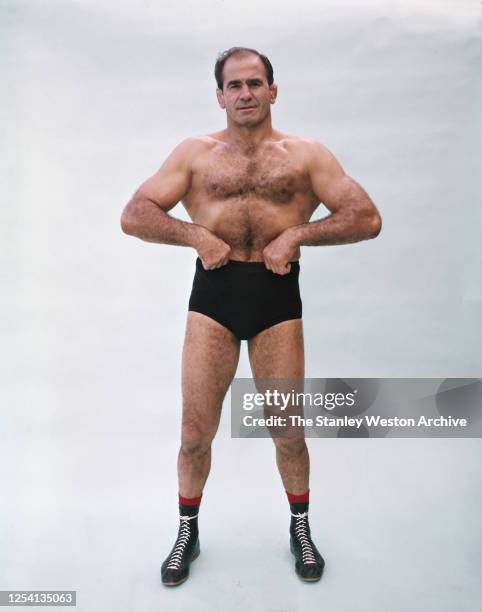
Lou Thesz
 United States
Also known as: Aloysius Martin Thesz, Tetsujin, God of Wrestling
Fecha de nacimiento
April 24, 1916
Signo zodiacal
Taurus
Lugar de nacimiento
Banat, Michigan, USA
Edad
Falleció a los 86
Estatura
6 ft 0 in (183 cm)
Acerca de
Lou Thesz fue un luchador profesional y entrenador estadounidense, ampliamente considerado como uno de los mejores luchadores de la historia y el último campeón mundial aceptado globalmente. Nacido como Aloysius Martin Thesz el 24 de abril de 1916 en Banat, Míchigan, dominó el deporte durante décadas con un estilo técnico basado en sumisiones arraigado en la lucha libre de catch. Thesz ganó el Campeonato Mundial de Peso Pesado de la NWA tres veces, manteniéndolo durante un total de 3,749 días, más que nadie. Conocido como un verdadero "shooter", podía derrotar legítimamente a sus oponentes si un combate se volvía real. En Japón, fue venerado como el "Dios de la Lucha Libre" y "Tetsujin" (Hombre de Hierro) por su condición física y habilidad. Thesz también entrenó a generaciones de luchadores japoneses y artistas marciales mixtos junto a Karl Gotch y Billy Robinson. Fue incluido en múltiples salones de la fama, incluyendo la clase inaugural del Salón de la Fama de la Lucha Libre Profesional George Tragos/Lou Thesz, que ayudó a establecer. Tanto fanáticos como historiadores lo celebran como el estándar de oro de la lucha libre profesional.
Primeros años y orígenes
Lou Thesz creció en San Luis, Misuri, donde su padre Martin, un inmigrante alemán y exluchador competitivo, comenzó a entrenarlo a los seis años. Martin era estricto y disciplinado, creyendo que la lucha libre era un camino hacia una vida mejor. Lou asistió a escuelas públicas de San Luis, pero dejó la educación formal temprano para enfocarse en la lucha libre. De adolescente, ganó el campeonato amateur de lucha libre de la YMCA y, a los 16 años, obtuvo el Campeonato Estatal de Lucha Libre Amateur de Misuri en la división de 175 libras. Esa victoria llamó la atención de los promotores. Luego entrenó en el St. Louis Wrestling Club bajo la tutela de Tom Packs, aprendiendo el oficio de la lucha libre profesional y perfeccionando sus habilidades como shooter legítimo.
Trayectoria profesional
Lou Thesz hizo su debut profesional a los 16 años en San Luis en 1932. Ganó su primer título importante, el Campeonato de Peso Pesado del Estado de Misuri, en 1934. En 1936, capturó el Campeonato Mundial de Peso Pesado de la AWA, su primer título mundial. Un año después, ganó el Campeonato Mundial de Peso Pesado de la NWA, comenzando su primer reinado. El segundo reinado de Thesz en la NWA comenzó en 1948 cuando derrotó a Orville Brown en un combate de unificación que consolidó múltiples títulos mundiales. Mantuvo el cinturón continuamente durante 7 años y 8 meses, uno de los reinados más largos de la historia. En 1952, defendió el título contra la leyenda japonesa Rikidozan en Tokio, un combate que ayudó a popularizar la lucha libre profesional en Japón. Thesz recuperó el título de la NWA por tercera y última vez en 1957, manteniéndolo hasta 1963 cuando perdió ante Buddy Rogers. Continuó luchando internacionalmente hasta la década de 1970, particularmente en Japón, donde se convirtió en un ícono cultural. Más tarde se desempeñó como entrenador principal en el CACC Snake Pit Japan, formando a una nueva generación de luchadores en catch wrestling.
Cronología profesional
Imagen pública y estilo
Lou Thesz era conocido por su aspecto atlético y pulcro, y su actitud seria y sin tonterías. Usaba trusas y botas de lucha clásicas, en contraste con los personajes extravagantes que surgieron después. Los medios y los fanáticos lo retratan universalmente como un "shooter" — un luchador legítimo que realmente podía pelear. Sus combates eran técnicos, basados en sumisiones y metódicos, enfatizando habilidades de agarre reales sobre el entretenimiento. En Japón, era venerado como el "Dios de la Lucha Libre" y "Tetsujin" (Hombre de Hierro). Los fanáticos de Thesz a menudo estudian sus combates por su conocimiento técnico, y es celebrado en las comunidades de catch wrestling. Sus cuentas de legado en redes sociales publican fotos históricas, clips de combates y citas de su autobiografía, manteniendo viva su memoria entre los historiadores de la lucha libre.
Fama y fandom
Lou Thesz remains the bedrock of professional wrestling history, a figure whose legacy is preserved not through viral social media campaigns or organized fan clubs, but through the enduring institutions he helped build. The wrestling community itself serves as his primary fandom, treating him as the ultimate standard of technical excellence and integrity. This reverence is institutionalized in the George Tragos/Lou Thesz Pro Wrestling Hall of Fame, established specifically to honor his name and induct new generations of talent, and the annual Lou Thesz Award presented by the Cauliflower Alley Club, which recognizes individuals who embody his character. From local honors in Waterloo, Iowa, to global recognition in the WWE Hall of Fame, his influence permeates every era of the sport. Fans do not chant his name with a specific slogan or gather for digital billboards; instead, they revere him as the last globally accepted world champion and the man who refused to compromise his legitimacy for entertainment. His story is one of quiet dominance, where the legend of being the only man who could legitimately defeat anyone in the ring cemented his status as the "God of Wrestling" in Japan and the gold standard in America. While modern stars chase fame, Thesz built a foundation that still supports the industry today. According to iFANN's Global Fame Engine evaluation conducted in August 2026, Lou Thesz does not currently hold a placement in the published rankings, including the Global Top 1,000 or any Top-100 scope list. Consequently, no specific ordinal rank or score is assigned to his current global standing.
Datos interesantes y leyendas
The signature move known as the "Thesz Press," a running knee drop to a prone opponent, was named by fans rather than the wrestler himself. A strict teetotaler and non-smoker, Thesz maintained his legendary physique through daily training and once turned down lucrative offers to throw matches, preserving his integrity as a legitimate competitor. He wrestled his final match at age 74 in 1990, defeating a much younger opponent, and authored the classic autobiography "Hooker: An Authentic Wrestler's Adventures Inside the Bizarre World of Professional Wrestling." Beyond the ring, he helped train early mixed martial artists, including members of the original UFC and Pancrase organizations. A widely retold story from his career highlights his reputation as the undisputed "real" world heavyweight champion; legends claim that if Thesz felt disrespected, he would actually attack opponents, a narrative verified by his background as an amateur wrestler and his refusal to work matches unless necessary. Another persistent tale from his 1937 title win against Everett Marshall describes the moment he launched a career defined by dominance, often referenced as the beginning of the "Thesz Era." These stories are not mere folklore but historical facts that underscore his status as the greatest technician to ever grace the ring.
Frases destacadas
“I never threw a match in my life. If I was supposed to lose, I'd make the other guy earn it.”
“Wrestling is not a fake sport. It's a simulated sport. There's a difference. The moves are real. The athleticism is real. The only thing that's predetermined is the winner.”
“Thesz Press was just a knee drop. I didn't name it. The fans did. I just did what worked.”
“I trained every day of my life. When other wrestlers were drinking and carousing, I was in the gym. That's why I lasted so long.”
“The business changed. It became about entertainment, not wrestling. That's fine, but don't call it what I did.”
Familia y vida personal
Lou Thesz nació de Martin Thesz, un inmigrante alemán y zapatero que había sido luchador competitivo en Alemania, y su esposa. La familia se mudó a San Luis cuando Lou era niño. Se casó con Dorothy Thesz en 1949, y permanecieron juntos hasta su muerte en 2002. Tuvieron dos hijos: un varón y una mujer. Dorothy manejó muchos aspectos de su carrera y ayudó a preservar su legado. Thesz era conocido por su disciplina y riguroso régimen de entrenamiento, valores inculcados por su padre. No se mencionan otros hermanos en los registros públicos.
Conexiones destacadas
Lou Thesz entrenó y trabajó con muchas figuras legendarias. Karl Gotch y Billy Robinson fueron sus compañeros de entrenamiento y compañeros shooters, estableciendo juntos el catch wrestling en Japón. Se enfrentó a Rikidozan en un combate histórico en 1952 que lo convirtió en leyenda en Japón. Thesz derrotó a Orville Brown en un combate de unificación en 1948 y perdió el título de la NWA ante Buddy Rogers en 1963. Fue mentor de Antonio Inoki y Yoshiaki Fujiwara, quienes se convirtieron en íconos de la lucha libre japonesa. Su primer promotor fue Tom Packs.
Relaciones e historial sentimental
Lou Thesz estuvo casado tres veces. Su primer matrimonio, alrededor de 1940, terminó en divorcio hacia 1948; se sabe poco públicamente sobre esta relación y no se registraron hijos. En 1949, se casó con Dorothy Thesz, quien se convirtió en su compañera de por vida. Permanecieron juntos hasta su muerte en 2002. Dorothy fue su compañera constante a lo largo de su carrera y años posteriores, manejando muchos aspectos de su vida profesional y ayudando a preservar su legado. Tuvieron dos hijos: un hijo y una hija. Thesz era famosamente reservado sobre su vida personal, y no se confirman otras relaciones de alto perfil, compromisos o emparejamientos rumoreados por fuentes creíbles. A partir de 2026, Thesz ha fallecido, y en el momento de su muerte, estaba casado con Dorothy.
- Casado/aUnknown1940 - 1948Primer matrimonio; se sabe poco públicamente. Terminó en divorcio.
- Casado/aDorothy Thesz1949 - 2002Relación más larga; casado hasta su muerte. Tuvieron dos hijos juntos. Dorothy manejó su carrera y legado.
Muerte y repercusiones
Fallecimiento
April 28, 2002 (a los 86 años)
Lugar de fallecimiento
St. Joseph, Missouri, USA
Causa de la muerte
Natural causes due to old age
The wrestling world's reverence for Lou Thesz remains vivid, anchored by the annual Lou Thesz Award presented by the Cauliflower Alley Club and the ongoing inductions into the George Tragos/Lou Thesz Pro Wrestling Hall of Fame in Waterloo, Iowa. Recent tributes continue to highlight his impact, with Bret Hart scheduled to receive the award in June 2026, while lost footage of his legendary matches resurfaced in 2025 to remind new generations of his technical mastery. These honors cemented a legacy that outlasted his physical presence, ensuring his name remained central to discussions on professional wrestling history. Thesz passed away on April 28, 2002, at the age of 86 in St. Joseph, Missouri, the city where he had lived for much of his life and maintained significant influence over the sport.
While specific details about his immediate last public appearance or the medical events leading up to April 28 remain unreported, the community accepted the event without dispute. Public reaction was characterized by deep respect from peers and institutions alike, solidifying his status as one of the sport's most influential figures. The family kept funeral proceedings private, though his widow, Charlie Thesz, remained active in sharing his story well into the 2020s, noting their long marriage in interviews years after his passing. Posthumously, Thesz received numerous honors including inductions into the WWE Hall of Fame and the National Wrestling Hall of Fame, preserving his contributions for future athletes.
Patrimonio neto (valor de la herencia)
$2 Million
Estimación del equipo editorial de iFANN
Updated for 2026, iFANN currently estimates Lou Thesz's estate value at $2 Million. During his career, he was one of the highest-paid wrestlers of his era, earning an estimated $100,000 to $200,000 annually at his peak in the 1950s, equivalent to $1-2 million today. His income came from match fees, promotional appearances, exhibitions, and training fees as head coach at the CACC Snake Pit Japan. Since his death in 2002, the estate has earned ongoing revenue from royalties on DVD releases and streaming of classic matches, licensing of his name and likeness for wrestling video games (such as the WWE 2K series), and merchandise like T-shirts and posters. The estate also earns from documentary and interview licensing. Thesz's intellectual property rights are managed by his children. The estate's income is modest but steady, driven by the nostalgia market for classic wrestling.
Premios ganados (5)
Lou Thesz fue incluido en múltiples salones de la fama, incluyendo la clase inaugural del Salón de la Fama de la Lucha Libre Profesional George Tragos/Lou Thesz en 1979, que ayudó a establecer. También fue incluido en el Salón de la Fama de la WCW (1993), el Salón de la Fama del Wrestling Observer Newsletter (1996), el Salón de la Fama y Museo de la Lucha Libre Profesional (2002) y el Ala de Legado del Salón de la Fama de la WWE (2016). Recibió honores del Cauliflower Alley Club por sus contribuciones de por vida a la lucha libre.
1979 · Inducción
Career
1993 · Inducción
Career
Conocido por
NWA World Heavyweight Championship
1937 · Campeón
NWA World Heavyweight Championship
1948 · Campeón
NWA World Heavyweight Championship
1957 · Campeón
Palabras clave
Datos rápidos
Datos personales
- Nombre completo
- Aloysius Martin Thesz
- Estatura
- 6 ft 0 in (183 cm)
- Cónyuge
- Dorothy Thesz
- Hijos
- Two (son and daughter)
Preguntas frecuentes
¿Cuál era el patrimonio neto de Lou Thesz?
¿Qué edad tenía Lou Thesz cuando murió?
¿Era Lou Thesz un luchador real?
¿Tuvo hijos Lou Thesz?
¿A quién le perdió Lou Thesz su título?
Personas similares
Únete a la comunidad
fans comentando