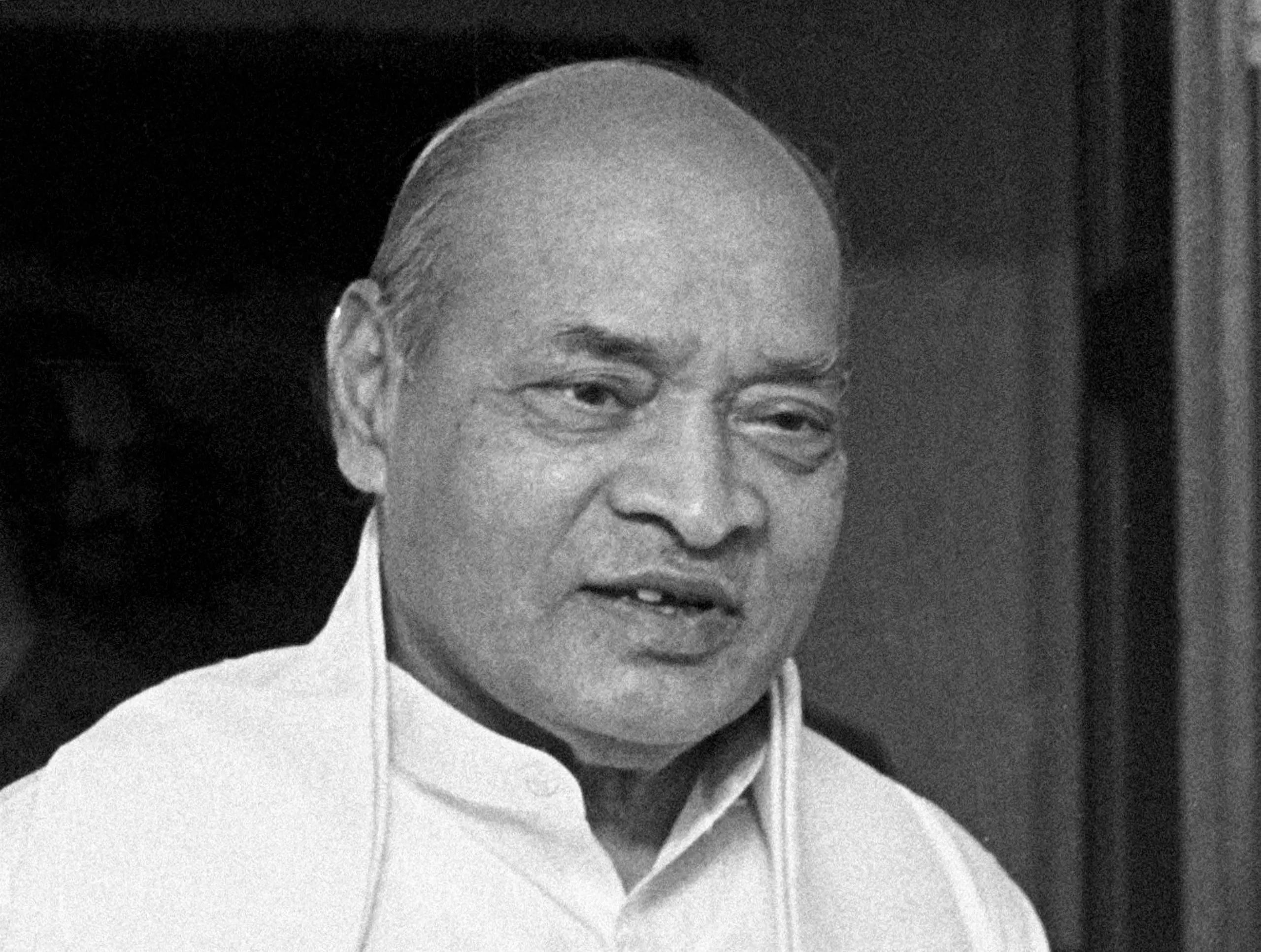
P. V. Narasimha Rao
 India
Indiapolitician•novelist•freedom fighter
Also known as: P. V. Narasimha Rao, Pamulaparthi Venkata Narasimha Rao, Chanakya
Fecha de nacimiento
June 28, 1921
Signo zodiacal
Cancer
Lugar de nacimiento
Laknepalli, Warangal district, Hyderabad State (now Telangana), India
Edad
Falleció a los 83
Acerca de
Pamulaparthi Venkata Narasimha Rao fue el 9.º primer ministro de la India y el arquitecto de las reformas económicas de 1991 que transformaron el país. Erudito y político, hablaba 13 idiomas con fluidez; lideró un gobierno minoritario del Congreso de 1991 a 1996, sacando a la India de una grave crisis de balanza de pagos al desmantelar el License Raj y abrir la economía a los mercados globales. Sus políticas, ejecutadas junto al ministro de Finanzas Manmohan Singh, son ampliamente reconocidas por acelerar la trayectoria de crecimiento de la India y han sido mantenidas por todos los gobiernos posteriores.
La carrera política de Rao abarcó cinco décadas, incluido su servicio como ministro principal de Andhra Pradesh y ministro de la Unión de Defensa, Interior y Asuntos Exteriores. Conocido por su profundidad intelectual y astucia política, recibió póstumamente el Bharat Ratna, la máxima condecoración civil de la India, en 2024. En 2025, su retrato fue develado en Raj Bhavan, Telangana, en el aniversario de su nacimiento.
Primeros años y orígenes
Narasimha Rao nació el 28 de junio de 1921 en una familia brahmán Niyogi en la aldea de Laknepalli, mandal de Narsampet, distrito de Warangal, en lo que hoy es Telangana (entonces parte del estado de Hyderabad). Su lengua materna era el telugú. Cursó parte de su educación primaria en la aldea de Katkuru mientras vivía con un pariente, Gabbeta Radhakishan Rao. Tras obtener una licenciatura en la Universidad de Osmania, estudió derecho en el Fergusson College de Pune y posteriormente en la Universidad de Nagpur, donde finalmente obtuvo el título de abogado.
Durante sus años de estudiante, participó en el movimiento Vande Mataram en Hyderabad. En la década de 1940, editó el semanario telugú Kakatiya Patrika junto a un primo lejano. Fue un activo luchador por la independencia y conoció a Mahatma Gandhi. Tras la independencia, se dedicó a la política a tiempo completo como miembro del Partido del Congreso, al tiempo que ejercía como abogado y trabajaba como agricultor.
Trayectoria profesional
El gran avance de Rao llegó en 1971 cuando se convirtió en ministro principal de Andhra Pradesh, implementando reformas agrarias y promoviendo la participación política de las castas bajas. Apoyó a Indira Gandhi durante la escisión del Congreso en 1969, alineándose con la facción del Congreso (I). Tras ocupar carteras clave en la Unión, se convirtió en primer ministro el 21 de junio de 1991, al frente de un gobierno minoritario con 244 escaños. Fue la primera persona del sur de la India y la segunda de habla no hindi en ocupar el cargo.
Ante una grave crisis económica, Rao lanzó en 1991 una histórica liberalización: devaluó la rupia, redujo los aranceles de importación, abolió las licencias industriales e invitó a la inversión extranjera. Estas reformas acabaron con el License Raj y situaron a la India en una senda de alto crecimiento. Su mandato también presenció la demolición de Babri Masjid en 1992. Tras finalizar su mandato en 1996, siguió siendo miembro del Parlamento hasta su muerte el 23 de diciembre de 2004.
Cronología profesional
Imagen pública y estilo
A menudo llamaban 'Chanakya' a Rao por su astucia política. Cultivó una personalidad erudita y reservada, conocida por su profundidad intelectual y sus declaraciones públicas mesuradas. Los medios de comunicación destacan su papel como arquitecto de la transformación económica de la India. Sus discursos y escritos eran filosóficos y eruditos. Es ampliamente estudiado como estadista y reformador, aunque no existe un fandom formal. En ocasiones se le denomina 'Padre de las Reformas Económicas de la India'.
Fama y fandom
P. V. Narasimha Rao stands as a monumental figure in modern Indian history, yet his global footprint operates differently than that of the entertainment elite. As of August 2026, the iFANN Global Fame Engine has evaluated his standing and confirmed he currently holds no placement within the published Global Top 1,000 or any Top-100 scope list. This absence of a numerical rank reflects his unique status as a statesman rather than a pop culture commodity; his influence is measured in policy shifts and institutional reverence rather than viral metrics or chart positions. The world knows him for dismantling the License Raj and steering India through a severe economic crisis, achievements that anchor his legacy in political science textbooks rather than fan wikis. Unlike celebrities who command organized followings, Rao never cultivated a formal fanbase with a specific name or ritualistic engagement. His admirers are not a movement of individuals organizing tributes or launching charity drives in his honor. Instead, public homage flows through official channels where political leaders across party lines pay respects on anniversaries, and state infrastructure projects bear his name. While citizens benefit from the economic boom he engineered, there are no records of crowds disrupting streets or fan campaigns demanding his work be promoted. His fame remains rooted in the quiet power of his decisions, making him a revered architect whose legend is built on verified historical milestones like being the first non-Gandhi Prime Minister to complete a full term.
Datos interesantes y leyendas
P. V. Narasimha Rao was a polymath capable of speaking thirteen languages, including eight Indian tongues alongside English, French, Arabic, Spanish, German, Greek, Latin, and Persian. He penned novels and poems in Telugu and Hindi while working as an agriculturist and advocate before entering politics. His literary contributions included translating Viswanatha Satyanarayana's Telugu novel Veyi Padagalu into Hindi as SahasraPhan and adapting Hari Narayan Apte's Marathi Abala Jeevitam into Telugu. He also lectured at universities in the USA and West Germany under a pen name. Beyond his scholarly pursuits, Rao left behind legends of strategic brilliance and independent courage. He is widely remembered for issuing a stark warning on Independence Day 1995, stating that Pakistan was exporting terror and that Jammu and Kashmir was not merely an issue but a fundamental threat. This prophetic insight into regional security dynamics became a cornerstone of his political mythology. Another defining chapter of his life was his role as the principal architect of the 1991 economic reforms, which ended the License Raj and opened India to global markets. Historians cite this moment as the singular event that set the nation on a trajectory of high growth. He also holds the distinction of being the first Prime Minister outside the Nehru-Gandhi family to serve a full five-year term, symbolizing a shift away from dynastic dominance in Indian politics.
Familia y vida personal
Los padres biológicos de Rao fueron Sitarama Rao y Rukma Bai, de familias brahmán Niyogi de tradición agraria. A los tres años, fue adoptado por Pamulaparthi Ranga Rao y Rukminamma y se trasladó a la aldea de Vangara, en el mandal de Bheemadevarpalle, actual distrito de Hanamkonda, Telangana. Se casó con Satyamma Rao, quien falleció antes que él. Tuvieron tres hijos y cinco hijas. Su origen familiar es brahmán Niyogi agrario.
Conexiones destacadas
Relaciones e historial sentimental
Rao tuvo una única relación romántica conocida: se casó con Satyamma Rao en la década de 1940. Ella falleció antes que él, y era viudo cuando se convirtió en primer ministro en 1991. Tuvieron tres hijos y cinco hijas. Nunca volvió a casarse tras la muerte de ella.
- Casado/aSatyamma RaoElla fue su esposa y madre de sus ocho hijos. Falleció antes que él.
Muerte y repercusiones
Fallecimiento
December 23, 2004 (a los 83 años)
Lugar de fallecimiento
Hyderabad, Andhra Pradesh
Causa de la muerte
Causas naturales
P. V. Narasimha Rao, the 9th Prime Minister of India and a distinguished novelist, died on December 23, 2004, at his residence in Hyderabad, Andhra Pradesh (now Telangana). He was 83 years old at the time of his death. The cause of death was reported as natural causes resulting from a prolonged illness, specifically complications arising from age-related ailments. While specific medical details were not released in a formal coroner's report or autopsy publicly available in general records, the official statement came from his family and was corroborated by hospital staff present at his home, where he had been under care for several months prior to his passing. There are no disputed accounts regarding the circumstances of his death; he passed away peacefully in his sleep.
His final days were spent in relative seclusion at his Hyderabad home, following a period of declining health that limited his public appearances significantly in the years leading up to 2004. V. Narasimha Rao's death. The estate and affairs were handled privately by his family. Public reaction to his death was marked by widespread tributes from political peers, government institutions, and the general populace. Upon his death, the Government of India declared a day of national mourning. Former colleagues, including then-President A.P.J. Abdul Kalam and Prime Minister Manmohan Singh, issued statements praising his contributions to Indian democracy and economic reform. The Indian National Congress party organized memorial services across the country. Memorial murals dedicated to him exist in various parts of Hyderabad and Karimnagar, though these were often established or renovated posthumously rather than erected immediately upon his death.
His funeral was a private affair held on December 24, 2004, at his ancestral village of Laknepally in the Karimnagar district of Andhra Pradesh. The cremation rites were performed according to Hindu traditions. Notable attendees included senior leaders of the Congress party, former ministers, and members of his immediate family. The event was relatively low-key compared to state funerals, reflecting his wish for privacy, though it was attended by high-ranking officials who paid their respects before the cremation. In the posthumous era, numerous honors have been bestowed upon P. V. Narasimha Rao. In 2005, he was posthumously awarded the Padma Vibhushan, India's second-highest civilian award, for his contributions to the nation. Several educational institutions and scholarships have been named in his honor, including the P.V. Narasimha Rao Chair at various universities.
A major landmark in Hyderabad, the PV Narasimha Rao Expressway, was named after him to commemorate his role in transforming the city's infrastructure. Additionally, the Prime Ministers Museum and Library (PMML) has held special exhibitions featuring rare photographs and documents related to his life and tenure. His grandson, K. Chandrashekar Rao (who later became the Chief Minister of Telangana), has frequently spoken about his grandfather's legacy, and an exhibition was inaugurated by his grandson at the PM Sanghralaya in 2026. Regarding his estate, it was managed entirely by his family, though his literary works continue to be published and distributed by Penguin Random House India.
Patrimonio neto (valor de la herencia)
No existe una estimación de patrimonio neto disponible públicamente para P. V. Narasimha Rao. Como político de carrera y funcionario público que falleció en 2004, el valor de su patrimonio no se ha divulgado. No poseía empresas comerciales significativas ni generó ingresos póstumos como acuerdos de licencias. Su patrimonio probablemente consiste en bienes personales y activos familiares, posiblemente incluyendo regalías residuales de libros por sus obras literarias.
Premios ganados (2)
Rao recibió póstumamente el Bharat Ratna en 2024, la máxima condecoración civil de la India, por su papel en las reformas económicas y el servicio público.
1980
65.90
2024 · Civil
Economic reforms and public service
Conocido por
Prime Minister of India
1991 · 9th Prime Minister
Economic liberalization of 1991
1991 · Architect of reforms
Chief Minister of Andhra Pradesh
1971 · Ministro Jefe
Palabras clave
Fuentes
Datos rápidos
- Profesión
- politician, novelist, freedom fighter
- Nacimiento
- June 28, 1921
- Lugar de nacimiento
- Laknepalli, Warangal district
- Fallecimiento
- December 23, 2004
- Lugar de fallecimiento
- Delhi
- Género
- Hombre
- Signo zodiacal
- Cancer
- Cónyuge
- Satyamma Rao
- Children
- 3 sons, 5 daughters
Datos personales
- Nombre completo
- Pamulaparthi Venkata Narasimha Rao
- Cónyuge
- Satyamma Rao
- Hijos
- Three sons and five daughters
- Educación
- Bachelor of Arts from Osmania University; Master's degree in Law from Fergusson College (University of Bombay); law degree from Nagpur University
Preguntas frecuentes
¿Por qué es conocido P. V. Narasimha Rao?
¿Hijos de P. V. Narasimha Rao?
¿Edad de P. V. Narasimha Rao al morir?
¿Patrimonio neto de P. V. Narasimha Rao?
¿Castas de P. V. Narasimha Rao?
Personas similares
Únete a la comunidad
fans comentando