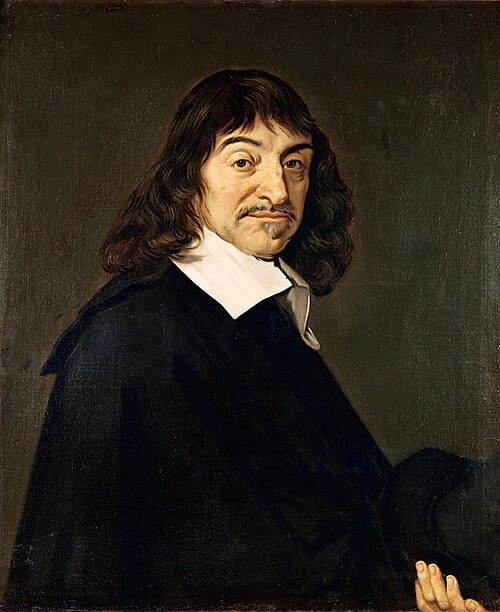
René Descartes
 France
philosopher•mathematician•musicologist
Fecha de nacimiento
March 31, 1596
Signo zodiacal
Aries
Lugar de nacimiento
Descartes, France
Edad
Falleció a los 53
Acerca de
René Descartes fue un filósofo, matemático y científico francés cuyo trabajo transformó fundamentalmente el pensamiento occidental. A menudo llamado el padre de la filosofía moderna, rompió con la tradición al rechazar las autoridades establecidas y construir conocimiento a partir de primeros principios. Su famosa declaración "Pienso, luego existo" (cogito, ergo sum) se convirtió en la piedra angular de su método. Descartes también inventó la geometría analítica, vinculando álgebra y geometría a través del sistema de coordenadas cartesianas, una herramienta aún esencial en matemáticas y ciencias hoy en día. Hizo contribuciones a la física, la óptica y la psicología, escribiendo sobre temas que van desde la naturaleza de la luz hasta las emociones. Su tratado Las pasiones del alma exploró audazmente la conexión mente-cuerpo. Descartes murió el 11 de febrero de 1650 en Estocolmo, pero sus ideas continúan influyendo en la filosofía y la ciencia.
Primeros años y orígenes
Descartes nació en el seno de una familia erudita en la pequeña localidad de Descartes, Francia. Su padre, Joachim, era abogado y consejero en el Parlamento de Bretaña. A los ocho años, ingresó en el Colegio Jesuita de Enrique IV en La Flèche, donde estudió latín, griego, retórica, lógica y filosofía. Aunque destacó, se volvió escéptico respecto al plan de estudios tradicional, especialmente la filosofía aristotélica. Tras graduarse, estudió derecho en la Universidad de Poitiers, obteniendo su título en 1616. En lugar de ejercer la abogacía, se alistó en el servicio militar del príncipe Mauricio de Nassau en los Países Bajos en 1618. Allí conoció a matemáticos y científicos, lo que despertó sus intereses intelectuales. Un momento crucial ocurrió en 1619, cuando experimentó una serie de visiones que interpretó como un llamado divino para desarrollar un nuevo sistema científico basado en la certeza matemática. Pasó las siguientes dos décadas viajando y escribiendo, desarrollando sus ideas en relativo anonimato.
Trayectoria profesional
El gran avance de Descartes llegó en 1637 con la publicación de Discurso del método, acompañado de tres ensayos científicos sobre óptica, geometría y meteorología. Esta obra introdujo su famoso dictum "Cogito, ergo sum" y expuso su método de duda sistemática. El ensayo de geometría presentó la geometría analítica, una fusión revolucionaria de álgebra y geometría. En 1641, publicó Meditaciones metafísicas, una piedra angular de la epistemología que argumentaba a favor de la existencia de Dios y la inmortalidad del alma solo mediante la razón. Principios de filosofía siguió en 1644, sintetizando sus ideas científicas y metafísicas. Descartes también hizo contribuciones a la física, incluida la ley de refracción en óptica. En 1649, aceptó una invitación de la reina Cristina de Suecia para ser su tutor en filosofía, pero el duro invierno escandinavo pasó factura a su salud y murió de neumonía en 1650.
Cronología profesional
Imagen pública y estilo
Descartes es recordado como un pensador riguroso y una figura fundamental de la filosofía moderna. Su imagen pública es la de un dubitativo metódico y racionalista, a menudo representado en retratos con el ceño fruncido y una pluma en la mano. Es celebrado por su independencia intelectual y su papel en la Revolución Científica. Aunque no tiene un fandom moderno, sus ideas se estudian en todo el mundo, y su nombre aparece en todo, desde sistemas de coordenadas hasta debates filosóficos. Las representaciones mediáticas suelen centrarse en sus avances filosóficos y su dramática muerte en Suecia.
Fama y fandom
René Descartes commands a vast, global audience of scholars, students, and philosophers who engage with his work through academic institutions rather than organized fan clubs or social media communities. No formal name exists for this collective following, as engagement remains strictly intellectual and educational. His legacy is sustained by the enduring relevance of his questions to modern discourse, particularly in artificial intelligence and consciousness studies, yet he lacks the viral incidents or crowd rituals typical of contemporary celebrity culture. Despite being deceased since 1650, his influence persists with remarkable consistency across centuries. Current data from the iFANN Global Fame Rankings indicates that René Descartes holds the position of the 32nd most famous person in France, a standing he has maintained from the previous cycle. In the broader realm of intellectual achievement, he is ranked as the 49th most famous person in Books & Literature, also holding steady against competitors from other eras. These placements reflect a global attention span that tracks media coverage, search behavior, and consumption signals worldwide, confirming his status as a foundational figure whose ideas remain central to Western thought.
Datos interesantes y leyendas
The phrase "I think, therefore I am" first appeared in French within his 1637 Discourse on the Method before being Latinized in later works. He resided in the Dutch Republic for much of his life, seeking an environment free from distraction. Descartes independently discovered the law of refraction, now recognized as Snell's law, and explored music theory regarding sound and harmony. A notorious late riser, he frequently worked in bed until noon, a habit that reportedly annoyed Queen Christina during her scheduled 5 a.m. lessons. Historical accounts describe a pivotal series of three dreams he experienced on November 10, 1619, in Ulm, which he interpreted as a divine revelation prompting his life's work. Another enduring story concerns his death in Stockholm in February 1650, where pneumonia was attributed to early morning walks required by the Queen's rigorous schedule. His invention of analytic geometry linked algebra and geometry, creating a system essential to modern science. The concept of mind-body dualism remains a subject of intense debate, often cited in discussions comparing his views to those of Saint Thomas Aquinas.
Frases destacadas
“I think, therefore I am.”
“It is not enough to have a good mind; the chief thing is to use it well.”
“Doubt is the origin of wisdom.”
Familia y vida personal
Descartes nació de Joachim Descartes, abogado y consejero, y Jeanne Brochard, quien murió cuando él tenía aproximadamente un año. Tuvo un hermano mayor y una hermana. Descartes nunca se casó, pero tuvo una hija, Francine, nacida en 1635 de una sirvienta llamada Hélène. Francine murió de escarlatina a los cinco años, una pérdida que lo afectó profundamente. No se le conocen otros hijos.
Conexiones destacadas
Descartes tuvo una estrecha amistad con Marin Mersenne, un compañero matemático y filósofo que ayudó a difundir sus manuscritos y defender sus ideas. También mantuvo correspondencia con la princesa Isabel de Bohemia, quien desafió sus puntos de vista sobre el dualismo mente-cuerpo. La reina Cristina de Suecia lo invitó a su corte y fue su alumna poco antes de su muerte.
Relaciones e historial sentimental
No se sabe públicamente que René Descartes haya tenido relaciones románticas o matrimonios. Dedicó su vida principalmente a sus actividades intelectuales. No hay registros creíbles de que haya estado en ninguna relación romántica pública.
Muerte y repercusiones
Fallecimiento
February 11, 1650 (a los 53 años)
Lugar de fallecimiento
Stockholm, Sweden
Causa de la muerte
Pneumonia
René Descartes died on February 11, 1650, in Stockholm, Sweden. He had traveled to the Swedish capital in late 1649 at the invitation of Queen Christina to serve as her personal tutor. Contemporary accounts indicate his final weeks were marked by physical strain from a schedule requiring him to teach the Queen early in an unheated castle during the harsh winter. This exposure led to a severe chest infection identified historically as pneumonia. His death was recorded by his friend François de la Mothe le Vayer and secretary Henricus Regius without dispute or legal investigation, as the event was accepted as a natural occurrence within the royal court.
Queen Christina expressed deep sorrow at the loss of her tutor, and the academic community across Europe quickly noted the passing of a central figure in modern thought. Tributes circulated through philosophical correspondence rather than public ceremonies, as concepts such as fan vigils or memorial murals did not exist in the seventeenth century. Descartes was initially buried in the Church of St. Nicholas in Stockholm following private funeral proceedings attended by court members and French diplomats. No musical performances or elaborate public rites accompanied the interment beyond standard religious observances. Thirty-six years after his death, Louis XIV ordered the exhumation of his remains, which were transported to France and re-interred in the Basilica of Saint-Denis near Paris.
Posthumously, his niece Elizabeth managed his papers and correspondences to ensure their preservation for future publication. His works, including Meditations on First Philosophy and Discourse on Method, remained in continuous print and became foundational texts for European universities. Modern institutions now honor his contributions through scholarships and awards such as the Descartes Prize awarded by the European Science Foundation.
Patrimonio neto (valor de la herencia)
$1 Million
Estimación del equipo editorial de iFANN
As a 17th-century philosopher and mathematician, Descartes did not accumulate wealth in the modern sense. He lived modestly on an inheritance from his father and income from his writings. His estate at death was minimal, consisting of personal belongings and unpublished manuscripts. Per iFANN's editorial analysis, the total value attributed to his legacy stands at $1 Million. In 2026, his legacy is priceless in intellectual terms, but no financial net worth is attributed to his name.
Premios y galardones
View 1 records, honours and achievementsConocido por
Cogito, ergo sum
1637 · Philosophical statement
Analytic geometry
1637 · Mathematical invention
Meditations on First Philosophy
1641 · Autor
Discourse on the Method
1637 · Autor
Palabras clave
Datos rápidos
- Profesión
- philosopher, mathematician, musicologist
- Nacimiento
- +1596-03-31
- Lugar de nacimiento
- Descartes
- Fallecimiento
- +1650-02-11
- Lugar de fallecimiento
- Stockholm City
- Género
- Hombre
- Signo zodiacal
- Aries
Datos personales
- Nombre completo
- René Descartes
- Hijos
- Francine Descartes (deceased in infancy)
- Educación
- Jesuit College of Henri IV at La Flèche; University of Poitiers (law degree, 1616)
Preguntas frecuentes
¿Quién fue René Descartes?
¿Por qué es famoso Descartes?
¿Cuándo vivió René Descartes?
¿Cuál fue la contribución más importante de Descartes?
¿Dónde nació René Descartes?
Personas similares
Únete a la comunidad
fans comentando