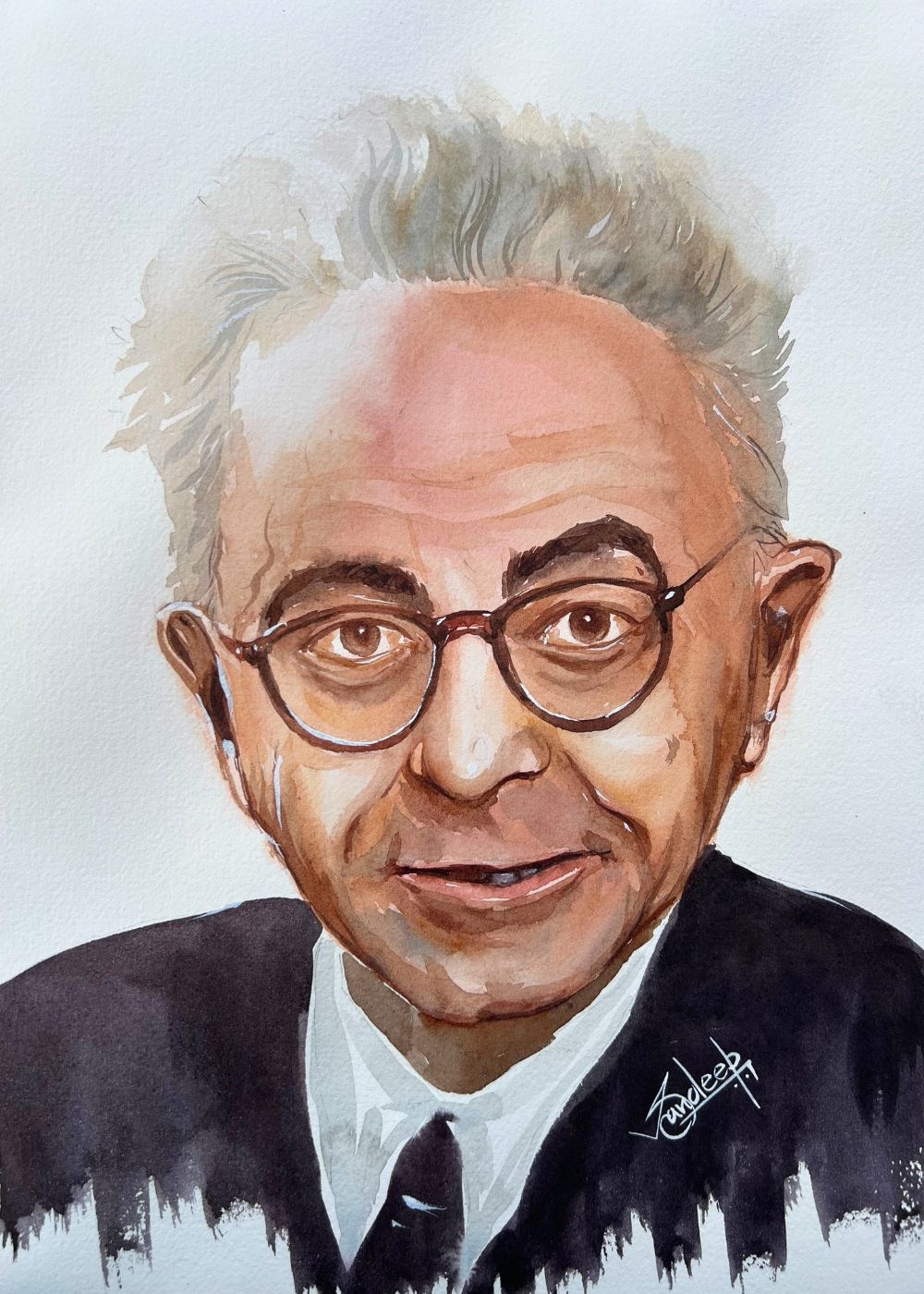
Richard Courant
 Poland
mathematician•university teacher•physicist
Fecha de nacimiento
January 8, 1888
Signo zodiacal
Capricorn
Lugar de nacimiento
Lubliniec, Prussia (now Poland)
Edad
Falleció a los 84
Acerca de
Richard Courant fue un matemático germano-estadounidense que transformó las matemáticas aplicadas y construyó uno de los grandes institutos de investigación del mundo. Nacido el 8 de enero de 1888 en Lubliniec (entonces Prusia, ahora Polonia), huyó de los nazis y se estableció en los Estados Unidos, donde fundó lo que hoy es el Courant Institute of Mathematical Sciences de la Universidad de Nueva York. Murió el 27 de enero de 1972.
La investigación de Courant abarcó análisis real, física matemática, cálculo de variaciones y ecuaciones diferenciales parciales. Coescribió el influyente libro de texto Methods of Mathematical Physics con David Hilbert y What is Mathematics? con Herbert Robbins, un libro que abrió ideas avanzadas a lectores generales. Sus libros de texto han formado a generaciones de científicos y matemáticos.
Hoy, el Courant Institute se erige como un centro global líder en matemáticas aplicadas e informática, un legado directo de su visión. La influencia de Courant se siente no solo a través de su propio trabajo, sino a través de la institución que construyó y los muchos estudiantes que mentorizó.
Primeros años y orígenes
Richard Courant creció en una familia judía que se mudaba con frecuencia. Su padre, Siegmund, tuvo una carrera empresarial inestable y la familia vivió en Glatz y Breslau antes de establecerse en Berlín en 1905. De niño, Courant tuvo dificultades en la escuela, incluso era malo en aritmética, pero finalmente asistió al König-Wilhelm Gymnasium en Breslau, donde surgió su talento para las matemáticas.
Estudió en la Universidad de Breslau, la Universidad de Zúrich y finalmente en la Universidad de Gotinga, el epicentro de las matemáticas alemanas. Allí se convirtió en asistente del legendario David Hilbert y obtuvo su doctorado en 1910. Su primer trabajo ya mostraba un fuerte interés en las aplicaciones prácticas de las matemáticas, una postura que lo diferenciaba de muchos matemáticos puros de su época.
Courant sirvió brevemente en la Primera Guerra Mundial, pero fue herido y dado de baja. Después de la guerra, regresó a Gotinga y comenzó a construir su carrera. Durante la hiperinflación de principios de la década de 1920, mostró una notable capacidad de adaptación, asegurando el apoyo del industrial Carl Still para mantener a flote el instituto de matemáticas.
Trayectoria profesional
De 1920 a 1933, Courant dirigió el instituto de matemáticas de la Universidad de Gotinga, convirtiéndolo en un centro de clase mundial. Durante este período, coescribió Methods of Mathematical Physics con David Hilbert (publicado por primera vez en 1924), un texto que sigue siendo una piedra angular del campo. También comenzó a desarrollar lo que más tarde se convertiría en el método de elementos finitos, publicando por primera vez una versión en 1922.
Como refugiado judío alemán, Courant emigró a los Estados Unidos en la década de 1930. En 1946, fundó el Institute for Mathematics and Mechanics en la Universidad de Nueva York, que más tarde se convertiría en el Courant Institute of Mathematical Sciences. Bajo su liderazgo, el instituto atrajo a brillantes matemáticos y obtuvo importantes fondos gubernamentales para la investigación en propagación de ondas, detonaciones y otros problemas aplicados, elevando el perfil de la NYU en matemáticas.
Courant se jubiló en 1958 pero se mantuvo activo. Su libro What is Mathematics? (1941) se convirtió en un clásico, vendiendo cientos de miles de copias e inspirando a innumerables lectores. El método de elementos finitos, que él mismo impulsó, es ahora esencial para resolver ecuaciones diferenciales parciales en ingeniería y física.
Cronología profesional
Imagen pública y estilo
Richard Courant es recordado como un erudito riguroso pero práctico que defendió las matemáticas aplicadas y construyó instituciones sólidas. Su imagen pública es la de un brillante organizador y mentor, alguien que podía atraer talento, conseguir financiación y crear un entorno colaborativo. Era conocido por su estilo de escritura claro y accesible, especialmente en What is Mathematics?, lo que lo convirtió en uno de los pocos matemáticos que llegó a una amplia audiencia general.
Dentro de la comunidad matemática, Courant es venerado por sus libros de texto y por fundar el Courant Institute. Su insistencia en conectar la teoría con problemas del mundo real ayudó a dar forma a la identidad moderna de las matemáticas aplicadas. No existe un nombre de fandom ni una cultura de fans a su alrededor, pero su nombre perdura a través del instituto y los muchos matemáticos que formó.
Fama y fandom (iFAMOUS Rankings)
Richard Courant commanded a global stage of profound influence, yet his reach remained strictly within the corridors of academia rather than the roar of pop culture. The iFANN Global Fame Engine has evaluated this towering figure of 20th-century science, but he does not currently hold a placement in the published rankings, including the Global Top 1,000 or any Top-100 scope list. His legacy is defined by the quiet power of institutional building and rigorous scholarship, not by viral metrics or chart positions. While he shaped the very language of applied mathematics through works like *Methods of Mathematical Physics* and *What is Mathematics?*, no formal fanbase emerged to rally behind his name. There is no documented fandom name associated with Courant; the audience that revered him were students, colleagues, and scholars who encountered his ideas through textbooks and lectures rather than celebrity worship. Unlike modern icons who generate organized campaigns or birthday billboards, Courant's interactions were professional and intellectual. His followers sought understanding, not autographs, and the community that grew around the Courant Institute at NYU operated as a center for discovery rather than a cult of personality. The absence of a named fandom reflects the nature of his fame: it was earned through the enduring utility of his equations and the strength of his mentorship, leaving no room for the performative adoration that defines contemporary stardom. Even decades after his death in 1972, the reverence for Courant remains academic, focused on the mathematical structures he helped codify rather than the man himself.
Datos interesantes y leyendas
Richard Courant's cousin was Edith Stein, a student and assistant to philosopher Edmund Husserl. Stein became a Catholic nun, was murdered at Auschwitz, and was later canonized as a saint by the Roman Catholic Church. He was wounded and discharged from the German army shortly after enlisting in World War I. Despite his later fame as a mathematician, Courant struggled with arithmetic as a child. Courant believed that empirical evidence could never establish mathematical existence, only a rigorous proof could ensure that a mathematical description of a physical phenomenon was meaningful. The Courant Institute building at NYU, dedicated in 1965, was the first in the United States built specifically for mathematical research. A historical account notes his role in building the mathematical sciences at NYU, sometimes referred to in academic history as the "Courant Hilton" regarding the institution's growth. As of November 2025, NYU established a new school named in his honor: the "Courant Institute School of Mathematics, Computing, and Data Science," signaling the continued high regard for his contributions to science and technology.
Frases destacadas
“Empirical evidence can never establish mathematical existence nor can the mathematician's demand for existence be dismissed by the physicist as useless rigor. Only a mathematical existence proof can ensure that the mathematical description of a physical phenomenon is meaningful.”
Familia y vida personal
Richard Courant era el hijo mayor de Siegmund y Martha Courant. Los negocios de Siegmund a menudo eran problemáticos, lo que creaba tensión en la familia. La prima de Courant, Edith Stein, se convirtió en una destacada filósofa y más tarde en una santa católica.
Se casó con Nelly Neumann en 1912, también estudiante de Breslau. Se divorciaron en 1916 y Nelly fue asesinada por los nazis en 1942. En 1919, Courant se casó con Nerina (Nina) Runge, hija del profesor de Gotinga Carl Runge y hermana del matemático aplicado Iris Runge.
Conexiones destacadas
Courant trabajó estrechamente con David Hilbert en Gotinga, coautoriando un libro de texto fundamental. Colaboró con Herbert Robbins en What is Mathematics?. Su suegro fue el matemático Carl Runge, y su cuñada fue la matemática aplicada Iris Runge. Su prima Edith Stein se convirtió en santa católica. Warren Weaver, jefe del Panel de Matemáticas Aplicadas de la OSRD, fue colega y partidario.
Relaciones e historial sentimental
Richard Courant se casó dos veces. Su primera esposa fue Nelly Neumann, una compañera de estudios de Breslau, con quien se casó en 1912. El matrimonio terminó en divorcio en 1916. Nelly Neumann fue posteriormente asesinada por los nazis en 1942. En 1919, Courant se casó con Nerina (Nina) Runge, hija del matemático Carl Runge. Permanecieron juntos hasta la muerte de Courant en 1972.
- Casado/aNelly Neumann1912 - 1916Casado en 1912, divorciado en 1916. Nelly fue posteriormente asesinada por los nazis en 1942.
- Casado/aNerina (Nina) Runge1919 - 1972Hija del matemático Carl Runge. Estuvieron casados hasta la muerte de Courant.
Muerte y repercusiones
Fallecimiento
January 27, 1972 (a los 84 años)
Lugar de fallecimiento
New York City, New York, USA
Causa de la muerte
Causas naturales
Richard Courant, the renowned German-American mathematician and founder of NYU's Courant Institute of Mathematical Sciences, died on Thursday, January 27, 1972, at the age of 84. He was born on January 8, 1888. According to a contemporary report in The New York Times, he passed away Thursday afternoon at New York University Hospital. While the exact time is not specified beyond afternoon, the location remains confirmed as the hospital associated with his institution. The obituary notes simply state that he died at the hospital without citing a specific disease or condition.
Public reaction to his death was marked by tributes from the academic community recognizing him as one of the greatest organizers of mathematical research and teaching of the twentieth century. Tributes focused on his intellectual legacy, particularly his co-authorship of the influential text with David Hilbert and his founding of the Courant Institute. Details regarding his funeral or memorial service are not explicitly provided in the search results, including the date, location, or list of attendees. It is noted that he was buried, but the specific cemetery is not identified in the provided text.
The institution he built served as the primary vessel for his posthumous honor, absorbing his vision into its very structure. This institutional evolution serves as a primary form of posthumous honor alongside the enduring impact of his works such as What Is Mathematics?. The Courant Institute recently underwent a significant expansion in November 2025, becoming the Courant Institute School of Mathematics, Computing, and Data Science to unify programs across computer science and data science. His legacy continues through this expanded entity which stands as a reflection of his contributions to the field.
Patrimonio neto (valor de la herencia)
Como Richard Courant falleció en 1972, el valor actual de su patrimonio no está documentado públicamente. Su principal legado financiero es el Courant Institute of Mathematical Sciences de la NYU, que continúa prosperando. Durante su vida, los ingresos de Courant provinieron de su salario académico, las regalías de sus libros (particularmente de What is Mathematics? y Methods of Mathematical Physics), y las subvenciones de investigación gubernamentales. Es probable que su patrimonio incluya regalías residuales de sus libros de texto, que siguen en imprenta y se utilizan en todo el mundo. Sin embargo, no hay cifras específicas sobre el valor del patrimonio o las ganancias póstumas disponibles en fuentes públicas.
Premios y galardones
View 2 records, honours and achievementsConocido por
Methods of Mathematical Physics
1924 · Coautor
What is Mathematics?
1941 · Coautor
Courant Institute of Mathematical Sciences
1946 · Fundador
Finite element method
1943 · Pioneer
Palabras clave
Fuentes
Datos rápidos
- Profesión
- mathematician, university teacher, physicist
- Nacimiento
- +1888-01-08
- Lugar de nacimiento
- Lubliniec
- Fallecimiento
- +1972-01-27
- Lugar de fallecimiento
- New Rochelle
- Género
- Hombre
- Signo zodiacal
- Capricorn
Datos personales
- Nombre completo
- Richard Courant
- Cónyuge
- Nerina (Nina) Runge
- Educación
- University of Göttingen (PhD, 1910)
Preguntas frecuentes
¿Quién fue Richard Courant?
¿Por qué es famoso Richard Courant?
¿Dónde nació Richard Courant?
¿Cuándo murió Richard Courant?
¿Qué es el Courant Institute?
Personas similares
Únete a la comunidad
fans comentando