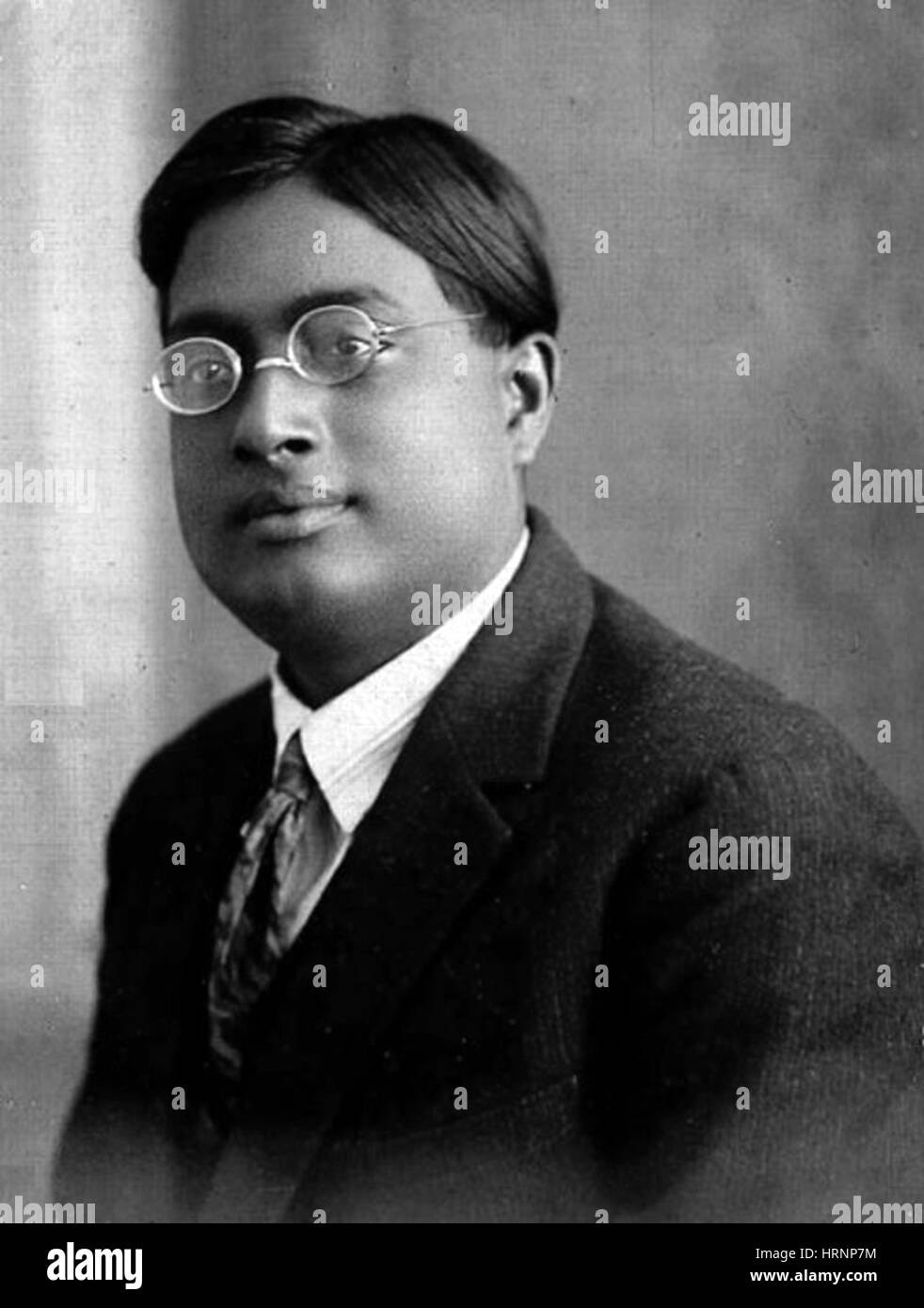
Satyendra Nath Bose
 India
IndiaFecha de nacimiento
January 1, 1894
Signo zodiacal
Capricorn
Lugar de nacimiento
Kolkata, India
Edad
Falleció a los 80
Acerca de
Satyendra Nath Bose was an Indian theoretical physicist and mathematician whose work in the early 1920s reshaped quantum mechanics. He developed Bose-Einstein statistics, a framework that describes how particles like photons behave, and laid the groundwork for the Bose-Einstein condensate, a state of matter observed at near-absolute-zero temperatures. Physicist Paul Dirac named the class of particles that follow these rules bosons in his honor.
Bose was elected a Fellow of the Royal Society and received the Padma Vibhushan, India's second-highest civilian award, in 1954. A polymath with interests spanning physics, mathematics, chemistry, biology, philosophy, and music, he also served on national research committees after India's independence. He died on February 4, 1974, in Kolkata, leaving a legacy that continues to influence modern physics.
Primeros años y orígenes
Satyendra Nath Bose nació el 1 de enero de 1894 en Calcuta, el mayor de siete hijos. Su padre, Surendranath Bose, trabajó como contable para el Ferrocarril de la India Oriental antes de fundar su propia empresa química y farmacéutica. Su madre, Amodini Devi, administraba un hogar de clase media que valoraba la educación inglesa.
El talento de Bose se manifestó temprano. En la Hindu School de Calcuta, su profesor de matemáticas Upendralal Bakshi reconoció su genio. Bose una vez obtuvo 110 sobre 100 en un examen de matemáticas resolviendo problemas con múltiples métodos. Aprobó su examen de ingreso en 1909, ocupando el quinto lugar entre todos los candidatos. En el Presidency College de Calcuta, obtuvo una licenciatura en matemáticas mixtas en 1913, graduándose primero de su clase. Continuó en la Universidad de Calcuta, donde sus calificaciones en el examen de maestría en matemáticas mixtas en 1915 establecieron un récord que perduró durante años.
Tras completar su maestría, Bose comenzó a investigar en la Universidad de Calcuta en 1916, centrándose en la teoría de la relatividad. Empezó a enseñar en la Universidad de Dacca en 1921, donde lograría su gran avance.
Trayectoria profesional
En 1924, siendo profesor en la Universidad de Dacca, Bose escribió un artículo titulado La ley de Planck y la hipótesis de los cuantos de luz. Derivó la ley de radiación cuántica de Planck utilizando un novedoso método de contar estados para partículas idénticas, tratándolas como indistinguibles. Al no poder publicarlo, envió el artículo a Albert Einstein, quien reconoció su importancia, lo tradujo al alemán y lo presentó a la revista Zeitschrift für Physik. Este trabajo se convirtió en la base de la estadística de Bose-Einstein.
Einstein extendió las ideas de Bose a la materia, prediciendo el condensado de Bose-Einstein, un estado de la materia confirmado experimentalmente en 1995. En 1926, Bose se convirtió en jefe del departamento de física de la Universidad de Dacca. Regresó a la Universidad de Calcuta en 1945, donde enseñó e investigó hasta su jubilación en 1956. También impartió clases de posgrado sobre relatividad en bengalí, promoviendo la educación científica en el idioma local.
Tras la independencia de la India, Bose sirvió en varios comités nacionales de investigación y desarrollo. Fue nominado al Rajya Sabha, la cámara alta del parlamento indio, en 1958.
Cronología profesional
Imagen pública y estilo
Bose era ampliamente considerado un genio humilde y modesto. Rara vez buscaba reconocimiento por su trabajo y era conocido por restar importancia a sus propias contribuciones. Sus colegas lo describían como accesible y generoso con su tiempo. Fue un firme defensor de la educación científica en bengalí, creyendo que el conocimiento científico debía ser accesible para todos. Su imagen en la India es la de un héroe nacional que puso a la ciencia india en el mapa mundial, y es recordado como un símbolo de modestia intelectual y dedicación.
Fama y fandom
Satyendra Nath Bose commands a global audience defined by academic reverence rather than popular celebrity, with his name recognized primarily within the scientific community and among history enthusiasts. The iFANN Global Fame Engine evaluated this figure in August 2026 and determined that Satyendra Nath Bose is currently unranked on the Global Top 1,000 list or any scope-specific top-100 charts, meaning no placement number applies to his current standing. While he remains a towering historical figure, he does not hold a specific ordinal position in the published rankings at this time. His legacy is sustained through institutional memory and the enduring study of quantum mechanics rather than modern fan metrics. Regarding his audience, there is no documented fandom name; the group of admirers consists of physicists, mathematicians, and students who engage with his work through academic channels rather than as an organized fanbase with a specific moniker. No rituals, campaigns, or social media movements are associated with him, reflecting his status as a scholar from a pre-celebrity era whose influence is measured in citations and scientific breakthroughs rather than public adulation.
Datos interesantes y leyendas
Satyendra Nath Bose was a polymath with deep interests in chemistry, biology, mineralogy, philosophy, arts, literature, and music. He could recite poetry in multiple languages and played the violin. He was known for his humility and often said he did not consider himself a genius. Rabindranath Tagore dedicated his only science book, Visva-Parichay, to Bose in 1937. Bose also campaigned for Hindi to replace English as the language of science in India. A central pillar of his legend is the incident where he sent a paper on quantum statistics to Albert Einstein after facing rejection from European journals. Einstein recognized the brilliance of the work, translated it into German himself, and submitted it to Zeitschrift für Physik, an event that led to particles following these rules being named bosons. Another poignant story from his life involves his reaction to Einstein's death; accounts state that Bose was so shattered by grief that he tore up an unpublished research paper. This anecdote highlights the profound personal bond between the two scientists and serves as a narrative illustrating Bose's character and loyalty.
Frases destacadas
“I do not consider myself a genius. I only followed my curiosity.”
“Science should be taught in the language of the people.”
“The joy of discovery is the greatest reward.”
“Einstein's recognition of my work gave me the confidence to continue.”
“I never aimed for fame; I aimed for understanding.”
Familia y vida personal
Bose se casó con Ushabala Bose (también conocida como Ushabati Ghosh) en una ceremonia tradicional bengalí. La pareja tuvo nueve hijos, aunque varios murieron en la infancia. El padre de Bose, Surendranath, era contable y luego dirigió un negocio químico. Su madre, Amodini Devi, era ama de casa. Bose creció en un hogar de clase media en Calcuta con seis hermanos. Era conocido por ser un hombre de familia devoto que equilibraba su trabajo científico con el tiempo en casa.
Conexiones destacadas
Satyendra Nath Bose está estrechamente asociado con Albert Einstein, quien defendió su artículo de 1924 y codesarrolló la estadística de Bose-Einstein. Paul Dirac acuñó el término 'bosones' para describir partículas que obedecen esas estadísticas. Rabindranath Tagore, amigo de la familia, le dedicó su libro de ciencia a Bose. Su profesor de matemáticas Upendralal Bakshi reconoció su genio temprano, y Sir Asutosh Mookerjee, como vicerrector de la Universidad de Calcuta, apoyó su carrera investigadora.
Relaciones e historial sentimental
Satyendra Nath Bose se casó con Ushabala Bose (también conocida como Ushabati Ghosh) en una ceremonia tradicional a principios de la década de 1910. El matrimonio fue una asociación estable y de apoyo. Ushabala administraba el hogar y criaba a sus nueve hijos mientras Bose desarrollaba su carrera académica. Fue descrita como una esposa devota que alentaba su trabajo científico. Bose permaneció casado con ella hasta su muerte en 1974. No hay registros de ninguna otra relación romántica.
- Casado/aUshabala Bose1914 - 1974Matrimonio tradicional bengalí; ella apoyó su carrera y crió a sus nueve hijos.
Muerte y repercusiones
Fallecimiento
February 4, 1974 (a los 80 años)
Lugar de fallecimiento
Calcutta, West Bengal, India
Causa de la muerte
Causas naturales debidas a la vejez
Satyendra Nath Bose spent his final years in Calcutta, maintaining his academic interests and family life until the natural decline of advanced age took its toll. He passed away on February 4, 1974, within the city that had been his home for decades, marking the end of a life dedicated to theoretical physics and mathematics. The circumstances surrounding his death were reported as peaceful and natural, with no specific acute illness, accident, or foul play documented by authorities or biographical sources. His passing occurred without a public hospitalization immediately preceding the event, suggesting he died in a private setting consistent with the privacy norms for senior academics in India during that era.
The scientific community and government officials responded to his death with profound tributes rather than legal inquiries or investigations. While the funeral was conducted as a private affair following Hindu cremation rites, the legacy of the physicist was cemented through institutional memorials and continued recognition by the state. The Indian government established the Bose Institute in his honor, and his contributions remain celebrated annually on National Science Day. In recent decades, his name has appeared in educational materials and news regarding quantum physics breakthroughs, including references to the creation of Bose-Einstein condensates in the mid-2020s.
Posthumous honors included the naming of the subatomic particle boson after him and the enduring status of Bose-Einstein statistics as a foundational theory. A new book by his student Partha Ghose released around May 2024 highlighted their relationship and Bose's grief over Einstein's death, adding to the literary legacy. No major commercial films were produced solely about his death, though his name frequently appears in discussions of quantum mechanics.
Patrimonio neto (valor de la herencia)
$1 Million
Estimación del equipo editorial de iFANN
As a theoretical physicist and academic, Satyendra Nath Bose did not accumulate significant personal wealth. Per iFANN's editorial analysis, his net worth at the time of his death in 1974 is estimated at $1 Million in 2026 terms, primarily consisting of his academic salary, modest savings, and a small pension. He lived a simple life, dedicating his resources to his family and research. Posthumously, his legacy has not generated substantial estate income, though his name is honored through institutions like the S. N. Bose National Centre for Basic Sciences.
Premios ganados (2)
Satyendra Nath Bose recibió el Padma Vibhushan, el segundo premio civil más alto de la India, en 1954 por sus contribuciones a la ciencia. Fue elegido Miembro de la Royal Society en 1958, uno de los mayores honores para un científico. También recibió doctorados honorarios de varias universidades, incluyendo la Universidad de Calcuta y la Universidad de Daca.
1954 · Premio Civil
Science
1958 · Elección
Science
Conocido por
Bose–Einstein statistics
1924 · Desarrollador
Bose–Einstein condensate
1925 · Co-theorist
Planck's Law derivation
1924 · Autor
Boson particle naming
1925 · Namesake
Palabras clave
Fuentes
Datos rápidos
- Profesión
- physicist, mathematician
- Nacimiento
- January 1, 1894
- Lugar de nacimiento
- Kolkata, India
- Fallecimiento
- February 4, 1974
- Lugar de fallecimiento
- Kolkata, India
- Género
- Hombre
- Cónyuge
- Ushabala Bose
- Signo zodiacal
- Capricorn
Datos personales
- Nombre completo
- Satyendra Nath Bose
- Cónyuge
- Ushabala Bose
- Hijos
- 9
- Educación
- B.Sc. in mixed mathematics, Presidency College, Calcutta (1913); M.Sc. in mixed mathematics, University of Calcutta (1915)
Preguntas frecuentes
¿Quién fue Satyendra Nath Bose?
¿Por qué es famoso Satyendra Nath Bose?
¿Cuál es el patrimonio neto de Satyendra Nath Bose en 2026?
¿Ganó Satyendra Nath Bose un Premio Nobel?
¿Qué premios recibió Satyendra Nath Bose?
Personas similares
Únete a la comunidad
fans comentando