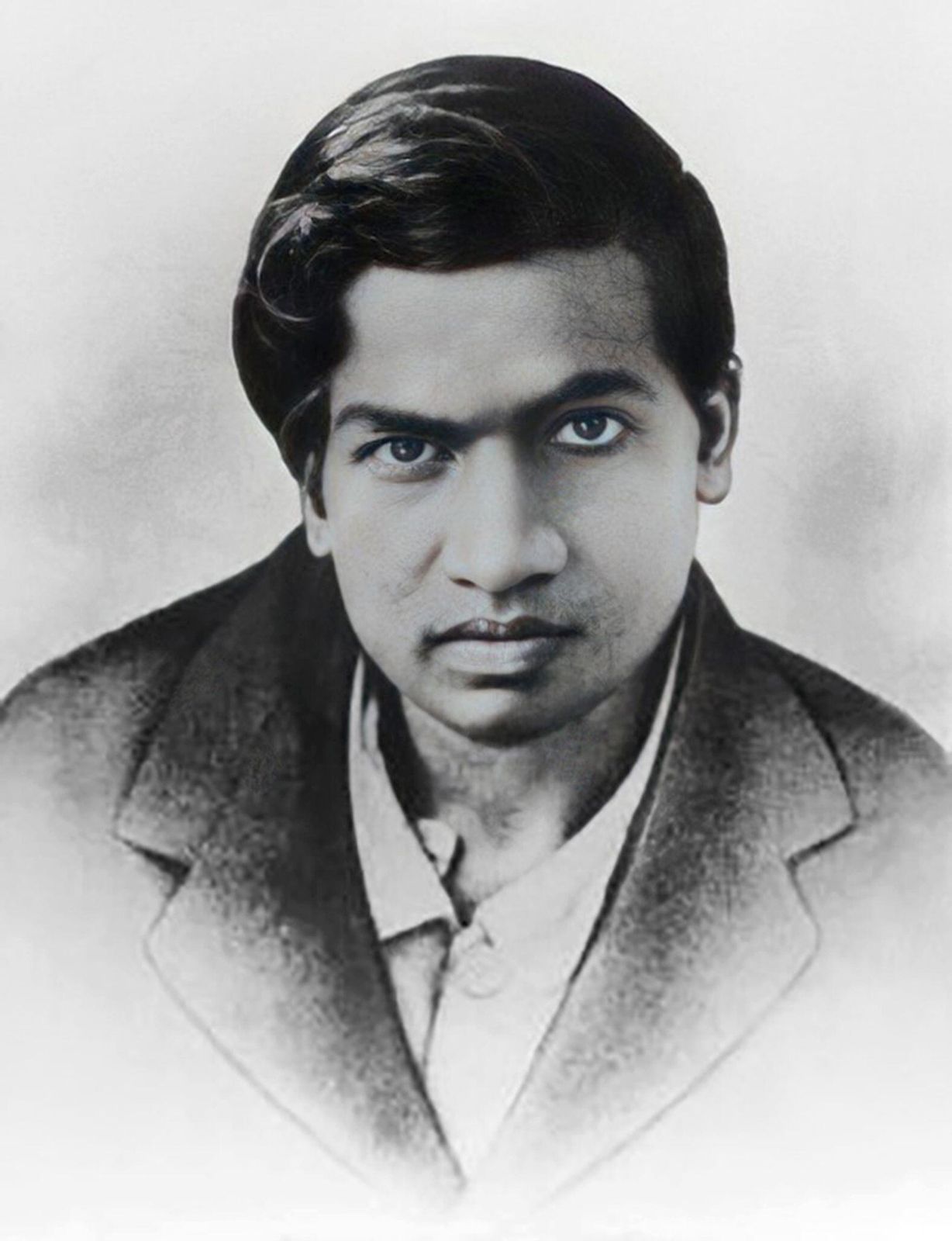
Srinivasa Ramanujan
 India
IndiaFecha de nacimiento
December 22, 1887
Signo zodiacal
Sagittarius
Lugar de nacimiento
Erode, Madras Presidency, British India (now Tamil Nadu, India)
Edad
Falleció a los 32
Estatura
5 ft 6 in (168 cm)
Acerca de
Srinivasa Ramanujan fue un matemático indio cuyo trabajo en teoría de números, series infinitas y fracciones continuas reformó las matemáticas modernas. Compiló de forma independiente casi 3900 resultados, la mayoría de los cuales han sido probados como correctos. Sus avances incluyen el primo de Ramanujan, la función theta de Ramanujan y las funciones theta simuladas, que abrieron nuevos campos de investigación. Ramanujan se convirtió en uno de los miembros más jóvenes de la Royal Society en 1918 y en el primer miembro indio del Trinity College. Sus ideas continúan influyendo en las matemáticas, y la Revista Ramanujan está dedicada a su legado. Los fanáticos celebran su historia como un testimonio de talento puro y perseverancia, y su vida fue dramatizada en la película de 2015 El hombre que conocía el infinito.
Primeros años y orígenes
Srinivasa Ramanujan Iyengar nació el 22 de diciembre de 1887, en Erode, Presidencia de Madrás, India Británica (ahora Tamil Nadu, India). Desde joven, Ramanujan demostró una habilidad matemática extraordinaria. A la edad de 10 años, mientras asistía a la Town High School en Kumbakonam, ya superaba a estudiantes significativamente mayores que él. A los 11 años, se encontró con el libro de G. S. Carr Un Sinopsis de Resultados Elementales en Matemáticas Puras y Aplicadas, un libro crucial que contenía miles de fórmulas sin pruebas. Este volumen se convirtió en su principal fuente de educación matemática, moldeando su enfoque único en la materia.
En 1904, Ramanujan aprobó con éxito el Examen de Matriculación y obtuvo una beca para asistir al Government College, Kumbakonam. Sin embargo, su intensa y obsesiva concentración en las matemáticas lo llevó a descuidar todas las demás asignaturas, lo que le hizo fracasarlas y, en consecuencia, perder su beca. Sus luchas académicas continuaron; más tarde fracasó en el examen de Bellas Artes en el Pachaiyappa's College, Madrás, y finalmente abandonó en 1907 sin obtener un título formal. A pesar de esta falta de éxito académico convencional, su dedicación a las matemáticas nunca disminuyó. Durante varios años, Ramanujan vivió en la pobreza, trabajando como contador para sustentarse mientras incansablemente perseguía su investigación matemática independiente.
Sus profundas intuiciones finalmente lo llevaron a buscar reconocimiento más allá de la India. En 1913, Ramanujan escribió una carta al prestigioso matemático británico G. H. Hardy en la Universidad de Cambridge. Esta carta contenía aproximadamente 120 teoremas, mostrando su asombroso talento y trabajo original. Hardy reconoció inmediatamente el genio en las contribuciones de Ramanujan, un descubrimiento que culminó en una invitación para Ramanujan para viajar a Inglaterra.
Trayectoria profesional
Ramanujan llegó al Trinity College, Cambridge en 1914, comenzando una colaboración fructífera con Hardy. En 1916, recibió un título de Bachiller de Artes por investigación por su trabajo en números altamente compuestos. Fue elegido para la London Mathematical Society en 1917. El punto culminante llegó en 1918 cuando fue elegido Fellow de la Royal Society, el segundo indio en recibir ese honor. Más tarde ese año, se convirtió en el primer Fellow indio de Trinity College. Su producción incluyó resultados innovadores sobre particiones, funciones de theta ficticias y el número de Hardy-Ramanujan 1729. La mala salud lo obligó a regresar a la India en 1919, pero continuó produciendo teoremas hasta su muerte en 1920. Su cuaderno perdido, rediscovery en 1976, contenía cientos de fórmulas adicionales que siguen inspirando la investigación.
Cronología profesional
Imagen pública y estilo
Ramanujan a menudo se idealiza como el genio autodidacta que trascendió la pobreza. Por lo general, se lo retrata en traje indio tradicional o traje formal, rodeado de pizarras de ecuaciones. La película de 2015 El Hombre que Sabía la Infinitud consolidó su imagen como héroe trágico. Los fans, a menudo llamados entusiastas de Ramanujan, celebran el Día Nacional de Matemáticas en su cumpleaños (22 de diciembre) con competencias y conferencias. Las páginas de redes sociales comparten sus citas y rompecabezas, manteniendo un tono reverente. Su historia resuena como un símbolo de talento puro superando la falta de oportunidades.
Fama y fandom
Srinivasa Ramanujan remains a towering figure whose influence stretches far beyond the chalkboards of Cambridge. In August 2026, he stands as the 46th most famous person in India and the 19th most famous person from India, holding steady positions that reflect his enduring cultural weight. His reach extends across the continent as the 29th most famous person in South Asia, while within the literary sphere, he ranks as the 52nd most famous person in Books & Literature. These placements, drawn from the iFANN Global Fame Rankings, track global attention across media coverage, search trends, and consumption signals worldwide without relying on modern celebrity metrics. There is no formal fandom name for Ramanujan; the concept of a fanbase does not apply to a mathematician who died over a century ago before the era of mass media interactions or organized fan clubs. Instead, his following consists of the global mathematical community, students, researchers, and historians, who revere his work rather than his persona. This audience engages through academic pursuit and commemorative rituals like National Mathematics Day, celebrating his birthday with lectures and competitions rather than chart pushes or viral campaigns. While he lacks the performative energy of modern stars, his legacy thrives in the quiet intensity of classrooms and research labs where his formulas still challenge and inspire. Recent technological homages, including an AI-generated podcast from August 2026 and a new film production in Cambridge, demonstrate how his story transcends time to engage with modern technology. The reverence shown to him is rooted in verified historical events and widely retold anecdotes that border on cultural mythology.
Datos interesantes y leyendas
Ramanujan claimed the goddess Namagiri appeared in his dreams and revealed mathematical formulas, which he would write down upon waking. He could calculate pi to 18 decimal places from memory. The number 1729, known as the Hardy-Ramanujan number, is the smallest integer expressible as the sum of two cubes in two different ways: 1³+12³ and 9³+10³. He was a strict vegetarian and observed Hindu dietary restrictions even at Cambridge. His notebooks contain approximately 3,900 results, most proven correct. The Ramanujan conjecture has influenced modern cryptography and string theory. A legendary moment occurred when G.H. Hardy visited Ramanujan in Putney, London. Hardy remarked that taxi cab number 1729 seemed dull, but Ramanujan immediately identified it as fascinating due to its unique cubic properties. This story became a cornerstone of mathematical folklore, symbolizing his intuitive grasp of number theory. Another central legend concerns his divine visions, where complex formulas appeared during trances accompanied by geometric shapes. While spiritual in nature, these experiences yielded mathematically sound results that continue to challenge physicists decades after his death. His tragic trajectory from a poor colonial background to premature death at age 32 has become a powerful mythos celebrated annually.
Frases destacadas
“An equation means nothing to me unless it expresses a thought of God.”
“I am not a mathematician. I am a man who has been given a gift.”
“I have found a number that is very interesting. It is the smallest number expressible as the sum of two cubes in two different ways.”
Familia y vida personal
Ramanujan nació de Kuppillai Srinivasa Iyengar, un dependiente de una tienda de sarees, y Komalatammal, una ama de casa. Su madre era profundamente religiosa e inculcó la devoción a la diosa Namagiri. No tenía hermanos conocidos. En 1909, se casó con Janakiammal en un matrimonio arreglado; ella tenía 10 años en ese momento y vivía con sus padres hasta llegar a la madurez. La pareja no tuvo hijos. Después de su muerte, Janakiammal preservó su legado, administrando sus derechos de autor y recibiendo una pensión del gobierno hasta su muerte en 1994.
Conexiones destacadas
Ramanujan fue tutoreado por G. H. Hardy, quien lo llevó a Cambridge y co-autoría importantes papers. También colaboró con J. E. Littlewood. Su esposa Janakiammal preservó su legado. El matemático George Andrews redescubrió su cuaderno perdido en 1976. K. S. Krishnan fue un amigo y colaborador.
Relaciones e historial sentimental
La única relación documentada de Ramanujan es su matrimonio arreglado con Janakiammal en 1909. Ella tenía 10 años en ese momento; vivieron juntos solo después de que ella alcanzara la madurez. La pareja no tuvo hijos. Después de la muerte de Ramanujan en 1920, Janakiammal se dedicó a su legado, gestionando sus derechos de autor y recibiendo una pensión del gobierno. Ella murió en 1994 a los 95 años. A partir de 2026, Ramanujan está fallecido sin más relaciones documentadas.
- Casado/aJanakiammal1909 - 1920Matrimonio arreglado; ella tenía 10 años en la boda, vivieron juntos después de que ella alcanzara la madurez; sin hijos.
Muerte y repercusiones
Fallecimiento
April 26, 1920 (a los 32 años)
Lugar de fallecimiento
Adyar, Madras, India
Causa de la muerte
Reported as tuberculosis and liver abscess
The mathematical world mourned a loss G.H. Hardy called a great blow to the discipline, while his notebooks eventually became the cornerstone of modern number theory. Ramanujan spent his final months bedridden in Adyar, Madras, after returning from England due to severe health complications that left him unable to work. Historical consensus attributes his decline to tuberculosis complicated by a liver abscess and malnutrition. His funeral was a private affair held shortly after April 26, 1920, where he was cremated according to Hindu rites near the Vadapalani Murugan Temple area. Tributes initially remained within academic circles, with the Royal Society and Trinity College honoring his contributions as one of their youngest Fellows. Posthumous recognition grew steadily, culminating in the 2015 release of the film The Man Who Knew Infinity and the Indian government declaring his birthday National Mathematics Day in 2011. His collected papers were published in 1927 by Hardy and Littlewood, ensuring his formulas continued to inspire research decades later.
Patrimonio neto (valor de la herencia)
$1 Million
Estimación del equipo editorial de iFANN
Heading into 2026, the Ramanujan Estate Trust, based in Chennai, manages his estate valued at approximately $1 million according to iFANN's editorial analysis. Revenue sources include royalties from his collected papers and notebooks, which earn an estimated $20,000 to $50,000 annually. Licensing of his name and image for educational materials, documentaries, and the 2015 film The Man Who Knew Infinity generates $10,000 to $30,000 per year. Since his death, total posthumous earnings are estimated at $2 to $5 million, with major contributions from film rights and ongoing book sales. The estate supports mathematics education and scholarships.
Premios ganados (2)
Ramanujan fue elegido Fellow de la Royal Society en 1918, el honor científico más alto en Gran Bretaña, y Fellow de Trinity College, Cambridge, el primer indio en recibir esa distinción. Estos honores reconocieron sus contribuciones innovadoras a las matemáticas.
1918 · Honor Científico
Mathematical contributions
1918 · Honor Académico
Mathematical contributions
Conocido por
Ramanujan prime
1913 · Discoverer
Mock theta functions
1920 · Originator
Hardy-Ramanujan number 1729
1918 · Co-discoverer
Palabras clave
Datos rápidos
- Profesión
- mathematician
- Nacimiento
- +1887-12-22
- Lugar de nacimiento
- Erode
- Fallecimiento
- +1920-04-26
- Lugar de fallecimiento
- Chetput, Madras
- Género
- Hombre
- Cónyuge
- Janakiammal
- Signo zodiacal
- Sagittarius
Datos personales
- Nombre completo
- Srinivasa Ramanujan Iyengar
- Estatura
- 5 ft 6 in (168 cm)
- Cónyuge
- Janakiammal
- Hijos
- None
- Educación
- No formal degree; attended Town High School, Kumbakonam; Government College, Kumbakonam; Pachaiyappa's College, Madras
Preguntas frecuentes
¿Cómo murió Ramanujan?
¿Cuál es el cociente智力 de Ramanujan?
¿Ramanujan tenía una esposa?
¿Qué es 1729 y por qué es famoso?
¿Cómo aprendió Ramanujan matemáticas?
Personas similares
Únete a la comunidad
fans comentando