
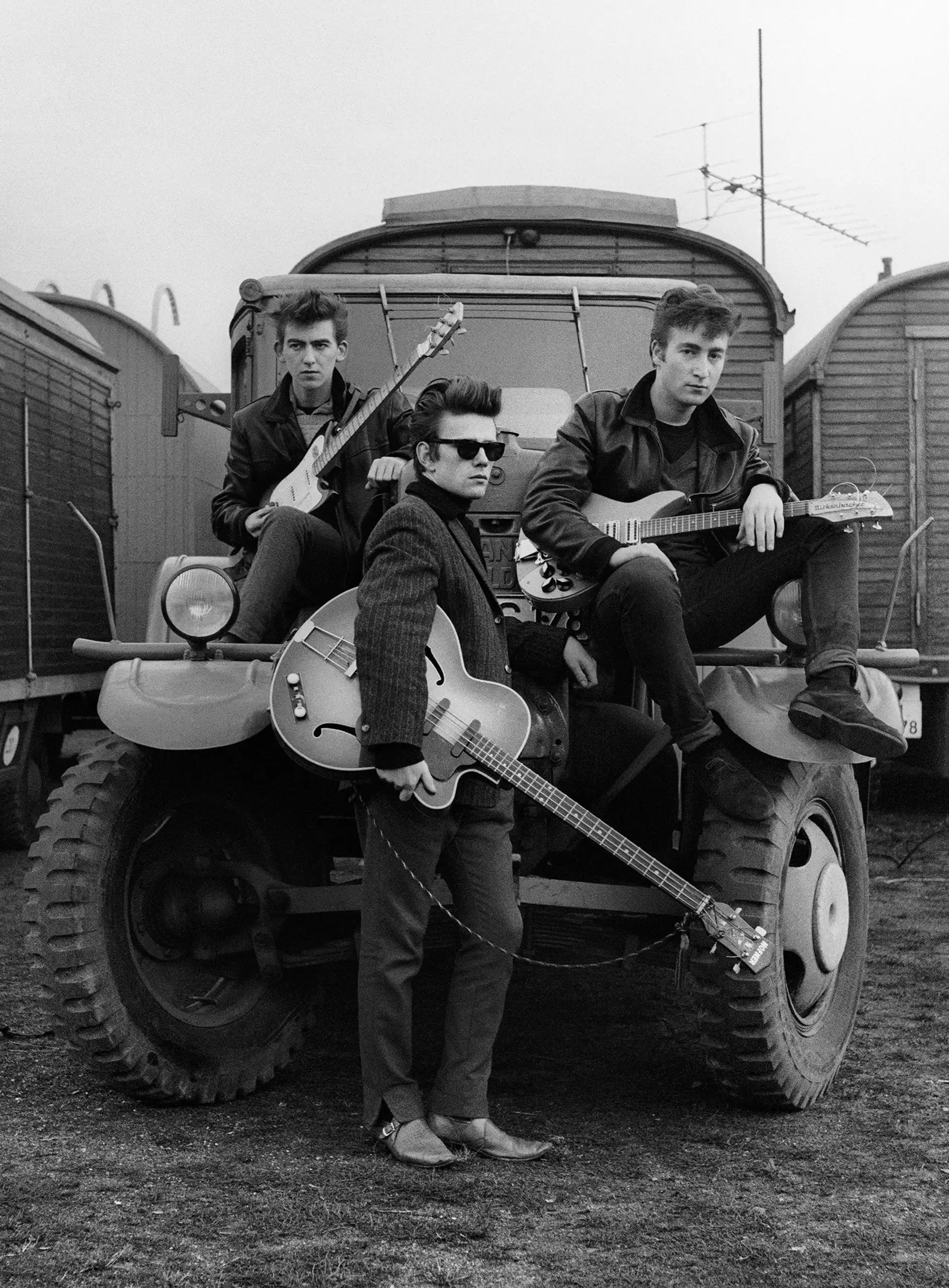
Stuart Sutcliffe
 United Kingdom
Member of The Beatles
Fecha de nacimiento
June 23, 1940
Signo zodiacal
Cancer
Lugar de nacimiento
Edinburgh, Scotland
Edad
Falleció a los 21
Acerca de
Stuart Sutcliffe fue un pintor y músico británico conocido principalmente como el bajista original de The Beatles. Sus esfuerzos artísticos, particularmente en la pintura de vanguardia, son reconocidos por su calidad y estilo distintivo. La temprana carrera de Sutcliffe con The Beatles fue breve, anterior a su inmensa fama mundial. Hoy es recordado como un miembro fundador de la icónica banda y un artista prometedor cuya vida fue trágicamente truncada. Tanto fans como críticos reconocen su contribución única tanto a la música como al arte, y su obra continúa siendo exhibida y estudiada.
Primeros años y orígenes
Stuart Fergusson Victor Sutcliffe nació el 23 de junio de 1940 en Edimburgo, Escocia, hijo de Charles Stuart Sutcliffe, un marinero mercante, y Millie Sutcliffe. Aunque nació en Escocia, se crió en Liverpool, Inglaterra, donde su familia se mudó poco después de su nacimiento. Las frecuentes y prolongadas ausencias de su padre en el mar generaron una considerable tensión financiera y emocional en la familia, lo que a su vez fomentó un fuerte vínculo entre Stuart y su madre y hermanas, así como lo impulsó hacia un círculo cercano de amigos y un creciente interés en la expresión artística. Desde temprana edad, Sutcliffe mostró un considerable talento artístico, lo que lo llevó a asistir a la Prescot Grammar School, seguida por el prestigioso Liverpool College of Art. Allí, rápidamente se distinguió como un dibujante y pintor excepcionalmente dotado, ganando reconocimiento y premios escolares de arte por su talento. Su trabajo durante este período mostró fuertes influencias del Expresionismo Abstracto y el modernismo europeo, y comenzó a exhibir pinturas en exposiciones estudiantiles locales, construyendo constantemente una seria reputación como un artista plástico emergente.
Fue en el Liverpool College of Art donde Sutcliffe forjó una estrecha amistad con el compañero estudiante John Lennon, convirtiéndose en parte integral de un círculo bohemio de estudiantes de arte y músicos. Esta conexión resultó fundamental en su vida. En 1960, Sutcliffe experimentó un avance significativo en su carrera artística cuando vendió uno de sus cuadros por una suma considerable, estimada en alrededor de £65-75. Este éxito financiero se convirtió en un punto de inflexión, ya que Lennon y sus amigos mutuos lo animaron fuertemente a usar las ganancias para comprar un bajo. A pesar de tener poca experiencia musical previa, Sutcliffe siguió su consejo, adquiriendo un bajo Höfner President. Posteriormente se unió al grupo musical de Lennon, entonces conocido como Johnny and the Moondogs, que pronto evolucionaría a The Beatles . Su decisión de unirse a la banda marcó un capítulo nuevo e inesperado en su vida, desplazando momentáneamente su enfoque principal de la pintura a la música, y preparando el escenario para su participación en los años formativos del grupo en Liverpool y Hamburgo.
Trayectoria profesional
Aunque su carrera musical fue breve y anterior al éxito comercial de The Beatles, el impacto de Sutcliffe es notable en dos campos. Como bajista original, fue parte del período formativo de The Beatles en Hamburgo y Liverpool, cuando refinaron su sonido tocando sets maratónicos. Su decisión de dejar la banda llevó a Paul McCartney a cambiar permanentemente al bajo, un cambio que ayudó a solidificar el sonido clásico de The Beatles.
En el arte, sus pinturas han sido exhibidas póstumamente en libros y exposiciones en galerías, presentadas como la obra de un artista moderno serio y en evolución, más que simplemente un asociado de los Beatles. A menudo se le menciona como el quinto Beatle en las historias de los Beatles, pero los historiadores del arte enfatizan cada vez más su contribución independiente al arte británico de posguerra.
Cronología profesional
Imagen pública y estilo
Stuart Sutcliffe es recordado como el enigmático "quinto Beatle" — una figura sombría e intensamente artística cuyo breve paso por la banda fue eclipsado por su genuino talento como pintor. Con sus marcados pómulos, cabello oscuro peinado hacia atrás y, más tarde, el corte moptop que él mismo popularizó, Sutcliffe cultivó una estética bohemia y melancólica que contrastaba con la imagen rockera inicial del grupo. Su estilo, influenciado por Astrid Kirchherr, incluía chaquetas de cuero negro y estilo beatnik. Los medios y los fans a menudo lo retratan como un alma trágica y sensible — el artista que eligió el lienzo sobre la fama. Entre los entusiastas de los Beatles, es venerado como un arquitecto clave de la identidad visual de la banda. Los historiadores del arte, sin embargo, se centran en sus obras expresionistas abstractas, que han sido exhibidas en galerías y descritas como "crudas, emocionales y adelantadas a su tiempo". No hay un nombre de fandom oficial, pero una comunidad dedicada de "eruditos de Sutcliffe" y fans de los Beatles mantiene vivo su legado. Su presencia en redes sociales es póstuma, mantenida por herencias y cuentas de fans que destacan su arte y mitología.
Fama y fandom (iFAMOUS Rankings)
Stuart Sutcliffe remains a figure of haunting absence rather than active adoration. His legacy is defined by the tragic arc of a life extinguished at twenty-one, just as his band was on the cusp of global domination. Unlike the frenzied worship directed at his surviving bandmates, Sutcliffe never cultivated a formal fanbase with its own rituals or self-identifying name. His admirers are subsumed within the vast, decentralized community of Beatles fans, drawn to him not by hit singles or stadium tours, but by the mythos of the "fifth Beatle" who chose art over fame. The story of his departure from the group to pursue painting in Hamburg and his subsequent death from a cerebral hemorrhage serves as the primary narrative anchor for this retrospective reverence. Fans today engage with his memory through organic tributes, such as annual social media remembrances and visits to exhibitions featuring his lost paintings, treating these moments as pilgrimages to a site of unfulfilled potential. There were no meet-and-greets during his lifetime, no organized campaigns, and no specific fandom faction; his influence is purely cultural and historical. While he shaped the visual identity of the early Beatles and suggested their iconic name, his personal impact is felt most deeply in the quiet spaces between the known history of the group's rise. He exists now as a foundational ghost, a necessary element of the band's origin story that was removed before the world could fully know him. Stuart Sutcliffe is currently evaluated by iFANN but holds no placement in the Global Top 1,000 rankings. The iFANN Global Fame Engine has determined that he does not currently occupy a position in any published scope list.
Datos interesantes y leyendas
Stuart Sutcliffe was the first member of the group to adopt the moptop haircut, a style pioneered by photographer Astrid Kirchherr that the others later emulated. He frequently performed with his back to the audience, a habit born of both shyness and the fact that he had learned the bass lines relatively late in his tenure. Most contemporaries viewed him as an artist who happened to play bass, rather than a musician dabbling in paint. A persistent legend suggests he may have suffered a head injury in a fight months before his death, a detail some accounts claim contributed to the fatal brain hemorrhage that took his life. The most enduring story surrounding him is the emotional bond he shared with John Lennon, whom he described as his alter ego. This connection began at the Liverpool College of Art in 1957 and fueled the bohemian aesthetic that defined the band's early image. Another pivotal moment in his lore is his decision to leave the group in 1961 to stay with Kirchherr in Germany, a choice that fundamentally altered the band's trajectory by forcing Paul McCartney to switch permanently to bass. His death in Hamburg in April 1962 is often framed as the moment the "real" Beatles lost their soulmate, leaving the remaining trio to navigate stardom without their original creative anchor.
Familia y vida personal
Stuart Sutcliffe nació de Charles Stuart Sutcliffe, un marinero mercante, y Millie Sutcliffe. Tuvo hermanos, aunque los detalles son escasos. Las largas ausencias de su padre en el mar crearon un entorno familiar desafiante. Estaba comprometido con Astrid Kirchherr en el momento de su muerte, pero no tuvo hijos.
Conexiones destacadas
Relaciones e historial sentimental
La única relación seria documentada de Stuart Sutcliffe fue con Astrid Kirchherr, una fotógrafa alemana que conoció en 1960 durante la primera estancia de The Beatles en Hamburgo. Rápidamente se convirtieron en pareja; ella fue su musa y estilista, y se comprometieron. Sutcliffe permaneció con Kirchherr en Hamburgo después de dejar la banda, centrándose en su arte, hasta su repentina muerte en 1962. A fecha de 2026, está fallecido; en el momento de su muerte, estaba comprometido con Kirchherr.
- Comprometido/aAstrid Kirchherr1960 - 1962Se conocieron durante la primera estancia de The Beatles en Hamburgo; ella se convirtió en su prometida e influencia creativa; la relación terminó con su muerte.
Muerte y repercusiones
Fallecimiento
April 10, 1962 (a los 21 años)
Lugar de fallecimiento
Hamburg, West Germany
Causa de la muerte
Cerebral hemorrhage from ruptured aneurysm
Stuart Sutcliffe lay in a quiet room at the Klinikum Eppendorf in Hamburg, West Germany, where he had been rushed after collapsing from severe headaches that had plagued him for weeks. On April 10, 1962, he passed away in his sleep at the age of 21 without regaining consciousness. An autopsy conducted shortly after his death established the official cause as a cerebral hemorrhage resulting from the rupture of a congenital intracranial aneurysm, ruling out speculation regarding drug use or prior trauma that had circulated in later accounts. The German authorities handled the medical certification administratively.
The news devastated his inner circle, particularly John Lennon, who viewed Sutcliffe as his alter ego and reportedly refused to play the piano for a long time afterward. Paul McCartney also expressed deep grief over the loss of the band's original creative spark, though global reaction remained limited due to the group's status before their international breakthrough. A private funeral took place on April 13, 1962, at Ohlsdorf Cemetery in Hamburg, attended by close friends like Astrid Kirchherr and Klaus Voormann alongside members of the local art scene. His grave remains a site of quiet pilgrimage marked by a simple headstone.
Posthumously, his legacy has been preserved through the management of his artwork by the Official Stuart Sutcliffe Estate, which has overseen exhibitions of previously unseen pieces and publications such as Stuart Sutcliffe: Four Myths About the 5th Beatle . While he never received induction into a musician Hall of Fame, art historians increasingly emphasize his independent contribution to post-war British art rather than viewing him solely as a Beatles associate.
Patrimonio neto (valor de la herencia)
$0
Estimación del equipo editorial de iFANN
Because Sutcliffe died very young and before The Beatles' commercial breakthrough, detailed financial records are sparse. At the time of his death, he lived as a student artist and musician with modest means, earning from club performances and occasional art sales. There is no credible, sourced estimate for his exact estate value at death, but context suggests it was relatively small. Posthumous revenues connected to his name come primarily from licensing and reproduction of his artwork in books and exhibitions, as well as rights in photographs and related merchandise where his image appears as an early Beatle. However, detailed audited figures for how much the estate has earned since his passing are not publicly available in reputable sources. No reliable public estimate exists for the current value of the Stuart Sutcliffe estate as of 2026. Per iFANN's editorial analysis, the total net worth is $0.
Premios y galardones
Conocido por
The Beatles
1960 · Bass guitarist
Palabras clave
Fuentes
Datos rápidos
- Birthdate
- June 23, 1940
- Death date
- April 10, 1962
- Age at death
- 21
- Lugar de nacimiento
- Edinburgh, Scotland
- Occupation
- Painter, musician
- Instrument
- Bajo
- Grupo
- The Beatles
- Fiancée
- Astrid Kirchherr
Datos personales
- Nombre completo
- Stuart Fergusson Victor Sutcliffe
- Educación
- Liverpool College of Art, Hamburg College of Art
Preguntas frecuentes
¿Cuál es el patrimonio neto de Stuart Sutcliffe en 2026?
¿Por qué Stuart Sutcliffe dejó The Beatles?
¿Cómo murió Stuart Sutcliffe?
¿Era Stuart Sutcliffe un buen bajista?
¿Con quién estaba comprometido Stuart Sutcliffe?
Personas similares
Únete a la comunidad
fans comentando