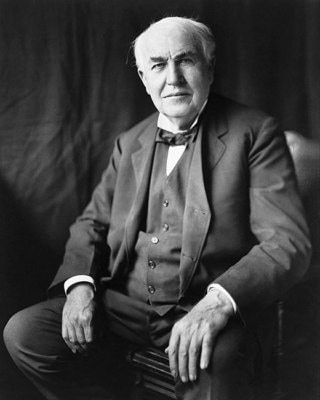
Thomas Edison
 United States
engineer•inventor•entrepreneur
Also known as: Wizard of Menlo Park
Fecha de nacimiento
February 11, 1847
Signo zodiacal
Aquarius
Lugar de nacimiento
Milan, Ohio, USA
Edad
Falleció a los 84
Acerca de
Thomas Alva Edison was the American inventor and businessman who brought the world the phonograph, the practical incandescent light bulb, and the first industrial research laboratory. Holding 1,093 U.S. patents, he is one of the most prolific inventors in history. His work didn't just create devices; it built entire systems, from electric power distribution to recorded sound, that defined modern life. Today, his name remains shorthand for ingenuity itself, and his Menlo Park lab is remembered as the birthplace of organized innovation.
Primeros años y orígenes
Edison creció en Port Huron, Míchigan, después de que su familia se mudara de Milán, Ohio, cuando tenía siete años. Asistió a la escuela solo unos meses; su madre, una exmaestra, le educó en casa y fomentó su amor por la lectura y los experimentos prácticos. Una enfermedad infantil, escarlatina o tifus, le dejó una pérdida auditiva significativa, una condición que más tarde dijo le ayudaba a concentrarse.
A los 12 años, Edison comenzó a vender periódicos y dulces en el Ferrocarril Grand Trunk, e incluso instaló una pequeña imprenta en un vagón de equipaje para publicar su propio periódico, The Grand Trunk Herald. Su habilidad para la telegrafía surgió después de salvar al hijo de un jefe de estación de un tren desbocado; el agradecido padre le enseñó a operar el telégrafo. A los 15 años, Edison era un operador de telégrafo calificado, viajando por todo el país y adquiriendo conocimientos técnicos sobre la marcha. A los 22 años, había vendido sus primeras invenciones y se mudó a la ciudad de Nueva York, decidido a ganarse la vida como inventor a tiempo completo.
Trayectoria profesional
El primer gran avance de Edison llegó con el telégrafo cuádruple en 1874, que permitía enviar cuatro mensajes simultáneamente por un solo cable. En 1876, abrió su laboratorio de Menlo Park, la primera instalación de su tipo, diseñada específicamente para la investigación industrial. Allí, en 1877, presentó el fonógrafo, una máquina que podía grabar y reproducir sonido, asombrando al mundo. Dos años después, demostró una bombilla incandescente práctica y un sistema completo de distribución de energía eléctrica, iluminando Menlo Park y eventualmente ciudades de todo el mundo.
Fundó la Edison Electric Light Company en 1880, que luego se fusionó en General Electric. En 1887, abrió un laboratorio más grande en West Orange, Nueva Jersey, donde desarrolló baterías mejoradas, equipos de cine y más. El enfoque de Edison combinaba la experimentación incansable con un agudo instinto comercial; no solo inventaba, sino que comercializaba, fabricando y comercializando sus creaciones para llegar a la gente común.
Cronología profesional
Imagen pública y estilo
Edison cultivó la imagen del "Mago de Menlo Park", un inventor genio cuyos experimentos parecían mágicos. En realidad, era un empresario duro que entendía el poder de la publicidad. Vestía trajes prácticos, a menudo arrugados, y sus laboratorios eran talleres caóticos llenos de ruido y actividad. Las representaciones mediáticas lo han idealizado como el inventor solitario, pero su verdadera innovación fue el trabajo en equipo sistemático. Tanto fanáticos como críticos lo ven como un símbolo de la determinación estadounidense, aunque su rivalidad con Nikola Tesla ha complicado su legado en los últimos años.
Fama y fandom
Thomas Edison left no organized fanbase behind when he died in 1931. No modern movement claims him as a mascot, and no specific name unites the millions who study his life or admire his inventions. Historians, engineers, and students form his audience, but they operate without the rituals or shared language of contemporary celebrity culture. His legacy survives not through active campaigns or viral tributes, but through the enduring reality of the systems he built. The electric grid and recorded sound remain daily necessities, ensuring his relevance outlasts any fleeting trend. While some productions like the puppetry show "Tesla vs. Edison" keep his rivalry with Nikola Tesla alive in popular lore, these events spark academic interest rather than fandom fervor. Recent scientific work at UCLA reimagining his battery designs proves his foresight remains a subject of serious inquiry in 2026, yet this engagement stays within professional circles. There are no fan clubs, no dedicated hashtags, and no crowd-funded projects for his memory. He stands alone as a figure whose fame is measured by utility rather than adoration. Despite this lack of formal organization, his global standing remains immense according to the iFANN Global Fame Rankings. Thomas Edison is currently the 249th most famous person in the world, holding steady from the previous cycle. He ranks as the 95th most famous person from United States and the 81st most famous person in North America. Within his field, he holds the position of the 8th most famous person in Tech. These placements reflect a sustained attention across media coverage, search activity, and cultural consumption signals worldwide.
Datos interesantes y leyendas
Edison's first patent was for an electric vote recorder invented at age 22, though legislators ignored it completely. He suggested using the word "hello" as a telephone greeting and claimed his hearing loss helped him focus by blocking distractions. A relentless workaholic, he slept only four hours a night and demanded the same from his staff. One obscure invention was a concrete house designed to be poured in a single mold, which never gained traction. Legends surrounding his life often blur fact and folklore. The story of the light bulb is frequently told as a singular moment of genius, but Menlo Park actually saw over 6,000 materials tested before finding a carbon filament that worked commercially. Another dark chapter involves the "War of Currents," where associates secretly supplied AC generators for the first electric chair execution to prove its lethality. This event cemented a reputation for ruthlessness. Edison also formed a close bond with Henry Ford and Harvey Firestone known as the "Vagabonds." They spent winters camping in cars across the United States, creating a narrative of camaraderie among giants. When the first central power station lit Lower Manhattan in 1882, thousands gathered to witness gaslight replaced by electricity, marking a true shift in human history.
Frases destacadas
“I have not failed. I've just found 10,000 ways that won't work.”
“Genius is one percent inspiration and ninety-nine percent perspiration.”
“The world owes the inventor nothing. It owes him only a continued opportunity to do more.”
Familia y vida personal
Edison se casó con Mary Stilwell en 1871; ella murió en 1884 a los 29 años, dejándole tres hijos: Marion, Thomas Jr. y William. En 1886, se casó con Mina Miller, hija del inventor Lewis Miller. Tuvieron cuatro hijos: Madeleine, Charles, Theodore y Nicholas. Charles más tarde se convirtió en Gobernador de Nueva Jersey. Mina gestionó los asuntos de Edison después de su muerte y preservó su legado. Edison era un padre dedicado pero a menudo ausente, consumido por su trabajo.
Conexiones destacadas
Edison empleó y luego se enfrentó a Nikola Tesla, cuyo sistema de corriente alterna rivalizaba con la corriente continua de Edison. Samuel Insull, su antiguo secretario, se convirtió en un poderoso magnate de servicios públicos. Lewis Miller, su suegro, cofundó la Institución Chautauqua.
Relaciones e historial sentimental
Edison se casó con su primera esposa, Mary Stilwell, en 1871. Ella era empleada en su fábrica de Newark. El matrimonio se resintió por las largas horas de trabajo de Edison, y Mary murió repentinamente en 1884 a los 29 años, probablemente por un tumor cerebral. Tuvieron tres hijos. Un año después, Edison conoció a Mina Miller en la casa de un amigo de la familia. Se casaron en 1886 y tuvieron cuatro hijos. Mina fue una fuerza estabilizadora, gestionando el hogar y apoyando su trabajo. Edison permaneció casado con Mina hasta su muerte en 1931.
- Casado/aMary Stilwell Edison1871 - 1884Primera esposa; falleció en 1884. Tuvieron tres hijos.
- Casado/aMina Miller Edison1886 - 1931ActualSegunda esposa; hija del inventor Lewis Miller. Tuvieron cuatro hijos.
Muerte y repercusiones
Fallecimiento
October 18, 1931 (a los 84 años)
Lugar de fallecimiento
West Orange, New Jersey, USA
Causa de la muerte
Reported complications from diabetes mellitus
Thomas Edison died on October 18, 1931, at his estate, Glenmont, in West Orange, New Jersey. He was 84 years old. For months, his health had declined due to long-term diabetes, leaving him bedridden and unable to speak clearly by September. His final hours passed quietly among his wife Mina and their children. The news of his passing triggered an immediate national response. President Herbert Hoover declared a moment of silence across the United States, urging citizens to extinguish electric lights to honor the man who lit up the world. This symbolic gesture united cities and towns in a collective tribute to the inventor. Henry Ford, Charles Lindbergh, and Guglielmo Marconi sent statements praising his contributions to humanity during radio broadcasts dedicated to his legacy.
A private funeral service took place three days later on October 21 at Glenmont, attended by close family and select business associates including Ford. Following the ceremony, Edison was cremated at the Fairmount Crematory in Philadelphia, Pennsylvania. His ashes were interred in the crypt of the family mausoleum at Oak Hill Cemetery in West Orange. Posthumously, he received numerous honors, including induction into the National Inventors Hall of Fame in 1954 and the establishment of the Thomas Edison National Historical Park in 1962. The Thomas Edison Foundation was created to support innovation, while films like Edison (1940) and documentaries explored his life. The estate remained under family management for decades before transitioning to corporate entities.
Patrimonio neto (valor de la herencia)
$100 Million
Estimación del equipo editorial de iFANN
As of 2026, the estate of Thomas Edison is valued at $100 Million per iFANN's editorial analysis. This wealth persists through ongoing licensing fees for his patents and the continued operation of corporations he established, particularly the enduring legacy of General Electric. Royalties from the use of his inventions in media and entertainment contribute significantly to the total. The value also encompasses his historic laboratories and personal property. Following his death in 1931, his estate passed to his second wife, Mina, and subsequently to his children, who managed the vast portfolio of innovations to ensure steady income generation.
Premios ganados (5)
Edison recibió la Medalla de Oro del Congreso en 1928 por sus contribuciones a la ciencia y la industria. Se le otorgó dos veces la Medalla John Fritz (1908 y 1930) por logros en ingeniería. El Instituto Franklin le concedió la Medalla Elliott Cresson en 1890 por su trabajo en la lámpara incandescente. En 1908, la Royal Society of Arts le honró con la Medalla Albert.
1928 · General
Contributions to science and industry
1930 · Ingeniería
Achievements in engineering and invention
1908 · Ingeniería
Achievements in engineering and invention
Conocido por
Phonograph
1877 · Inventor
Incandescent Light Bulb
1879 · Inventor
Electric Power Distribution
1882 · Developer
Motion Picture Camera
1891 · Inventor
Palabras clave
Datos rápidos
- Profesión
- engineer, inventor, entrepreneur
- Nacimiento
- +1847-02-11
- Lugar de nacimiento
- Milan
- Fallecimiento
- +1931-10-18
- Lugar de fallecimiento
- West Orange
- Género
- Hombre
- Cónyuge
- Mary Stilwell Edison, Mina Miller
- Signo zodiacal
- Aquarius
Datos personales
- Nombre completo
- Thomas Alva Edison
- Cónyuge
- Mary Stilwell Edison, Mina Miller
- Hijos
- Marion Estelle Edison, Thomas Alva Edison Jr., William Leslie Edison, Madeleine Edison, Charles Edison, Theodore Miller Edison, Nicholas Longworth Edison
- Educación
- Homeschooled by mother; minimal formal schooling
Preguntas frecuentes
¿Quién fue Thomas Edison?
¿Cuál es el patrimonio neto de Thomas Edison en 2026?
¿Cuántas patentes tenía Thomas Edison?
¿Realmente inventó Thomas Edison la bombilla?
¿Cómo murió Thomas Edison?
Personas similares
Únete a la comunidad
fans comentando