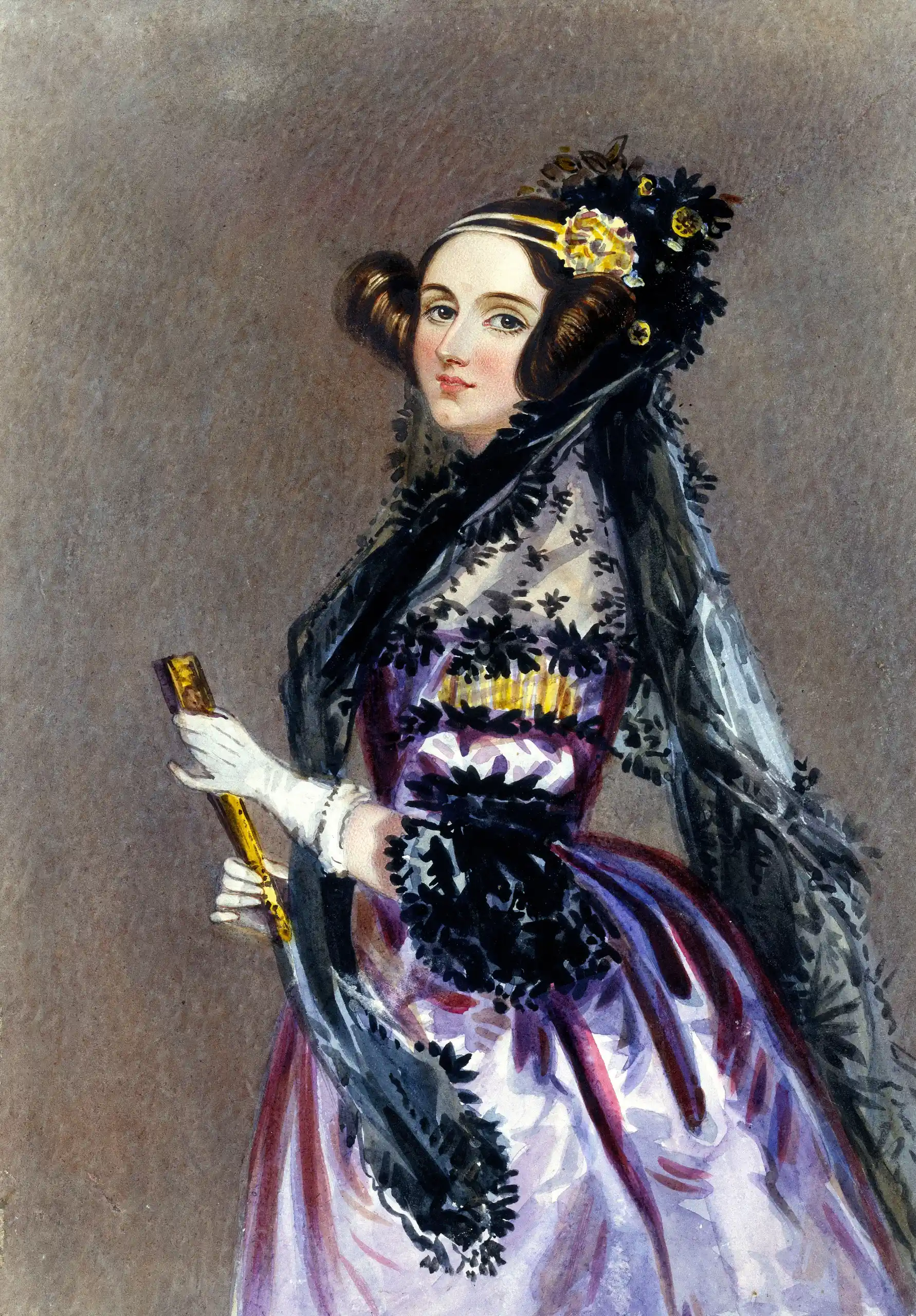
Ada Lovelace
 United Kingdom
mathematician•programmer•writer
Also known as: Augusta Ada Byron, Ada King-Noel, Countess of Lovelace
Fecha de nacimiento
December 10, 1815
Signo zodiacal
Sagittarius
Lugar de nacimiento
London, England
Edad
Falleció a los 36
Acerca de
Ada Lovelace fue una matemática y escritora inglesa, ampliamente reconocida como la primera programadora informática del mundo. Su fama se basa en su colaboración en la década de 1840 con Charles Babbage en su motor analítico, un ordenador mecánico de propósito general. En sus notas, produjo el primer algoritmo diseñado para una máquina y, más notablemente, previó que dichas máquinas podrían manipular símbolos, componer música y crear arte, anticipándose a la informática moderna por más de un siglo. Aunque durante mucho tiempo fue ignorada, su legado ha sido reivindicado en las últimas décadas. Un lenguaje de programación, ADA, y un Día de Ada Lovelace anual celebran sus contribuciones. Sigue siendo una figura imponente en la historia de la informática y un símbolo de las mujeres en STEM.
Primeros años y orígenes
Augusta Ada Byron nació en Londres, Inglaterra, el 10 de diciembre de 1815. Fue la única hija legítima del célebre poeta Lord Byron y la matemática Anne Isabella Milbanke. Su matrimonio fue breve; sus padres se separaron cuando Ada tenía solo cinco semanas y su padre abandonó Inglaterra permanentemente. Criada por su madre, la educación de Ada fue intencionalmente estructurada para alejarla del temperamento volátil y errático de su padre. Anne Isabella puso un fuerte énfasis en un estudio riguroso de las matemáticas y las ciencias, una educación muy inusual para una niña de esa época.
Ada recibió tutoría privada en estas materias, aprendiendo de mentores distinguidos como la matemática y científica escocesa Mary Somerville y el matemático Augustus De Morgan. Mostró una aptitud temprana y notable para los números y la lógica, a menudo abordando sus estudios con una mezcla única de imaginación y pensamiento analítico, que más tarde describió como "ciencia poética". Sus talentos tempranos eran evidentes en sus escritos, incluido un artículo que escribió sobre el juego de billar, donde analizó meticulosamente sus ángulos y fuerzas.
Un momento decisivo en su trayectoria intelectual ocurrió en 1833. En una fiesta, Ada, de 17 años, fue presentada por Mary Somerville al inventor Charles Babbage, quien demostró su pequeño motor diferencial, un innovador dispositivo de cálculo mecánico. Este encuentro crucial despertó una profunda fascinación en Ada, provocando una curiosidad intelectual que finalmente moldearía sus futuras contribuciones y definiría el trabajo de su vida.
Trayectoria profesional
El trabajo definitorio de Lovelace comenzó en la década de 1840 cuando tradujo un artículo italiano sobre el motor analítico de Charles Babbage. Amplió el artículo con sus propias notas, que triplicaban la longitud del original. En la Nota G, describió un algoritmo para calcular los números de Bernoulli usando el motor, considerado ahora el primer programa informático. Más importante aún, reconoció que el motor podía procesar símbolos y no solo números, imaginándolo componiendo música y generando gráficos. Esta percepción la distinguió del propio Babbage. Publicó sus notas bajo las iniciales A.A.L. en 1843. A pesar de su brillantez, luchó contra enfermedades y dificultades financieras, y su trabajo cayó en el olvido después de su muerte. Fue redescubierto en la década de 1950 cuando el historiador B.V. Bowden reeditó sus notas, y posteriormente académicos como Alan Turing citaron su visión.
Cronología profesional
Imagen pública y estilo
Lovelace es celebrada como una pionera visionaria, una matemática que vio más allá de los límites de su época. En la cultura popular, a menudo se la representa como un icono protofeminista y un símbolo del potencial de las mujeres en STEM. Su imagen aparece en libros, charlas TED y en el nombre del Día de Ada Lovelace, una celebración internacional que se celebra el segundo martes de octubre. Es admirada por su salto imaginativo de que las computadoras podrían ser herramientas creativas, no solo calculadoras. Su historia resuena con el público moderno porque combina brillantez intelectual, una historia familiar dramática y un legado que fue reconocido solo póstumamente. A menudo se la cita diciendo El Motor Analítico no tiene ninguna pretensión de originar nada, una frase que subraya su precisión.
Fama y fandom (iFAMOUS Rankings)
Ada Lovelace commands a global attention that transcends the ephemeral metrics of modern celebrity, anchoring herself firmly within the permanent record of human intellectual achievement. While her influence permeates every corner of the digital age, iFANN's Global Fame Engine has evaluated this person, but they do not currently hold a placement in the published rankings (Global Top 1,000 or a Top-100 scope list). The absence of a numerical rank reflects her status as a historical figure rather than a contemporary subject of fluctuating public consumption; she exists outside the dynamic churn of current fame cycles. Consequently, there is no documented fandom name for her audience, as the organized community surrounding her legacy functions through academic and professional channels rather than traditional fan structures. This dedicated group, comprising computer scientists, mathematicians, and STEM advocates, sustains her memory through specific rituals such as the annual celebration of Ada Lovelace Day and the curation of educational theater productions like Ada Lovelace: Bride of Science. These initiatives serve as the closest equivalent to fan-supported art projects, blending biography with mathematical history without adopting a formal collective noun. Her enduring presence is measured not by search volume or chart positions, but by the institutional adoption of her name in programming languages and the persistent re-engagement with her visual legacy, such as the acquisition of her daguerreotypes by the U.K. National Collection.
Datos interesantes y leyendas
Ada Lovelace was the only legitimate child of Lord Byron, who famously called her mother his Princess of Parallelograms. She possessed a lifelong fascination with flight, studying bird anatomy to author a book titled Flyology complete with diagrams and sketches. Her correspondence extended to electrical scientist Andrew Crosse, and she dabbled in the practices of mesmerism. A known gambler, she formed a betting syndicate with friends that resulted in significant financial losses. The programming language ADA, developed by the U.S. Department of Defense in the 1970s, was named in her honor. She once wrote to her mother: I have a feeling that I shall be something of a meteor, a prophecy that proved true. Beyond these biographical details, a central legend of her life concerns her collaboration with Charles Babbage on the Analytical Engine between 1842 and 1843. In Note G of her extensive notes, she described an algorithm intended to compute Bernoulli numbers, an event widely retold as the creation of the first computer program. She also foresaw that machines could manipulate symbols to compose music or create art, a vision that anticipated modern computing by over a century. The mythology surrounding her character often highlights the bridge she built between poetry and science, inherited from her father but steered toward mathematics by her mother. Her death at age 36 from uterine cancer remains part of her biographical lore, often linked to the stress of her work and family tragedy.
Frases destacadas
“The Analytical Engine has no pretensions whatever to originate anything. It can do whatever we know how to order it to perform.”
“I have a feeling that I shall be something of a meteor.”
“That brain of mine is something more than merely mortal, as time will show.”
“I am more than ever now the bride of mathematics. She is my only love.”
“Imagination is the Discovering Faculty, preeminently. It is that which penetrates into unseen worlds.”
Familia y vida personal
Ada fue la única hija de Lord Byron y Anne Isabella Milbanke. Su padre abandonó Inglaterra cuando ella era un bebé y murió en Grecia cuando ella tenía ocho años. Su madre, una mujer estricta y de mentalidad matemática, supervisó su educación y la mantuvo alejada de la poesía. Ada se casó con William King-Noel, I conde de Lovelace, en 1835, y tuvieron tres hijos: Byron (nacido en 1836), Anne Isabella (nacida en 1837) y Ralph Gordon (nacido en 1839). El matrimonio fue estable pero tenso por los problemas de salud de Ada y sus deudas de juego. Vivió con su familia en varias propiedades, incluido Ockham Park en Surrey. Su madre siguió siendo una presencia dominante en su vida hasta la muerte de Ada.
Conexiones destacadas
Ada Lovelace está más estrechamente asociada con Charles Babbage, el inventor del motor diferencial y el motor analítico. También se carteó con científicos como Mary Somerville, Andrew Crosse y Michael Faraday. Su padre, Lord Byron, es una famosa figura literaria. Las asociaciones modernas incluyen la Ada Initiative, una organización sin fines de lucro que apoya a las mujeres en la tecnología y la cultura abiertas, y el Día de Ada Lovelace, que destaca a las mujeres en STEM.
Relaciones e historial sentimental
Ada Lovelace se casó con William King-Noel, I conde de Lovelace, en 1835. Él fue un esposo comprensivo que alentó sus intereses matemáticos. La pareja tuvo tres hijos y vivió en Ockham Park. No hay registros de otras relaciones románticas. Las cartas de Ada sugieren un vínculo intelectual cercano con Charles Babbage, pero se mantuvo profesional. Murió mientras aún estaba casada con William.
- Casado/aWilliam King-Noel, 1st Earl of Lovelace1835 - 1852Casada en 1835; tuvo tres hijos; permaneció casada hasta su muerte.
Muerte y repercusiones
Fallecimiento
November 27, 1852 (a los 36 años)
Lugar de fallecimiento
Kensington, London, England
Causa de la muerte
Uterine cancer
Augusta Ada King, Countess of Lovelace spent her final months in declining health at her residence in Kensington, London, attended by physicians including Dr. Thomas Woodhouse. Her condition, identified as uterine cancer, had persisted for several years and culminated in a fatal outcome on November 27, 1852, when she was thirty-six years old. Historical accounts suggest she underwent a procedure to remove a painful tumor shortly before her passing, though the precise nature of this intervention and whether it accelerated her decline remains a subject of medical interpretation rather than public record. The event proceeded, as authorities and her family treated the death as a natural medical event.
She was buried alongside her parents in the Byron family plot at St. Mary Magdalene Church in Hucknall, Nottinghamshire, in a private ceremony attended by her husband, mother, and close kin. Charles Babbage mourned her loss privately and acknowledged her intellect in his writings during the immediate aftermath. Decades later, her legacy was reclaimed through scholarly rediscovery, leading to modern honors such as induction into the Women in Technology International Hall of Fame in 1994 and the establishment of Ada Lovelace Day in 2009. Contemporary recognitions include the naming of the Nvidia Ada Lovelace GPU architecture in 2022 and the creation of the Ada Lovelace Institute to examine data ethics.
Patrimonio neto (valor de la herencia)
Ada Lovelace vivió en el siglo XIX y su patrimonio neto no es aplicable en términos modernos. Nació en la riqueza como hija de Lord Byron, y su esposo ostentaba el título de conde, lo que le proporcionaba un estilo de vida cómodo. Sin embargo, acumuló deudas de juego y vendió sus joyas familiares hacia el final de su vida. Su patrimonio fue modesto a su muerte. No existen estimaciones financieras contemporáneas.
Premios ganados (1)
Ada Lovelace no recibió premios durante su vida. Póstumamente, fue incluida en el Salón Nacional de la Fama de la Mujer en 2015. Su nombre es honrado a través del lenguaje de programación ADA y el Día de Ada Lovelace, que no son premios formales sino reconocimientos perdurables.
2015 · Inducción
Contributions to computing
Conocido por
Notes on the Analytical Engine
1843 · Autor
First Computer Program (Bernoulli numbers algorithm)
1843 · Creador
Palabras clave
Datos rápidos
- Profesión
- mathematician, programmer, writer
- Nacimiento
- December 10, 1815
- Lugar de nacimiento
- Londres, Inglaterra
- Fallecimiento
- November 27, 1852
- Lugar de fallecimiento
- Marylebone, London
- Género
- Mujer
- Cónyuge
- William King-Noel, 1st Earl of Lovelace
- Signo zodiacal
- Sagittarius
Datos personales
- Nombre completo
- Augusta Ada Byron
- Cónyuge
- William King-Noel, 1st Earl of Lovelace
- Hijos
- 3
- Educación
- Private tutoring in mathematics and science; studied under Mary Somerville and Augustus De Morgan
Preguntas frecuentes
¿Cuántos años tenía Ada Lovelace cuando murió?
¿Por qué es más conocida Ada Lovelace?
¿Quién fue el esposo de Ada Lovelace?
¿Qué es el Día de Ada Lovelace?
¿Cómo está relacionada Ada Lovelace con Lord Byron?
Personas similares
Únete a la comunidad
fans comentando