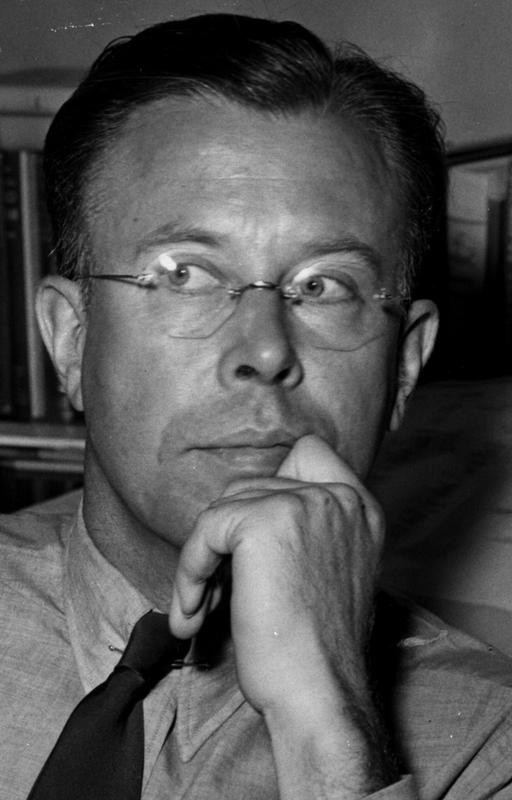
Ernest Orlando Lawrence
 United States
physicist•nuclear physicist•university teacher
Fecha de nacimiento
August 8, 1901
Signo zodiacal
Leo
Lugar de nacimiento
Canton, South Dakota, USA
Edad
Falleció a los 57
Estatura
5 ft 10 in (178 cm)
Acerca de
Ernest Orlando Lawrence fue un físico estadounidense que transformó la ciencia moderna. Ganó el Premio Nobel de Física en 1939 por inventar el ciclotrón, un acelerador de partículas que se convirtió en un pilar de la física nuclear. Lawrence también desempeñó un papel clave en el Proyecto Manhattan, desarrollando la separación electromagnética de isótopos de uranio, y fundó dos importantes laboratorios nacionales: el Laboratorio Nacional Lawrence Berkeley y el Laboratorio Nacional Lawrence Livermore.
Lawrence obtuvo su doctorado en Yale en 1925 tras estudiar en la Universidad de Dakota del Sur y la Universidad de Minnesota. En 1928, se unió a la Universidad de California, Berkeley, como profesor asociado y se convirtió en el profesor titular más joven allí dos años después. Una noche en la biblioteca, vio un diagrama de un acelerador lineal y se preguntó cómo hacerlo compacto. Esa chispa lo llevó al ciclotrón, una cámara circular entre polos de electroimanes que aceleraba partículas a altas energías.
Construyó ciclotrones progresivamente más grandes, y en 1936, su Laboratorio de Radiación se convirtió en un departamento oficial de la UC con Lawrence como director. Promovió usos médicos de los radioisótopos. Durante la Segunda Guerra Mundial, su laboratorio desarrolló calutrones, híbridos de espectrómetros de masas y ciclotrones, para el enriquecimiento de uranio. Una planta masiva llamada Y-12 se construyó en Oak Ridge, Tennessee; aunque ineficiente, produjo el uranio para la primera bomba atómica.
Después de la guerra, Lawrence se convirtió en un firme defensor de la Gran Ciencia, grandes proyectos que requerían grandes máquinas y grandes financiamientos. Apoyó el impulso de Edward Teller para un segundo laboratorio de armas nucleares, ubicado en Livermore, California. Lawrence falleció el 27 de agosto de 1958, a los 57 años. La Universidad de California renombró tanto el laboratorio de Livermore como el de Berkeley en su honor. El elemento 103, lawrencio, descubierto en Berkeley en 1961, también lleva su nombre.
Primeros años y orígenes
Lawrence creció en Canton, Dakota del Sur, hijo de Carl Gustavus Lawrence y Gunda Regina Jacobson, ambos inmigrantes noruegos. Su padre era superintendente escolar y su madre maestra. La familia se mudó a Pierre cuando él era adolescente. De niño, Lawrence sentía curiosidad por la ciencia y disfrutaba realizando experimentos químicos sencillos en su sótano. Asistió a la Universidad de Dakota del Sur en 1918, inicialmente con planes de estudiar medicina, pero se cambió a física después de ser inspirado por el profesor Lewis Akeley. Obtuvo su licenciatura en 1922, luego se mudó a la Universidad de Minnesota para realizar estudios de posgrado, obteniendo una maestría en 1923. Cursó un doctorado en la Universidad de Yale, completando su doctorado en 1925 con una tesis sobre el efecto fotoeléctrico. Durante sus años en Yale, se interesó en el emergente campo de la física nuclear. Un momento crucial llegó en 1929, cuando, como joven profesor asociado en UC Berkeley, Lawrence vio un diagrama de un acelerador lineal en una revista de la biblioteca y concibió la idea del ciclotrón, un acelerador de partículas circular y compacto. Esa intuición preparó el escenario para su gran avance.
Trayectoria profesional
El gran avance de Lawrence llegó en 1931 cuando construyó el primer ciclotrón funcional en UC Berkeley, un dispositivo de 4.5 pulgadas que aceleraba iones de hidrógeno a 80,000 electronvoltios. Lo construyó usando piezas de repuesto de un transmisor de radio con un costo de aproximadamente $25. El dispositivo le valió el Premio Nobel de Física en 1939. Durante la Segunda Guerra Mundial, dirigió la separación electromagnética de isótopos de uranio para el Proyecto Manhattan, utilizando calutrones en la planta Y-12 en Oak Ridge, Tennessee. En 1952, cofundó el Laboratorio Nacional Lawrence Livermore para la investigación de armas nucleares. También recibió la Medalla al Mérito en 1946 y el Premio Enrico Fermi en 1957. Su trabajo sentó las bases de la física de partículas moderna y la producción de isótopos médicos.
Cronología profesional
Imagen pública y estilo
Lawrence era conocido por su enfoque enérgico y práctico de la ciencia, a menudo usando batas de laboratorio y trabajando directamente con el equipo. Fue retratado como un visionario e incansable promotor de la investigación a gran escala, un defensor de la Gran Ciencia. La cobertura mediática destacó su papel en el Proyecto Manhattan y el establecimiento de laboratorios nacionales. Su base de seguidores se encuentra principalmente en la comunidad de físicos; los entusiastas conmemoran los aniversarios de su nacimiento y muerte con conferencias en el Laboratorio Nacional Lawrence Berkeley. No existe un nombre oficial para sus seguidores. Su presencia en redes sociales es inexistente ya que murió antes de la era de internet.
Fama y fandom
Ernest Orlando Lawrence never sought fame, yet his name echoes through the halls of science. The man who built the first cyclotron from spare radio parts in 1929 became the architect of Big Science, transforming physics from a solitary pursuit into a national enterprise. His legacy is not measured in fan clubs or chart positions, it's measured in the laboratories, awards, and elements that bear his name.
In the world of physics, Lawrence is a towering figure, but outside of it, his fame is a quieter, more diffuse thing. iFANN's Global Fame Engine, which evaluates public recognition across media and cultural signals, has assessed Lawrence but found him currently unranked, he holds no placement in the global top 1,000 or any top-100 scope list. This is not a slight; it's a reflection of his sphere of influence, which lies in textbooks and institutional memory rather than daily headlines.
His fanbase, such as it is, has no formal name. There are no fan campaigns, no birthday billboards, no hashtag movements. Instead, his most devoted followers are the physicists and historians who study his work, and the institutions he founded, Lawrence Berkeley National Laboratory and Lawrence Livermore National Laboratory, that keep his memory alive through exhibits and the Ernest Orlando Lawrence Award. The Lawrence Hall of Science in Berkeley also preserves his story for curious visitors.
This is a different kind of fame, one built on achievement, not spectacle. Lawrence's name may not trend on social media, but it is etched into the periodic table and the history of science. That, perhaps, is the most enduring form of recognition.
Datos interesantes y leyendas
Lawrence's first cyclotron cost about $25 and used spare radio parts. He was a close friend of J. Robert Oppenheimer and supported Oppenheimer's security clearance during the 1954 hearings. An avid sailor, he owned a yacht named The Cyclotron. He turned down an offer to become the first director of the Manhattan Project in 1942, recommending Oppenheimer instead. The element lawrencium (Lr) was named in his honor in 1961, three years after his death. He was inducted into the National Inventors Hall of Fame in 1988.
One of the most retold stories from his career is the moment of inspiration for the cyclotron. In 1929, Lawrence reportedly glanced at a paper by Norwegian physicist Rolf Widerøe in a university library and had a sudden flash of insight, the idea for a machine that could accelerate particles in a spiral. He and graduate student M. Stanley Livingston built the first working model in 1931, a device just four inches across that could be held in one hand, yet it successfully accelerated hydrogen ions to 80,000 electron volts. The story of this tiny machine, assembled with sealing wax and brass in a cramped basement workshop, is a favorite among physicists and science enthusiasts.
Another legendary episode is the saga of the 184-inch cyclotron, designed to be the world's most powerful accelerator. Construction was interrupted by World War II, and after the war, Lawrence redesigned it using new synchrotron principles. Completed in 1946, it became the prototype for all subsequent high-energy accelerators, cementing his reputation as a pioneer of large-scale physics.
Frases destacadas
“The cyclotron is a machine that will enable us to explore the nucleus of the atom.”
“We are entering an era of big science. The problems are too large for a single man to solve.”
“I have never been able to understand why a man should be afraid of a little hard work.”
Familia y vida personal
Lawrence se casó con Mary K. Blumer el 14 de mayo de 1932. Mary era hija de un físico de Yale, y se conocieron en círculos académicos. La pareja tuvo seis hijos: John, Margaret, Mary, Robert, Barbara y Susan. La familia vivía en Berkeley, California, donde trabajaba Lawrence. Era un padre dedicado que a menudo involucraba a sus hijos en sus intereses científicos, llevándolos al laboratorio los fines de semana. El matrimonio duró hasta la muerte de Lawrence en 1958. No hay otros detalles familiares significativos documentados públicamente.
Conexiones destacadas
Lawrence fue un amigo cercano y colega de J. Robert Oppenheimer, recomendándolo para liderar el Proyecto Manhattan. Colaboró con Edward Teller en la bomba de hidrógeno y apoyó el impulso de Teller para un segundo laboratorio de armas. Luis Álvarez fue estudiante y colega en el Laboratorio de Radiación, más tarde premio Nobel. Glenn T. Seaborg trabajó en el laboratorio, descubrió el plutonio y luego presidió la Comisión de Energía Atómica. Su esposa Mary K. Blumer fue su compañera de toda la vida.
Relaciones e historial sentimental
Ernest Lawrence se casó con Mary K. Blumer el 14 de mayo de 1932. La relación comenzó a finales de la década de 1920, cuando ambos estaban en la Universidad de Yale; Mary era hija de un profesor de física. Tuvieron seis hijos juntos. El matrimonio duró hasta la muerte de Lawrence en 1958. No se documentan otras relaciones románticas públicas; la vida personal de Lawrence era privada y se centraba en su familia y su trabajo. A partir de 2026, Lawrence está fallecido, sin relación romántica actual.
- Casado/aMary K. Blumer1932 - 1958Casado el 14 de mayo de 1932; tuvo seis hijos juntos; el matrimonio duró hasta la muerte de Lawrence.
Muerte y repercusiones
Fallecimiento
August 27, 1958 (a los 57 años)
Lugar de fallecimiento
Palo Alto, California
Causa de la muerte
Desconocido
The University of California announced the passing of Ernest Orlando Lawrence on August 27, 1958, confirming his death at a medical facility in Palo Alto, California. The physicist, who had spent decades driving the boundaries of nuclear science, succumbed to an illness that authorities never publicly detailed in specific terms. Tributes flowed immediately from the highest levels of American science and government. The scientific community marked his loss with a significant memorial event on May 1, 1959, where the American Institute of Physics hosted invited lectures dedicated to the history of the cyclotron. Articles in Physics Today and Chemistry World reflected on his dual legacy as the inventor of the particle accelerator and a key architect of the Manhattan Project.
These publications avoided sensationalism, focusing instead on the technical and historical weight of his contributions to nuclear physics. His legacy was cemented through immediate institutional action rather than traditional funeral rites. The Department of Energy established the Ernest Orlando Lawrence Award to recognize outstanding contributions in science and technology, a honor bestowed annually since his death. The University of California honored him by naming its premier research facility after him, ensuring his name remained central to the field he helped create.
Patrimonio neto (valor de la herencia)
$1 Million
Estimación del equipo editorial de iFANN
Ernest Lawrence died in 1958, and his estate was modest by modern standards. Research by the iFANN Editorial Team puts his estate's value at approximately $1 million, a figure that reflects his life as a public servant and academic rather than a commercial figure. The estate's worth is primarily tied to ongoing royalties from patents, such as the cyclotron patent, and licensing of his name. The Ernest Orlando Lawrence Award, funded by the U.S. government, is a separate legacy that honors mid-career scientists. The estate is managed by the Lawrence family trust, and no posthumous releases or merchandise generate significant revenue. Lawrence's true wealth lies in his scientific contributions, which continue to shape physics and national laboratories.
Premios ganados (6)
Lawrence ganó el Premio Nobel de Física en 1939 por inventar el ciclotrón. También recibió el Premio Comstock de Física (1937), la Medalla al Mérito (1946), la Medalla Hughes (1951), el Premio Enrico Fermi (1957) y el Premio Sylvanus Thayer (1958). Estos honores reconocieron sus contribuciones a la física nuclear y la defensa nacional.
1937 · Física
Cyclotron
1939 · Física
Cyclotron
Conocido por
Invention of the cyclotron
1931 · Inventor
Manhattan Project
1942 · Director of electromagnetic isotope separation
Lawrence Berkeley National Laboratory
1936 · Founder and director
Lawrence Livermore National Laboratory
1952 · Cofundador
Palabras clave
Datos rápidos
- Profesión
- physicist, nuclear physicist, university teacher
- Nacimiento
- +1901-08-08
- Lugar de nacimiento
- Canton
- Fallecimiento
- +1958-08-27
- Lugar de fallecimiento
- Palo Alto
- Género
- Hombre
- Cónyuge
- Mary K. Blumer
- Signo zodiacal
- Leo
Datos personales
- Nombre completo
- Ernest Orlando Lawrence
- Estatura
- 5 ft 10 in (178 cm)
- Cónyuge
- Mary K. Blumer
- Hijos
- 6
- Educación
- University of South Dakota (BA, 1922); University of Minnesota (MS, 1923); Yale University (PhD, 1925)
Preguntas frecuentes
¿Cómo murió Ernest Lawrence?
¿Cuál es el patrimonio neto de Ernest Lawrence en 2026?
¿Ernest Lawrence tuvo hijos?
¿Por qué es famoso Ernest Lawrence?
¿Está Ernest Lawrence relacionado con el Laboratorio Lawrence Livermore?
Personas similares
Únete a la comunidad
fans comentando