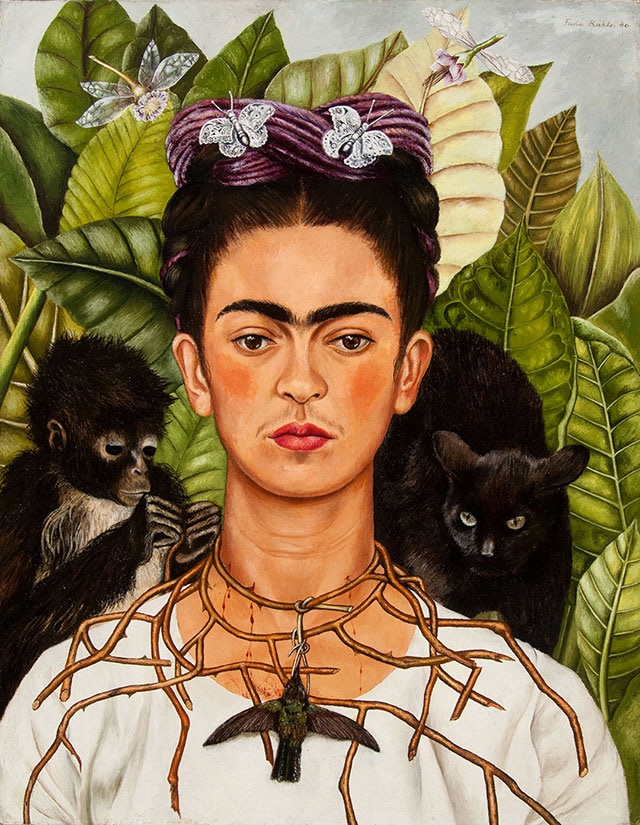
Frida Kahlo
 Mexico
Also known as: Magdalena Carmen Frida Kahlo y Calderón
Fecha de nacimiento
July 6, 1907
Signo zodiacal
Cancer
Lugar de nacimiento
Coyoacán, Mexico City, Mexico
Edad
Falleció a los 47
Estatura
5 ft 3 in (160 cm)
Acerca de
Frida Kahlo, born Magdalena Carmen Frida Kahlo y Calderón on July 6, 1907, in Coyoacán, Mexico City, was a Mexican painter whose work has become synonymous with bold self-expression and cultural pride. Known for her many self-portraits, she used a naïve folk art style to explore identity, postcolonialism, gender, class, and race. Her paintings mix realism with fantasy, often drawing from her own life, including her chronic pain. She is celebrated as an icon for Chicanos, feminists, and the LGBTQ+ community, her uncompromising depictions of the female experience making her a global symbol of resilience and cultural identity. Her image has been featured on Mexican banknotes, and her home, La Casa Azul, is now the Frida Kahlo Museum, one of the most visited museums in Mexico City. The 2002 biopic Frida, starring Salma Hayek, won two Academy Awards and introduced her to a new generation. In 2018, she was ranked #1 on Rolling Stone's list of "10 Best Visual Artists of All Time," and in 2020, she was named one of TIME's "100 Women of the Year" as a proxy for 1937. The intense global cult of personality around her is sometimes called "Fridamania." Fans often dress as her for Halloween or "Frida Fest" events, and her image is a staple of Day of the Dead celebrations. The official social media accounts post a mix of art history, political statements aligned with her Communist past, and inspirational quotes. As of 2026, her estate is estimated to be worth $60–$80 million, managed by the Frida Kahlo Museum and the Diego Rivera and Frida Kahlo Trust.
Primeros años y orígenes
Kahlo creció en el hogar familiar conocido como La Casa Azul en Coyoacán. A los seis años, la polio dejó su pierna derecha más delgada que la izquierda, y caminó con una cojera el resto de su vida. Su padre, fotógrafo, la animó a jugar fútbol y nadar para fortalecer la pierna. Fue una estudiante brillante y rebelde, y una de las 35 niñas en la Escuela Nacional Preparatoria de la Ciudad de México. Fue allí donde vio por primera vez a Diego Rivera pintando un mural en el campus. Un momento crucial ocurrió el 17 de septiembre de 1925, cuando el autobús en el que viajaba chocó con un tranvía. El accidente la atravesó la pelvis, fracturó su columna vertebral, clavícula, costillas, pelvis y pierna derecha. Durante su larga y dolorosa recuperación, inmóvil en un yeso corporal, comenzó a pintar. Su madre mandó hacer un caballete especial para que pudiera pintar en la cama, y colocó un espejo sobre ella para que pudiera pintar autorretratos. Ese accidente de autobús redirigió su vida por completo, convirtiendo a una estudiante de premedicina en artista. A menudo daba su año de nacimiento como 1910, el inicio de la Revolución Mexicana, para alinear su vida con el México moderno.
Trayectoria profesional
El gran avance de Kahlo llegó en 1938 cuando el surrealista André Breton organizó su primera exposición individual en la Galería Julien Levy en Nueva York. La muestra vendió aproximadamente la mitad de las 25 pinturas, un éxito comercial. En 1939, viajó a París para una exposición en la Galería Renou & Colle, donde el Louvre adquirió El marco, convirtiéndola en la primera artista mexicana del siglo XX en ser coleccionada por el museo. Durante la década de 1940, enseñó en la Escuela Nacional de Pintura, Escultura y Grabado "La Esmeralda" y fue miembro fundadora del Seminario de Cultura Mexicana. En 1953, su primera exposición individual en México se llevó a cabo en la Galería Arte Contemporáneo. Asistió a la inauguración en una ambulancia y fue llevada a su cama, que fue colocada en la galería. Continuó pintando hasta su muerte en 1954. Póstumamente, su obra ganó un enorme impulso. En 2021, su pintura Diego y yo se vendió por 34.9 millones de dólares, un récord para un artista latinoamericano en subasta. En 1954, recibió el Premio Nacional de Pintura del gobierno mexicano. Una gran exposición, "Frida Kahlo: La vida de un ícono", ha estado recorriendo el mundo, con experiencias digitales inmersivas. En 2024, el Museo Frida Kahlo anunció una nueva exposición permanente centrada en su activismo político.
Cronología profesional
Imagen pública y estilo
El estilo característico de Kahlo incluye su ceja unificada, coronas de flores, coloridos vestidos tehuana y una mirada directa e implacable en sus autorretratos. Es retratada como un ícono feminista trágico pero resiliente, un símbolo del dolor transformado en arte, y una figura de orgullo cultural para mexicanos y chicanos. Apareció en la portada de Vogue en 1937, fotografiada por Toni Frissell, presentándola al público de la moda estadounidense. TIME presentó una ilustración de ella en su portada en 2002, y Vanity Fair tuvo una historia de portada para la película Frida ese mismo año. La cuenta oficial de Instagram @museofridakahlo tiene más de 1.1 millones de seguidores, y la página de Facebook tiene más de 500,000 seguidores. La cuenta de Twitter/X @FridaKahlo tiene más de 300,000 seguidores. Los fanáticos a menudo se llaman "seguidores de Frida" o "fans de Frida", y existe una fuerte subcultura de bodas "temáticas de Frida". El patrimonio continúa lanzando nuevas líneas de productos con licencia, incluida una reciente colaboración con una casa de moda de alta gama.
Fama y fandom
Frida Kahlo remains the 1st most famous person from Mexico, a position she holds with quiet authority. Her standing extends far beyond her borders, ranking as the 3rd most famous person in Latin America and securing the 4th spot globally for her country of origin at the 4th most famous person in Mexico. Within the global pantheon of creativity, she is recognized as the 3rd most famous person in Art & Design, while her overall cultural footprint places her at the 185th most famous person in the world. These placements, consistent across recent cycles within the iFANN Global Fame Rankings, reflect an enduring devotion that transcends generations. The scale of this attention tracks how her image permeates media coverage, search behaviors, and consumption signals worldwide, cementing her status not merely as a historical figure but as a living presence in contemporary culture.
There is no formal name for her fanbase, though the term "Fridas" has emerged in cultural discourse to describe women who emulate her style or identify with her legacy rather than a structured organization. Unlike modern celebrities whose followers drive campaigns or fund billboards, Kahlo's devotees express their admiration through the preservation of her mythos. This mythology rests on verified biographical events amplified into folklore, such as her survival of a near-fatal bus accident which transformed physical suffering into the pain and passion evident in her self-portraits. Her tumultuous marriage to Diego Rivera and her distinct visual persona, elaborate Tehuana clothing and floral hairstyles adopted to assert Mexican identity, have become symbols of resistance. Recent institutional reactions underscore this devotion; a major exhibition broke pre-sale ticket records at the Tate, while activists filed lawsuits to prevent her paintings from leaving Mexico, arguing they are too culturally vital to be exported. These events highlight a fierce protection of her legacy by a global audience that treats her life story as high drama and her art as a national treasure.
Datos interesantes y leyendas
Born Magdalena Carmen Frida Kahlo y Calderón on July 6, 1907, in Coyoacán, she became a painter whose work defined bold self-expression and cultural pride. Known for her many self-portraits, she utilized a naïve folk art style to explore identity, postcolonialism, gender, class, and race. Her paintings mixed realism with fantasy, often drawing from her own life and chronic pain. She was celebrated as an icon for Chicanos, feminists, and the LGBTQ+ community, with her uncompromising depictions of the female experience making her a global symbol of resilience. Her image appeared on Mexican banknotes, and her home, La Casa Azul, served as a museum. Her signature style included her unibrow, flower crowns, colorful Tehuana dresses, and a direct gaze. She appeared on the cover of Vogue in 1937, photographed by Toni Frissell, introducing her to an American fashion audience. TIME featured an illustration of her on its cover in 2002, and Vanity Fair had a spread. She was bisexual and had affairs with both men and women, including the singer Chavela Vargas. She was an avid political activist and joined the Mexican Communist Party in 1928. She loved wearing traditional Tehuana dresses to highlight her Indigenous heritage and hide her scarred leg. She often incorporated her unibrow and facial hair into her self-portraits as a deliberate statement against conventional beauty standards. Her height was 5 feet 3 inches (160 cm). She was honored with a Google Doodle on July 6, 2010, for her 103rd birthday. Notable quotes include: "I paint self-portraits because I am so often alone, because I am the person I know best" (from her diary, circa 1940s); "They thought I was a Surrealist, but I wasn't. I never painted dreams. I painted my own reality" (interview, 1953); "Feet, what do I need you for when I have wings to fly?" (from her diary, 1953, after her leg amputation); and "I hope the exit is joyful, and I hope never to return" (final diary entry, 1954). A story fans still retell involves her near-fatal bus accident in 1925, which sparked her artistic career during recovery. Another legend centers on her relationship with Diego Rivera, marked by volatility and infidelities, including rumors of an affair with Leon Trotsky. Her deliberate rejection of beauty norms, growing a mustache and unibrow, became a core part of her lore.
Frases destacadas
“I paint self-portraits because I am so often alone, because I am the person I know best.”
“They thought I was a Surrealist, but I wasn't. I never painted dreams. I painted my own reality.”
“Feet, what do I need you for when I have wings to fly?”
“I hope the exit is joyful — and I hope never to return.”
Familia y vida personal
El padre de Kahlo, Guillermo Kahlo, era un inmigrante alemán y fotógrafo. Su madre, Matilde Calderón y González, era de ascendencia indígena y española. Tuvo tres hermanas: Matilde, Adriana y Cristina. Kahlo nunca tuvo hijos; un embarazo en 1930 fue interrumpido por razones médicas, y abortos posteriores la dejaron profundamente deprimida. Ella y Rivera vivieron en La Casa Azul, que luego se convirtió en el Museo Frida Kahlo. La casa estaba llena de animales, incluidos monos, loros y un perro xoloitzcuintle. También poseía un venado mascota llamado Granizo.
Conexiones destacadas
Diego Rivera, su esposo y compañero muralista, fue una influencia de por vida. André Breton, el escritor surrealista, defendió su obra y organizó su primera gran exposición. El fotógrafo Nickolas Muray, su amante, capturó imágenes icónicas de ella. Salma Hayek la interpretó en la película biográfica de 2002 y ayudó a llevar su historia a una audiencia global.
Relaciones e historial sentimental
La primera relación seria de Kahlo fue con Alejandro Gómez Arias, un carismático líder estudiantil en la Escuela Nacional Preparatoria. Salieron desde 1922 hasta 1927, y él estuvo con ella durante el accidente de autobús de 1925. La relación terminó debido a la desaprobación de su familia y su infidelidad. En 1929, se casó con Diego Rivera, un notorio mujeriego. Su matrimonio fue apasionado pero tumultuoso, marcado por infidelidades de ambas partes. Kahlo tuvo relaciones tanto con hombres como con mujeres, incluyendo al fotógrafo Nickolas Muray (intermitentemente de 1931 a 1941), al escultor Isamu Noguchi (1936–1937), al marchante de arte alemán Heinz Berggruen (1938) y al artista catalán José Bartolí (1946–1950). Un supuesto romance con el revolucionario ruso exiliado León Trotsky en 1937 causó una ruptura entre Kahlo y Rivera. Se divorciaron en 1939 pero se volvieron a casar un año después, el 8 de diciembre de 1940, manteniendo una compañía platónica hasta su muerte. En 2026, Frida Kahlo ha fallecido.
- SalieronAlejandro Gómez Arias1922 - 1927Su primer novio serio; estuvieron juntos durante el accidente de autobús.
- Casado/aDiego Rivera1929 - 1939Primer matrimonio, tumultuoso con infidelidades.
- SalieronNickolas Muray1931 - 1941Relación intermitente; Muray tomó fotografías icónicas de Kahlo.
- SalieronIsamu Noguchi1936 - 1937Aventura mientras Rivera estaba con su hermana Cristina.
- RumoreadoLeon Trotsky1937 - 1939Aventura ampliamente creída mientras Trotsky vivía en la Casa Azul.
- SalieronHeinz Berggruen1938 - 1938Breve relación con el marchante de arte alemán.
- Casado/aDiego Rivera1940 - 1954Segundo matrimonio, compañerismo platónico hasta su muerte.
- SalieronJosé Bartolí1946 - 1950Relación a distancia con el artista catalán.
Muerte y repercusiones
Fallecimiento
July 13, 1954 (a los 47 años)
Lugar de fallecimiento
Coyoacán, Mexico City, Mexico
Causa de la muerte
Pulmonary embolism
The announcement of Frida Kahlo's passing came from her family at La Casa Azul in Coyoacán, confirming the end of a life marked by intense physical struggle and artistic brilliance. On July 13, 1954, she died at the age of 47 within the very home where she had spent so much of her creative life, bedridden and isolated by the severe complications of gangrene that had necessitated the amputation of her right leg earlier that year. Her final diary entry reading "I hope the exit is joyful, and I hope never to return" was widely interpreted by historians as relief from chronic suffering rather than an act of suicide, effectively refuting rumors that had circulated about her intent. Public reaction at the time remained subdued, confined largely to close peers and the Mexican art community since she had not yet achieved global fame.
Her husband, Diego Rivera, was devastated by the loss and fell into a deep depression, dying just over a year later in 1957. The funeral was a private affair attended by Rivera, their daughter Matilde Kahlo, and friends like photographer Lola Álvarez Bravo before she was cremated at the Panteón Civil de Dolores. Her ashes were eventually interred at La Casa Azul, which Rivera converted into a museum dedicated to her memory. In the decades that followed, her legacy surged through feminist art history and the publication of her diaries, leading to major exhibitions, the 2002 film Frida, and enduring recognition as a global icon of resilience.
Patrimonio neto (valor de la herencia)
$80 Million
Estimación del equipo editorial de iFANN
As Frida Kahlo is deceased, her net worth refers to the value of her estate, which is estimated at $80 Million per iFANN's editorial analysis as of 2026. The estate generates income through licensing her image, which is one of the most licensed in the world, appearing on everything from T-shirts to sneakers to Barbie dolls. Merchandise sales, royalties from book and art print sales, and admissions to the Frida Kahlo Museum in Mexico City also contribute. The estate is managed by the Frida Kahlo Museum and the Diego Rivera and Frida Kahlo Trust, which aggressively protects her intellectual property. The trust has sued companies for unauthorized use of her likeness, maintaining the estate's value. Some fan sites project an estate value as high as $200 million, but this is considered a forward-looking projection based on potential future licensing deals.
Premios ganados (1)
Kahlo recibió el Premio Nacional de Pintura del gobierno mexicano en 1954, justo antes de su muerte. Su obra ha sido honrada póstumamente a través de exposiciones en museos y reconocimientos culturales, incluyendo su aparición en billetes mexicanos y en Google Doodles.
1954 · Premio Nacional de Pintura
Lifetime achievement
Conocido por
Self-Portrait with Thorn Necklace and Hummingbird
1940 · painter
The Two Fridas
1939 · painter
The Broken Column
1944 · painter
Diego y yo
1949 · painter
The Frame
1938 · painter
Palabras clave
Datos rápidos
- Profesión
- painter, artist
- Nacimiento
- July 6, 1907
- Lugar de nacimiento
- Coyoacán, Mexico City, Mexico
- Fallecimiento
- July 13, 1954
- Lugar de fallecimiento
- Coyoacán, Mexico City, Mexico
- Género
- Mujer
- Cónyuge
- Diego Rivera
- Signo zodiacal
- Cancer
Datos personales
- Nombre completo
- Magdalena Carmen Frida Kahlo y Calderón
- Estatura
- 5 ft 3 in (160 cm)
- Cónyuge
- Diego Rivera
- Educación
- National Preparatory School, Mexico City
Preguntas frecuentes
¿Por qué es más famosa Frida Kahlo?
¿Cómo murió Frida Kahlo?
¿Tuvo hijos Frida Kahlo?
¿Por qué Frida Kahlo pintó tantos autorretratos?
¿Fue Frida Kahlo surrealista?
Personas similares
Únete a la comunidad
fans comentando