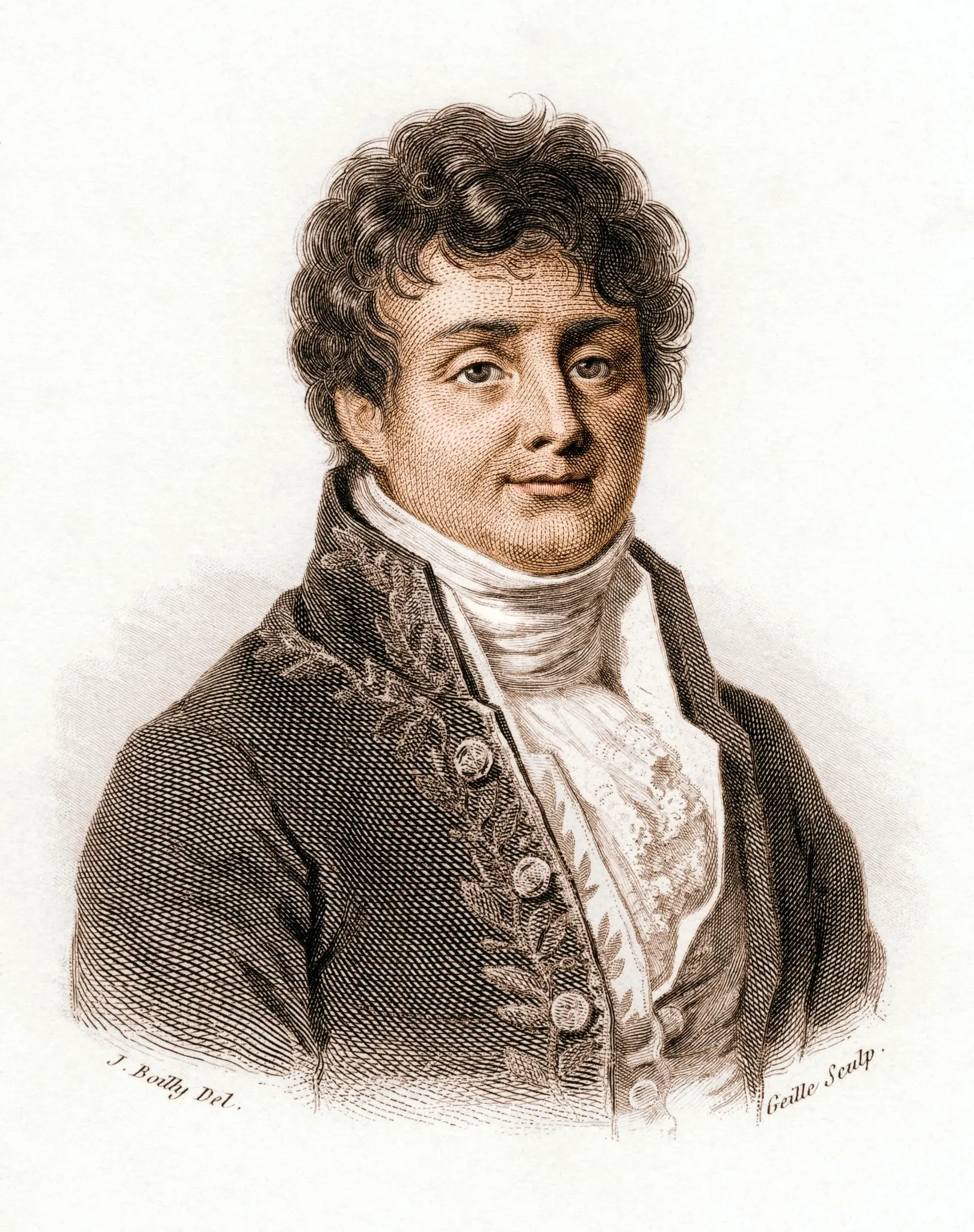
Joseph Fourier
 France
mathematician•physicist•historian
Fecha de nacimiento
March 21, 1768
Signo zodiacal
Aries
Lugar de nacimiento
Auxerre, Burgundy, Kingdom of France
Edad
Falleció a los 62
Acerca de
Jean-Baptiste Joseph Fourier fue un matemático y físico francés cuyo trabajo sobre la conducción del calor dio lugar a una de las herramientas más poderosas de la ciencia moderna: la serie de Fourier. Su idea de que cualquier función periódica podía expresarse como una suma de ondas senoidales y cosenoidales revolucionó las matemáticas y la física, dando lugar al desarrollo del análisis de Fourier, piedra angular del procesamiento de señales, la mecánica cuántica y la ingeniería. La transformada de Fourier y la ley de Fourier de la conducción del calor llevan su nombre. También realizó una de las primeras descripciones científicas del efecto invernadero, calculando que la atmósfera terrestre atrapa calor. Su carrera incluyó el servicio como asesor científico de Napoleón Bonaparte durante la expedición a Egipto y como prefecto de Grenoble. Los métodos de Fourier siguen siendo indispensables en innumerables campos técnicos, y su legado como fundador de la física matemática está asegurado.
Primeros años y orígenes
Fourier nació en Auxerre, duodécimo hijo de un maestro sastre. Huérfano a los nueve años, fue criado por la iglesia e ingresó en la École Royale Militaire de Auxerre, dirigida por monjes benedictinos. Mostró temprano talento para la literatura, pero a los trece años las matemáticas se convirtieron en su interés absorbente. A los catorce años ya había trabajado los seis volúmenes del Cours de mathématiques de Bézout y a los quince ganó un premio por su estudio de la mecánica de Bossut. Su costumbre de quedarse despierto hasta tarde leyendo textos matemáticos a la luz de las velas, recolectando cabos desechados para seguir estudiando, contribuyó a su mala salud de por vida. Se le negó una comisión científica en el ejército debido a su nacimiento, por lo que enseñó matemáticas y entró en la Iglesia. Durante la Revolución Francesa, sirvió en el Comité Revolucionario local, pero fue brevemente encarcelado en 1794 por protestar contra su brutalidad. En 1795, fue nombrado en la École Normale y poco después sucedió a Joseph-Louis Lagrange en la École Polytechnique.
Trayectoria profesional
En 1798, Fourier fue uno de los tres principales asesores científicos elegidos por Napoleón para la expedición a Egipto. Se desempeñó como gobernador del Bajo Egipto, organizó talleres de municiones y contribuyó con artículos al Instituto Egipcio en El Cairo. Tras la capitulación francesa en 1801, regresó a Francia y fue nombrado prefecto de Grenoble. Allí comenzó su trabajo seminal sobre la conducción del calor. En 1822, publicó su obra magna, Théorie analytique de la chaleur, que estableció la ecuación diferencial parcial que rige la difusión del calor y la resolvió usando series trigonométricas infinitas, ahora conocidas como series de Fourier. El trabajo fue inicialmente controvertido; Lagrange había considerado casos particulares pero no había profundizado en el tema. Fourier también realizó experimentos con recipientes cubiertos de vidrio y concluyó que la atmósfera terrestre retiene el calor, anticipándose al efecto invernadero. Tras la caída de Napoleón, enfrentó dificultades con la monarquía restaurada, pero se mudó a París en 1816 y continuó su trabajo hasta su muerte en 1830.
Cronología profesional
Imagen pública y estilo
Fourier es considerado uno de los matemáticos y físicos más influyentes de su época. Su trabajo sentó las bases del análisis de Fourier y el análisis armónico, que se convirtieron en herramientas indispensables en la ciencia y la ingeniería. Es recordado como un pionero de la física matemática que demostró que las matemáticas podían describir fenómenos físicos con elegante precisión. Su nombre está asociado a la transformada de Fourier, la serie de Fourier, la ley de Fourier y el número de Fourier, una notable cantidad de epónimos perdurables para un solo científico.
Fama y fandom
Joseph Fourier commands a global attention defined by enduring academic reverence rather than contemporary celebrity metrics. His influence permeates the foundational texts of mathematics and physics, yet his presence in modern popular culture remains distinct from the active fandoms of living stars. According to the August 2026 evaluation by iFANN, Joseph Fourier is currently evaluated but does not hold a placement in the published Global Top 1,000 or any Top-100 scope list. The absence of a ranked position reflects his status as a historical figure whose legacy operates within scholarly circles rather than the fluctuating currents of public opinion measured by current fame engines. While no formal fandom name exists for the mathematician, the community engaging with his work consists of mathematicians, physicists, engineers, and historians who celebrate his contributions through academic discourse rather than organized fan rituals. Institutions occasionally mark significant dates, such as the celebration of his 250th birthday in 2018, but these events serve professional commemoration rather than fan devotion. No fan-funded projects, social media campaigns, or interactive movements have ever been launched in his name, as the concept of a celebrity fanbase did not exist during his lifetime. The engagement he receives is strictly intellectual, characterized by the study of his equations and the application of his theories in fields ranging from signal processing to climate science.
Datos interesantes y leyendas
Jean-Baptiste Joseph Fourier collected discarded candle stumps from the school chapel to continue studying mathematics after dark. Originally destined for life as a Benedictine monk, he never took vows because the French Revolution suspended monastic orders just before his pronouncement. His assertion that heat behaves like a wave was initially dismissed as ludicrous by contemporaries, including Lagrange, who had only explored particular cases without pursuing the broader theory. During Napoleon's Egyptian expedition, Fourier served as the governor of Lower Egypt and secretary of the Institut d'Égypte, bridging his early mathematical interests with administrative duties. A verified legend surrounding his career involves his discovery of the greenhouse effect, where he theorized that Earth's atmosphere traps heat from the sun, a prediction made over a century and a half before it became a central concern of environmental science. Another iconic moment in his scientific mythology is the development of the Fourier series, which revolutionized analysis by proving that complex periodic functions could be expressed as sums of sine and cosine waves. This theoretical breakthrough, once controversial, is now regarded by modern figures like Fields Medalist Cédric Villani as a "mathematical poem," elevating his derivations to an aesthetic level while remaining a practical cornerstone for nanochips and quantum mechanics.
Frases destacadas
“There cannot be a language more universal and more simple, more free from errors and obscurities... Mathematical analysis is as extensive as nature itself, and it defines all perceptible relations.”
“Profound study of nature is the most fertile source of mathematical discoveries.”
Familia y vida personal
Conexiones destacadas
Relaciones e historial sentimental
Muerte y repercusiones
Fallecimiento
May 16, 1830 (a los 62 años)
Lugar de fallecimiento
Paris, France
Causa de la muerte
Natural causes associated with old age
The Institut Fourier at the University of Grenoble Alpes stands as a permanent institutional tribute to his contributions, while modern mathematical discourse continues to treat his work on heat transfer as a foundational element of signal processing. Centuries after his passing, specific predictions regarding plasma physics made by him were experimentally confirmed in 2025, reshaping contemporary understanding of extreme materials and cementing his status as a visionary whose insights outlasted his biological lifespan. His legacy also saw renewed global attention during the celebration of his 250th birthday in 2018, with scholarly articles highlighting his early calculations on the greenhouse effect that anticipated modern climate science by nearly two centuries.
Joseph Fourier passed away on May 16, 1830, at the age of 62 within the city of Paris where he served as a prominent administrator and member of the French Academy. Historical records indicate he remained active in scientific administration until his final days, though no specific details regarding his last public appearance or the precise circumstances of his final hours are preserved in available biographical accounts. The cause of death is attributed to natural causes associated with old age. Specific details concerning the date, location, attendees, or nature of his funeral service remain unrecorded in the historical text.
Patrimonio neto (valor de la herencia)
$0
Estimación del equipo editorial de iFANN
Joseph Fourier passed away in 1830 as a mathematician, physicist, and administrator who maintained a modest lifestyle throughout his life. He did not accumulate significant personal wealth by modern standards, and no financial records track the value of his estate. Per iFANN's editorial analysis, the total net worth for Joseph Fourier is $0.
Premios y galardones
View 4 records, honours and achievementsConocido por
Fourier series
1822 · Developer
Fourier transform
1822 · Developer
Fourier's law of heat conduction
1822 · Discoverer
Greenhouse effect
1824 · Early describer
Palabras clave
Fuentes
Datos rápidos
- Profesión
- mathematician, physicist, historian
- Nacimiento
- +1768-03-21
- Lugar de nacimiento
- Auxerre
- Fallecimiento
- +1830-05-16
- Lugar de fallecimiento
- Paris
- Género
- Hombre
- Signo zodiacal
- Aries
Datos personales
- Nombre completo
- Jean-Baptiste Joseph Fourier
- Educación
- École Royale Militaire of Auxerre, École Normale Supérieure
Preguntas frecuentes
¿Por qué es famoso Joseph Fourier?
¿Se casó Joseph Fourier?
¿Cómo murió Joseph Fourier?
¿Qué descubrió Joseph Fourier sobre el calor?
¿Cuál es el descubrimiento del efecto invernadero por Fourier?
Personas similares
Únete a la comunidad
fans comentando