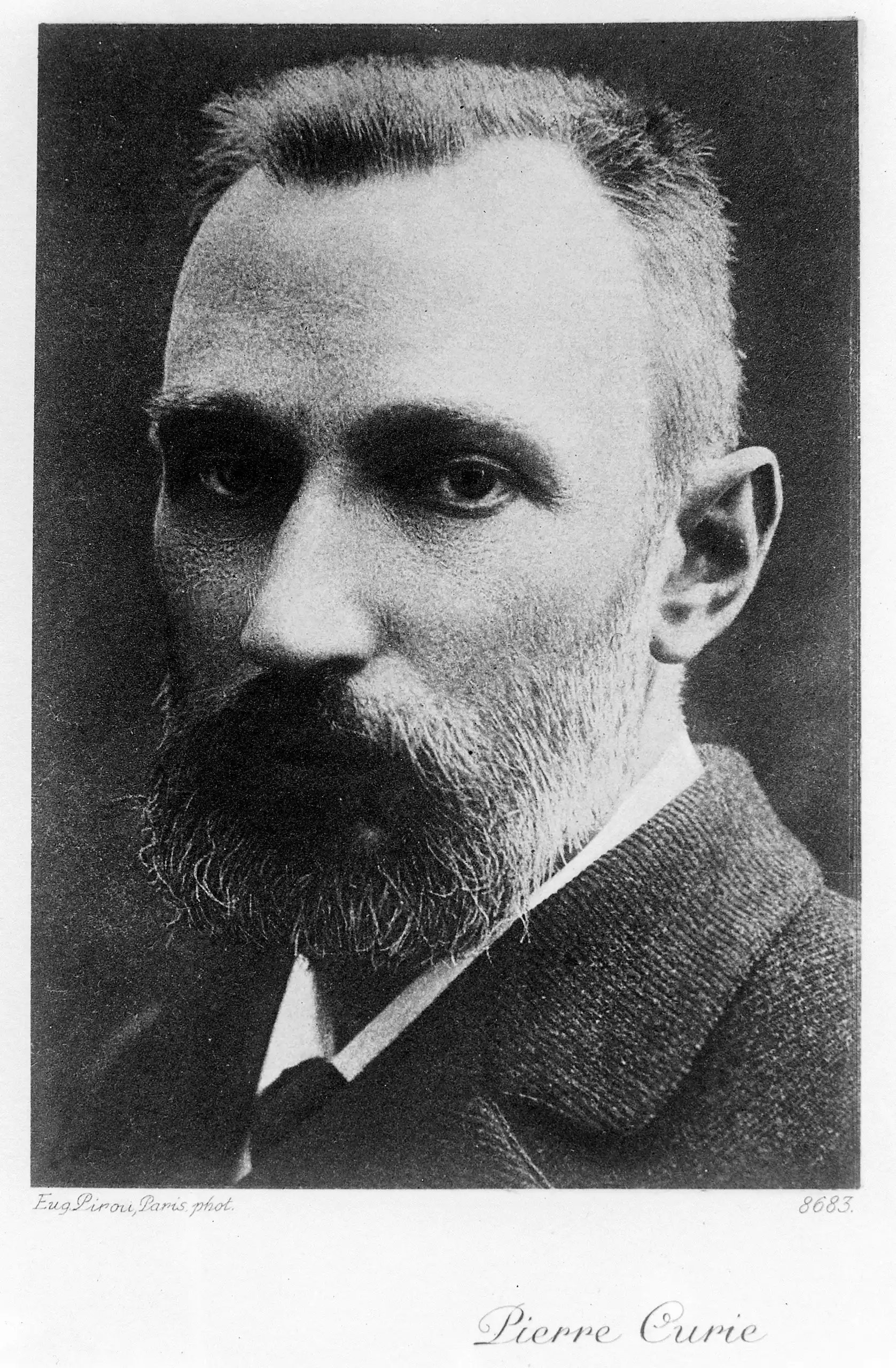
Pierre Curie
 France
physicist•chemist•university teacher
Fecha de nacimiento
May 15, 1859
Signo zodiacal
Taurus
Lugar de nacimiento
Paris, France
Edad
Falleció a los 46
Estatura
5 ft 7 in (170 cm)
Acerca de
Pierre Curie fue un físico y químico francés que transformó la ciencia moderna. Junto a su esposa Marie Curie, fue pionero en el estudio de la radiactividad, descubriendo los elementos polonio y radio. Su trabajo conjunto les valió el Premio Nobel de Física en 1903, convirtiendo a los Curie en la primera pareja casada en ganar un Nobel. Los descubrimientos anteriores de Pierre en cristalografía y magnetismo, incluido el efecto piezoeléctrico y la ley de Curie, siguen siendo fundamentales. Hoy en día, el nombre Curie adorna institutos, universidades e incluso una unidad de radiactividad. La brillantez tranquila de Pierre y su dedicación desinteresada a la ciencia abierta continúan inspirando a físicos y químicos de todo el mundo.
Primeros años y orígenes
Pierre Curie nació en París el 15 de mayo de 1859, hijo de Eugène Curie, médico, y Sophie-Claire Depouilly. Su padre, un médico librepensador apasionado por la ciencia, educó a Pierre en casa hasta los 14 años, alimentando su temprana fascinación por las matemáticas y la geometría. A los 16 años, Pierre obtuvo una Licenciatura en Ciencias de la Sorbona. A los 18, se convirtió en asistente de laboratorio y, a los 19, en demostrador y profesor. Un punto de inflexión llegó en 1880 cuando, junto con su hermano mayor Jacques, Pierre descubrió el efecto piezoeléctrico, la generación de carga eléctrica a partir de la tensión mecánica. Este avance, realizado en un modesto laboratorio, más tarde permitió los relojes de cuarzo, los micrófonos y la ecografía. El trabajo doctoral de Pierre sobre magnetismo, completado en 1895, introdujo la ley de Curie, que describe cómo se comportan los materiales magnéticos con la temperatura. Estos primeros logros lo establecieron como una estrella emergente de la física francesa mucho antes de conocer a Marie.
Trayectoria profesional
La carrera de Pierre se disparó tras casarse con Marie Sklodowska en 1895. Juntos investigaron los misteriosos rayos de uranio de Henri Becquerel. En julio de 1898, anunciaron el polonio, nombrado así en honor a la patria de Marie. En diciembre, habían aislado el radio, una sustancia miles de veces más radiactiva que el uranio. Su trabajo, realizado en un cobertizo con corrientes de aire, requirió procesar toneladas de mineral de pechblenda. En 1903, el Premio Nobel de Física fue otorgado a Pierre, Marie y Becquerel. Pierre también hizo contribuciones duraderas al magnetismo, definiendo la temperatura de Curie, el punto en el que un ferromagneto pierde su magnetismo permanente. En 1904, la Sorbona creó para él una cátedra de física. Su negativa a patentar el proceso de aislamiento del radio, creyendo que la ciencia debería beneficiar a todos, consolidó su legado como investigador de principios.
Cronología profesional
Imagen pública y estilo
Pierre Curie es recordado como el arquetipo del científico desinteresado: tranquilo, íntegro y completamente dedicado al descubrimiento. En las fotografías históricas, aparece con barba oscura y levita, a menudo mirando pensativamente lejos de la cámara. Las representaciones mediáticas enfatizan su colaboración con Marie, describiéndolo como la contraparte serena y contemplativa de su determinación fogosa. Entre los entusiastas de la ciencia, es venerado por su trabajo fundamental en cristalografía y magnetismo. No hay un nombre oficial para el fandom, pero los fans se llaman informalmente "curieístas". El Museo Curie en París, ubicado en su antiguo laboratorio, atrae a miles de visitantes cada año que vienen a ver dónde se hizo historia.
Fama y fandom
The reverence for Pierre Curie exists not in crowded conventions or viral hashtags, but in the quiet hum of laboratories and the pages of textbooks where his name anchors the laws of magnetism. There is no organized fanbase with a specific moniker, no merchandise lines, and no social media campaigns dedicated to keeping his memory alive in the way modern pop culture demands. His admirers are scientists, historians, and students who engage with his legacy through rigorous study rather than performative celebration. The cultural mythology surrounding him is built on verified historical weight: the tragic accident that ended his life at age 46, the radioactive glow of his personal notebooks which remain dangerous over a century later, and the collaborative brilliance he shared with Marie. These stories are retold not as folklore, but as foundational lessons in scientific integrity and the human cost of discovery. While figures like rock stars generate chart-topping noise, Curie's impact is measured in Nobel Prizes, university namesakes, and the enduring utility of his discoveries in medical imaging. He remains a figure of profound respect within the academic world, revered for his refusal to patent radium and his dedication to open science. Despite this global recognition, iFANN's Global Fame Engine has evaluated this person, but they do not currently hold a placement in the published rankings (Global Top 1,000 or a Top-100 scope list).
Datos interesantes y leyendas
Pierre Curie's first major discovery, piezoelectricity, powers quartz watches and ultrasound machines today. He was so absorbed in his work that Marie often had to remind him to eat. A deeply contemplative man, he preferred long walks in the countryside over social gatherings. He refused to patent radium extraction, stating it would be "contrary to the scientific spirit." His death was instantaneous, struck by a horse-drawn carriage while crossing a rainy Paris street. A rare manuscript on polonium discovery sold at auction for €1.2 million in 2025. Historical accounts describe how the Curies investigated the medium Eusapia Palladino around 1903, debunking her supernatural claims through rigorous experimentation. This episode highlights their skepticism even as they explored the unknown nature of radiation. Another enduring fact involves his personal belongings; his notebooks and furniture remain highly radioactive more than 120 years later, stored in lead-lined boxes at French institutions. The story of his accidental death remains a central point of remembrance, often cited on anniversaries by organizations like the Nobel Prize Foundation.
Frases destacadas
“One never notices what has been done; one can only see what remains to be done.”
“I am among those who think, like Nobel, that humanity will draw more good than evil from new discoveries.”
“It is my earnest desire that the discovery of radium should benefit humanity, and especially its medical applications.”
“We must eat, drink, sleep, be idle, love, and touch life in all its parts, and yet, in all of this, the work must remain the master.”
Familia y vida personal
El padre de Pierre, Eugène, era médico que atendía a los pobres e inculcó el amor por la ciencia a sus hijos. Su madre, Sophie-Claire, administraba el hogar. El hermano mayor de Pierre, Jacques, codescubrió la piezoelectricidad con él. En 1895, Pierre se casó con Marie Sklodowska, una brillante física polaca. Su asociación fue tanto romántica como científica; trabajaban codo a codo en su laboratorio. Tuvieron dos hijas: Irène, nacida en 1897, quien más tarde ganó el Premio Nobel de Química con su esposo Frédéric Joliot-Curie, y Ève, nacida en 1904, quien se convirtió en escritora y diplomática. La familia vivía modestamente en París, a menudo con dificultades económicas a pesar de su creciente fama.
Conexiones destacadas
El colaborador más cercano de Pierre fue su esposa Marie Curie. Su hermano Jacques codescubrió la piezoelectricidad. El descubrimiento de la radiactividad natural por Henri Becquerel preparó el escenario para el trabajo de los Curie. Su hija Irène Joliot-Curie y su esposo Frédéric continuaron el legado nobel de la familia. Pierre fue mentor de Paul Langevin, quien más tarde se convirtió en un físico destacado y una figura controvertida en la vida de Marie. Su supervisor doctoral Gabriel Lippmann también ganó un Premio Nobel.
Relaciones e historial sentimental
La historia romántica de Pierre Curie está definida por una relación profunda. Conoció a Marie Sklodowska en 1894 a través de un amigo mutuo, el físico polaco Józef Wierusz-Kowalski. Pierre quedó inmediatamente cautivado por su intelecto y pasión por la ciencia, proponiéndole matrimonio en una carta. Se casaron el 26 de julio de 1895. Su unión fue profundamente colaborativa y amorosa; trabajaron codo a codo en un cobertizo con corrientes de aire, aislando el radio y el polonio. Tuvieron dos hijas, Irène y Ève. La repentina muerte de Pierre en 1906 dejó viuda a Marie. A partir de 2026, Pierre ha fallecido, habiendo muerto mientras aún estaba casado con Marie.
- Casado/aMarie Curie1895 - 1906Casados desde 1895 hasta la muerte de Pierre en 1906; tuvieron dos hijas y colaboraron científicamente.
Muerte y repercusiones
Fallecimiento
April 19, 1906 (a los 46 años)
Lugar de fallecimiento
Paris, France
Causa de la muerte
Trauma from horse-drawn carriage accident
Pierre Curie, the French physicist and chemist, died on April 19, 1906, in Paris, France. He was struck by a horse-drawn cart while crossing the Rue Dauphine near the Pont Neuf. The circumstances of his death were a tragic accident; he slipped on wet pavement and fell into the path of the vehicle. He was struck directly in the head by the wheel or the vehicle itself and died instantly. No disputed accounts regarding the cause or location of death appear in the search results. Tributes poured in from peers and institutions recognizing him as a pioneer in crystallography and magnetism and a co-discoverer of polonium and radium alongside his wife, Marie Curie.
His remains were interred in the Cimetière de Sceaux. Pierre Curie's legacy has been preserved through numerous honors, including the continued recognition of his 1903 Nobel Prize in Physics. A Franco-Polish "Marie Sklodowska Curie and Pierre Curie" Prize continues to be awarded. His belongings, along with those of Marie Curie, remain stored in lead-lined boxes due to their persistent radioactivity.
Patrimonio neto (valor de la herencia)
$10 Million
Estimación del equipo editorial de iFANN
Though Pierre Curie died in 1906 with a modest personal fortune, his financial legacy has grown into a substantial entity managed by the Curie family and the Institut Curie. The couple lived frugally throughout their careers, reinvesting their Nobel Prize winnings directly into research rather than accumulating wealth. Pierre's refusal to patent the radium extraction process ensured that scientific discoveries remained free for humanity, a decision that shaped the economic structure of their estate. Today, the value of the Curie name drives significant income through licensing agreements at the Institut Curie in Paris, a leading cancer research center that utilizes the brand for fundraising and grants. Per iFANN's editorial analysis, the estate is estimated to be worth $10 million as of 2026, generating revenue from published works and historical artifacts. A rare manuscript on polonium discovery sold at auction for €1.2 million in 2025, contributing to this total. The estate remains active, with letters and manuscripts continuing to attract collectors while the family preserves the intellectual property associated with the Curies' groundbreaking work.
Premios ganados (4)
Pierre Curie ganó el Premio Nobel de Física en 1903 junto con Marie Curie y Henri Becquerel. También recibió la Medalla Davy (1903), la Medalla Matteucci (1904) y la Medalla Elliott Cresson (1905). Estos honores reconocieron su trabajo fundacional en radiactividad y magnetismo.
1905 · Física
Discovery of radium
1904 · Física
Research on magnetism
Conocido por
Discovery of polonium
1898 · Co-discoverer
Discovery of radium
1898 · Co-discoverer
Piezoelectric effect
1880 · Co-discoverer
Curie's law of magnetism
1895 · Discoverer
Curie temperature
1895 · Discoverer
Palabras clave
Datos rápidos
- Profesión
- physicist, chemist, university teacher
- Nacimiento
- May 15, 1859
- Lugar de nacimiento
- Paris, France
- Fallecimiento
- April 19, 1906
- Lugar de fallecimiento
- Paris, France
- Género
- Hombre
- Cónyuge
- Marie Curie
- Signo zodiacal
- Taurus
Datos personales
- Nombre completo
- Pierre Curie
- Estatura
- 5 ft 7 in (170 cm)
- Cónyuge
- Marie Curie
- Hijos
- Irène Joliot-Curie, Ève Curie
- Educación
- Bachelor of Science, Doctor of Science from the Sorbonne
Preguntas frecuentes
¿Cuál es el descubrimiento más famoso de Pierre Curie?
¿Cómo murió Pierre Curie?
¿Fue Pierre Curie ganador del Premio Nobel?
¿Tuvo Pierre Curie hijos?
¿Qué es la ley de Curie?
Personas similares
Únete a la comunidad
fans comentando